



The Reform of NATO and the Free World’s Security Pact
Reforming the structure does not go to the heart of the problem. A new understanding has to be reached among the allies that takes into consideration the political, economic and technical changes of the last decade.

“We, the peoples of the United Nations, determined to save succeeding generations from the scourge of war ... to live together in peace with one another as good neighbors and to unite our strength to maintain international peace and security … have resolved to combine our efforts to accomplish these aims.”
Such are the core ideas behind the birth of the United Nations (UN) organization in June 1945. These ideas are the product of weariness and wariness about new wars breaking out, as well as of the realization that, in spite of divergences, the world is tending towards unity. Franklin D. Roosevelt, who had his own vision of this new interdependency, intended to establish its rules. Unfortunately, the UN organization and its Security Council proved inadequate in attempting to suppress or simply ease the mounting tension between the communist states and the Free World. Hence the profound deception that followed, since much hope had been placed in the United Nations. Faced with the frenzied aggressiveness of world communism – led by Moscow – it was becoming essential to equip the Free World with an efficient security system.
NATO’s purpose
The North Atlantic Treaty Organization (NATO) is the most important regional pact concluded within this system and the United States is the main protagonist behind the creation of this pact. Similar imperatives underlie the creation of the Southeast Asia Treaty Organization (SEATO), the Baghdad Pact (renamed the Central Treaty Organization, CENTO) and the security pact signed between the United States and Japan, as well as the United States’ intervention in Korea under the United Nations flag. In terms of Western policy, this system – one that is not closed on itself – is the practical consequence of the ‘containment’ policy. This ‘containment’ policy is the policy that all too easily replaced ‘rollback’ – the driving back, with varying degrees of violence, of world communism from the positions it had gained through strength or cunning. The containment policy, on the other hand, held steadfast against all attempts to replace it with a policy of retreat.
When the North Atlantic Treaty was signed on 4th April 1949, the Federal Republic of Germany did not yet exist, but the fact that the world was split into two was perhaps more obvious than it is 15 years later. […]
OUTLINE
- NATO’s purpose
- International changes and the transformation of NATO
- Burden-sharing, geographic limits and Alliance globalization
Eugen Gerstenmaier (1906-1986) distinguished himself by taking part in German resistance to Nazism through the Kreisau Circle, which was responsible for the attempted assassination of Hitler on 20th July 1944. He was a member of the German Christian Democratic Union (CDU) and President of the Bundestag between 1954 and 1969.
The paper is translated by Clémence Sebag.

Available in:
Themes and regions
Share
This page contains only a summary of our work. If you would like to have access to all the information from our research on the subject, you can download the full version in PDF format.
The Reform of NATO and the Free World’s Security Pact

Iran: Anatomy of a Power at War
The elimination of Supreme Leader Ali Khamenei and several high-ranking officials at the outset of the 2026 American-Israeli operation did not succeed in bringing down the Iranian regime. The regime had prepared for such a scenario, notably by decentralizing its structures. Moreover, it continues to adapt to war. The power of the Islamic Revolutionary Guard Corps is growing at the expense of the Shiite clergy. The security apparatus defends the country’s sovereignty and justifies its actions in the name of raison d’état.
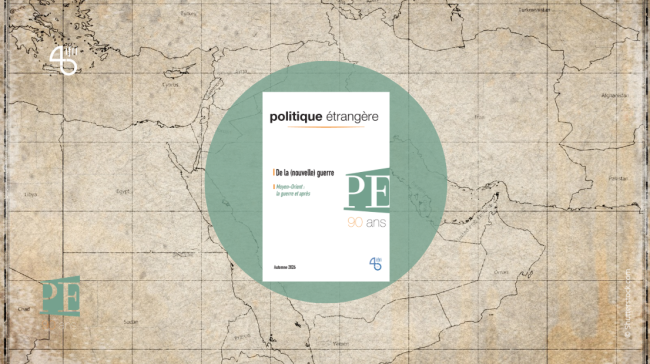
“Remodeling” the Middle East?
Chaos continues to spread, seemingly without end, across the Middle East. The Israeli-American attack on Iran has resulted in a clear military and diplomatic failure, but it is paving the way for a regional realignment, the consequences of which remain uncertain. New regional groupings are taking shape, either centered around Israel or built on the prospect of coexistence with Tehran, alongside a decline in American influence and the marginalization of Europe, while China maintains a low-key presence.

Silicon Valley and War: Lessons from Ukraine
Over the course of international conflicts, and particularly in Ukraine, major tech companies have emerged as central actors. Initially subject to wartime maneuvering, they have since become decisive actors in their own right, privatizing a significant share of wartime exchanges, shaping the information flows of societies, and presenting themselves as providers of security. This situation raises important questions about states’ autonomy in making decisions and taking action.

Does Artificial Intelligence Change the Nature of War?
From Gaza to Ukraine and Iran, current conflicts are being shaped by the arrival of artificial intelligence and robots on the battlefield. The changes under way are so profound that humans risk rapidly losing control over entire aspects of the conduct of military operations. While these technological developments are altering the character of war, their impact on the very nature of war itself remains a matter of debate.