



The German landscape of foundations and think tanks.

The number of crises we face is rising, due to failing states, wars and armed conflicts, poverty and lack of good governance in many countries. State and society are constantly confronted with new challenges. These crises occur simultaneously and at an ever faster pace.
They also have effects on domestic politics, as the current refugee crisis and the terrorist threat by the so called Islamic State, for example, show. Government, Parliament, administration and their staff are therefore faced with many challenges and have to be well informed to make reflected decisions.
This policy paper intends to examine the existing consultancy services available to policy-makers. Its aim is to present the landscape of policy consultancy and its main actors in Germany, to note the ways of working and the subjects of choice, to specify what requirements a good consultancy service must satisfy in Germany, and finally emphasize which international challenges should receive priority attention. This study will be looking at think tanks in particular and trace back the historical development of foreign policy consultancy in Germany.
Nicole Renvert is Research associate at the Deutsche Gesellschaft für Auswärtige Politik (DGAP) and member of the board of the "Forum Ebenhausen" of the Stiftung Wissenschaft und Politik (SWP) Berlin. She has been a scientific collaborator at the SWP and has worked as a transatlantic relations specialist for several business foundations.
This paper is published in French only - Nicole Renvert, « Le paysage allemand des fondations et think tanks. », Notes du Cerfa, n° 139, Ifri, juillet 2017.


The Study Committee on Franco-German Relations (Cerfa)
The Study Committee on Franco-German Relations (Cerfa) was created in 1954 by an inter-governmental agreement between the Federal Republic of Germany and France, in order to raise awareness of Germany in France and analyze Franco-German relations, including in their European and international dimensions. In its conferences and seminars, which bring together experts, political leaders, senior decision-makers and representatives of civil society from both countries, Cerfa develops the Franco-German debate and stimulates political proposals. It regularly publishes studies through two collections: Cerfa notes and studies as well as Franco-German visions.
Cerfa maintains close relations with the network of German foundations and think tanks. In addition to its research and debate activities, Cerfa promotes the emergence of a new Franco-German generation through original cooperation programs. This is how in 2021-2022, Cerfa led a program on multilateralism with the Konrad Adenauer Foundation in Paris. This program is aimed at young professionals from both countries interested in the issues of multilateralism in the context of their activities. It covered a wide range of themes relating to multilateralism, such as international trade, health, human rights and migration, non-proliferation and disarmament. Previously, Cerfa had participated in the Franco-German future dialogue, co-led with the DGAP from 2007 to 2020, and supported by the Robert Bosch Foundation and the Daniel Vernet group (formerly the Franco-German Reflection Group) which was founded in 2014 upon the initiative of the Genshagen Foundation.
Franco-German Relations Through the Lens of Donald Trump’s Second Term: Between Strategic Realignments, European Sovereignty, and the Enduring Transatlantic Bond
Donald Trump’s return to the presidency of the United States in 2025 acts as a powerful catalyst for the Franco-German relationship. Faced with growing uncertainty over the reliability of US security guarantees, Germany, more directly affected by the questioning of the transatlantic relationship, is gradually moving closer to the French position in favor of strengthening European strategic sovereignty.
MAGA and AfD: Toward a Transatlantic Alliance of Nationalist Right-Wing Parties
The rapprochement between Donald Trump’s MAGA movement and Germany’s AfD has accelerated significantly since Trump’s return to the White House.
VW, Mercedes, and BMW in the Face of Donald Trump—A Tightrope Walk Between Investing in the U.S., Maintaining Operations in Europe, and Catching Up in Electric Mobility
The German automotive industry faces a threefold challenge: competition from China; a difficult transition to electric vehicles; and US tariffs.
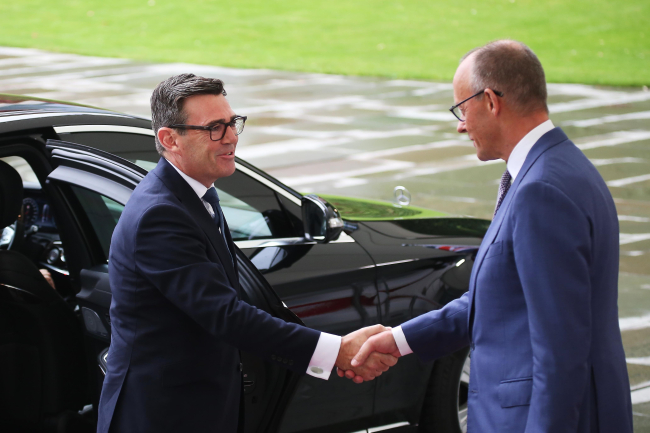
A Partnership Built on Security: Post-Brexit Rapprochement between Germany and the United Kingdom
Since the UK’s withdrawal from the EU, UK-German relations have undergone a remarkable transformation: from Berlin’s deliberate distancing from London during the Brexit negotiations, when Germany consistently prioritised EU-27 unity over bilateral arrangements, to a gradual rapprochement, culminating, for the time being, in the 2025 Kensington Treaty of Friendship.