




Paris Naval Conference 2026: Naval Rearmament and Operations in Contested Waters
Practical information
Accessibility
Themes and regions
Related centers and programs
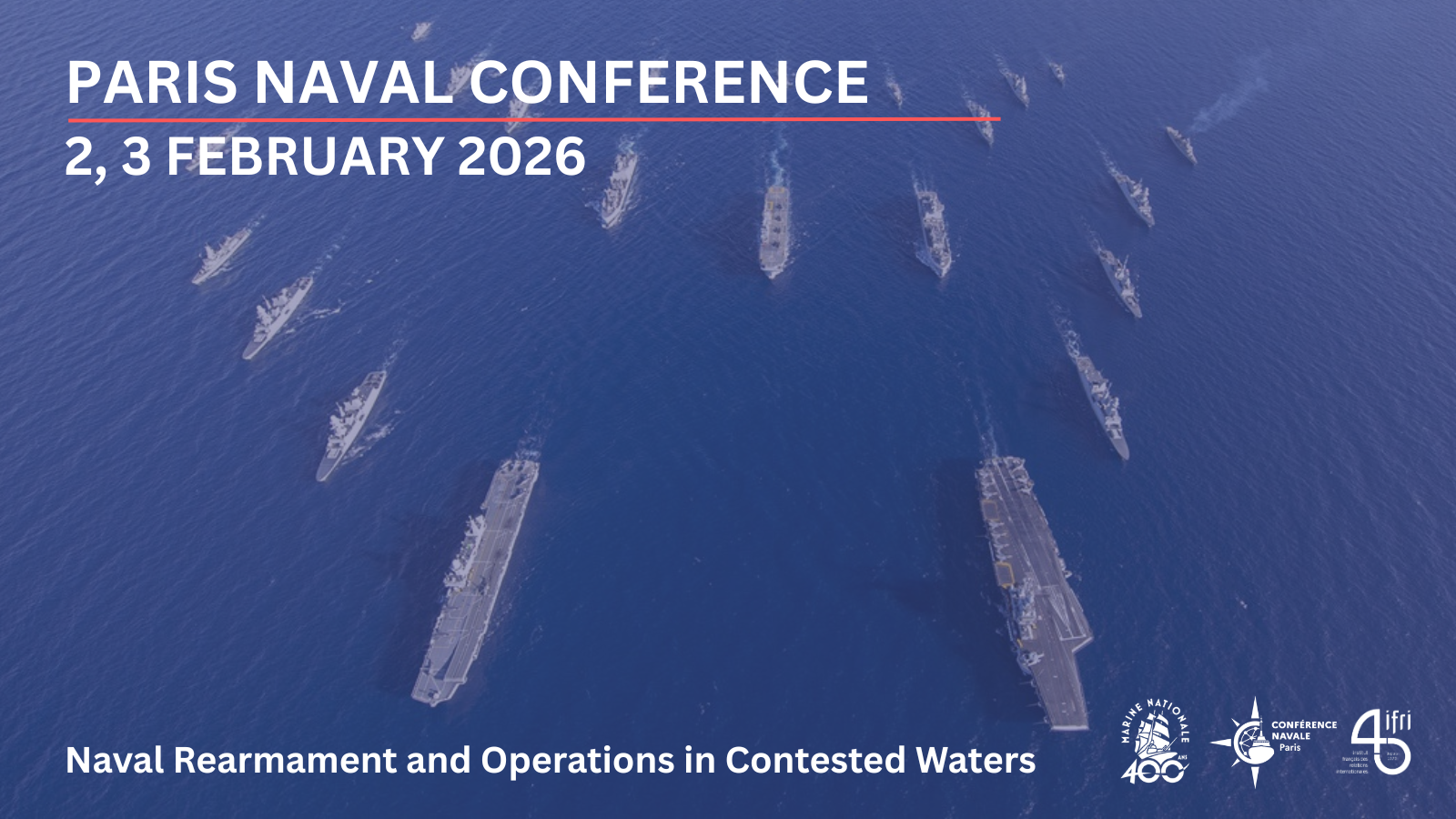
This fourth edition of the Paris Naval Conference (CNP), bringing together high-level military, industrial, and academic speakers, will address the challenges associated with general naval rearmament and naval operations in increasingly contested environments.
Since at least the fall of the Berlin Wall, Western navies, and particularly the U.S. Navy, have enjoyed complete freedom of action at sea, encountering no real opposition. This has enabled them to project their power across the globe, shaping their format, organization, and logistics to this end. The global ambitions of a growing number of countries, as evidenced by naval rearmament, the proliferation of offshore platforms, and increased ranges, now pose a new challenge: the ocean is no longer the sanctuary it once was. What are the organizational, operational, and logistical implications of this? What are the consequences for the format of the forces deployed, the size of crews, and the organization and defense of the rear base?
Titre Edito
Watch the livestream
Watch the livestream
Titre Edito
Program:
Program:
MONDAY, FEBRUARY 2
Strategic opening at the French Institute of International Relations
13h45 - 14h | Welcome coffee for the participants.
14h15 - 14h30 | Opening Welcome Speech by Dr. Thomas Gomart, director of Ifri, and Vice-Admiral Alban Lapointe, Deputy Chief of the French Navy.
14h30 - 16h | Panel 1: The revival of naval confrontation: decisive factors for victory at sea
Speakers:
- Captain Florian El-Ahdab, commanding officer of the FREMM Languedoc, Marine nationale
- Captain Jérôme Henry, Head of the Training Division at the Naval Action Force Headquarters, Marine nationale
- Captain Bryan McCavour, deputy assistant chief of staff for information warfare, Royal Navy
- Captain Alexandre Tachon, Coherence Officer for Submarine Forces, Marine nationale
Chair: Commander Guillaume Furgolle, military fellow at Ifri
16h - 16h30 | Coffee break
16h30 - 18h | Panel 2: Industrial logic and stakes in responding to the challenges of naval rearmament in Europe
Speakers:
- General Marie David, Deputy Director of the Naval Combat Management Unit, French Defence Procurement Agency (DGA)
- Jean-René Gourion, Deputy Chief Executive Officer, MBDA France
- Vincent Martinot-Lagarde, executive vice-president for Surface Ships, Naval Group
- Thierry Weulersse, vice-president ReArm Europe, Thales Group
Chair: Héloïse Fayet, research fellow at the Center for Security Studies, Ifri
18h - 19h30 | Cocktail for participants.
TUESDAY, FEBRUARY 3
Plenary session at the National Naval Museum in Paris.
10h15 - 10h40 | Arrival of participants, welcome coffee.
10h40 – 11h | Opening Welcome speech by Dr. Thomas Gomart, director of Ifri, and Air Force General Fabien Mandon, French Chief of the Defence Staff.
11h - 12h25 | Panel 1: Build and maintain air-sea superiority in a contested operational environment.
Speakers:
- Amiral Nicolas Vaujour, Chief of Staff of the French Navy
- General Sir Gwyn Jenkins, First Sea Lord, Royal Navy
- Amiral Daryl Caudle, Chief of Naval Operations, U.S. Navy
- Amiral de squadra Giuseppe Berutti Bergotto, Chief of Staff of the Marina Militare
- Vice-amiral Harold Liebregs, Commander of the Royal Netherlands Navy
Chair: Élie Tenenbaum, director of the Center for Security Studies, Ifri
12h15 - 12h45 | Press conference (accredited press only)
12h30 - 14h | Lunch
14h - 15h30 | Panel 2 : Protect critical infrastructure at sea, from space to the seabed, from the coastline to the high seas.
Speakers:
- Marc Delorme, seabed warfare director, Thales DMS Underwater Systems
- Annabelle Livet, research fellow on energy security, Foundation for Strategic Research
- Vice-admiral (2S) Didier Maleterre, Vice President and Defence Advisor, EXAIL
- Captain Henk Warnar, associate professor in War Studies, Netherlands Defense Academy
Chair: Nicolas Mazzucchi, head of the Naval Strategy & Wargaming Division at the Center for Naval Strategic Studies (CESM).
15h30 - 16h | Break
16h - 17h30 | Panel 3: Support and sustain distant naval operations in the face of prolonged, high-intensity conflicts.
Speakers:
- Vice-admiral (ret) Marc Aussedat, former commanding officer of the French Carrier Strike Group
- Eric Balufin, executive vice-president for Services, Naval Group
- Vice-admiral Ricardo Gómez Delgado, deputy chief of staff for support, MARCOM
- Francesco Zampieri, professor in strategic studies, Italian Naval Staff College
Chair: Héloïse Fayet, research fellow at the Center for Security Studies, Ifri
17h30 - 18h | Concluding remarks by Guillaume Ollagnier, Director General for International Relations and Strategy, Ministry of the Armed Forces
18h | Closing speech by Dr. Thomas Gomart and Admiral Nicolas Vaujour
The conference will conclude with a cocktail reception at the Naval Museum, hosted by the Chief of Naval Staff. The 2026 “Admiral Castex” prize will be presented at this event.

Contact
If you have any questions about this event, please contact the Ifri Security Studies Center ([email protected]).