




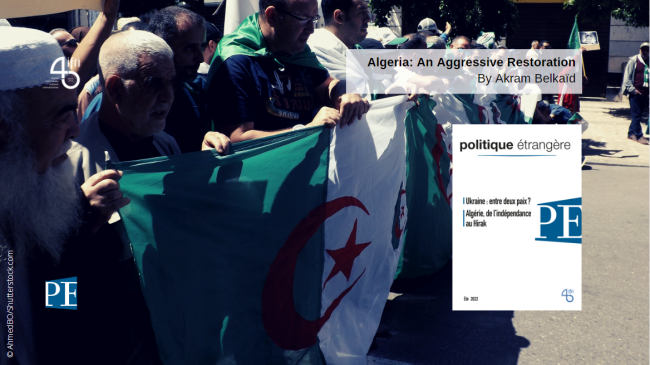
Algeria: An Aggressive Restoration
The election of President Abdelmadjid Tebboune, followed by the Covid-19 pandemic, marked the end of the road for the Hirak movement that had failed to establish itself as a political alternative despite its massive popularity.


Africa-France: Can Macron’s ‘new partnership’ succeed?
Africa has occupied a significant place in Emmanuel Macron’s political agenda but he will need more than fine speeches to change the longstanding paternalist image of France on the continent.

An Engine Replacement Could Kill Europe’s Huge F-35 Plans
If the decision to replace the engine for the F-35A is implemented, countries flying F-35s will find themselves forced into unforeseen and overly complicated supply chains.

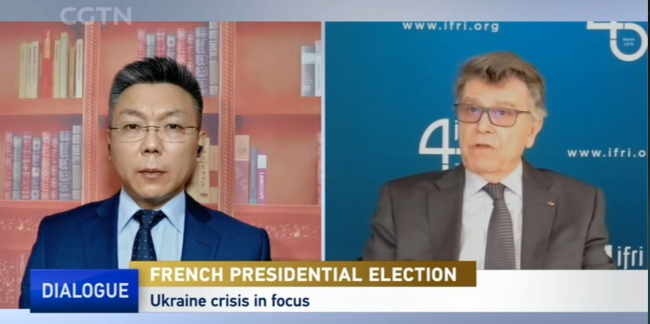
French Presidential Election, Ukraine crisis, China-France and China-EU relations
This week the guest of "Dialogue Weekend" on CGTV is Thierry de Montbrial, founder and executive chairman of Ifri, French Institute for International Relations. Last Sunday, Emmanuel Macron became the first French president to be re-elected since Jacques Chirac 20 years ago, with a 17-point victory over far-right populist Marine Le Pen.
The French Strategy of the Saarland. A German Federal State on the Way to a Living European Multilingualism
With the France Strategy, Saarland set out in 2014 to become an efficient multilingual German-French region within a generation.
The Weimar Triangle Three Decades After Its Foundation: Review and Prospects
When it was founded in August 1991, the Weimar Triangle was intended as a forum for trilateral consultations between the foreign ministers of France, the Federal Republic of Germany, and Poland on the future of Europe after the end of the Cold War.
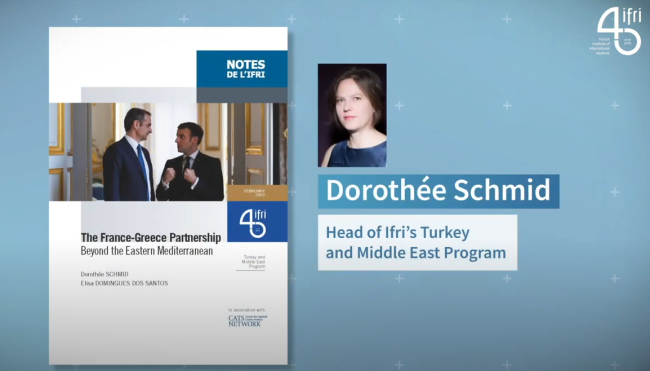
The French-Greek Partnership: Beyond The Eastern Mediterranean.
This week, Ifri, in partnership with CATS Network, is launching a series of five videos on the tensions in the Eastern Mediterranean, seen through the prism of the geopolitical rivalry between France and Turkey.
Building European Strategic Autonomy vs. Turkish Strategic Depth: Macron's Diplomatic Gamble.
This week, Ifri, in partnership with CATS Network, is launching a series of five videos on the tensions in the Eastern Mediterranean, seen through the prism of the geopolitical rivalry between France and Turkey.
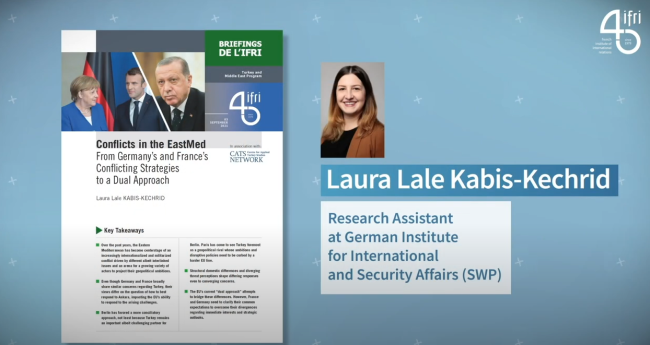
Conflicts in the EastMed: from Germany's and France's Conflicting Strategies to a Dual Approach.
This week, Ifri, in partnership with CATS Network, is launching a series of five videos on the tensions in the Eastern Mediterranean, seen through the prism of the geopolitical rivalry between France and Turkey.
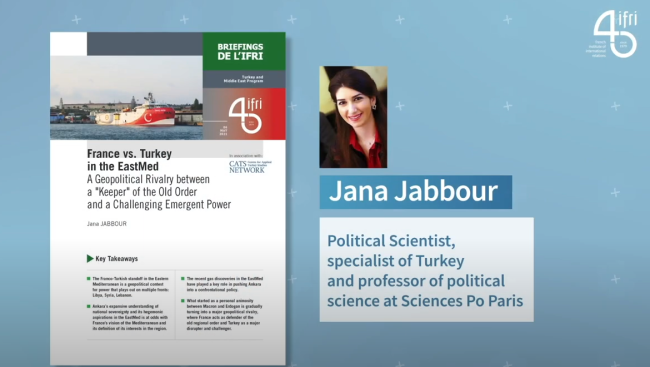
France/Turkey in the EastMed: a Closer Look at the Rivalry between the Two Countries.
This week, Ifri, in partnership with CATS Network, is launching a series of five videos on the tensions in the Eastern Mediterranean, seen through the prism of the geopolitical rivalry between France and Turkey.
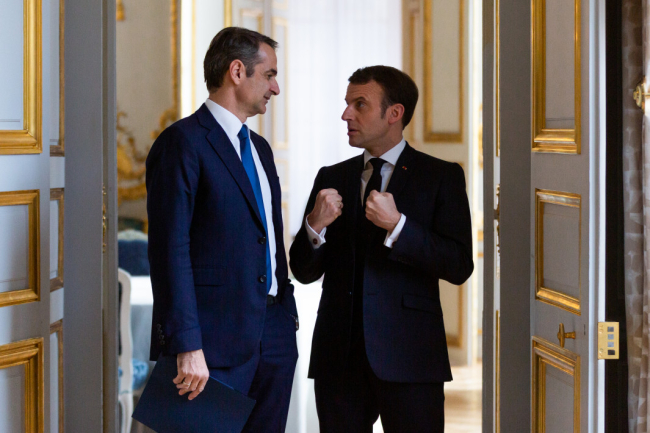
The French-Greek Partnership: Beyond the Eastern Mediterranean
The bilateral defense agreement signed by France and Greece in September 2021 confirms the strategic turn of the relationship between the two countries. It was already unveiled in 2020 when Paris supported Athens to counter Turkish maritime operations that France and Greece considered very hostile.

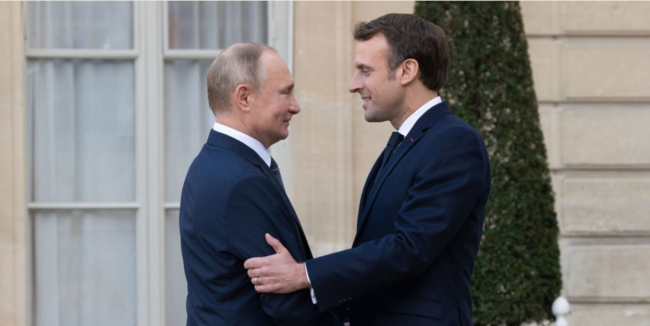
Kremlin Is Top Destination For Spooked European Leaders
Rarely in recent years has the Kremlin been so popular with European visitors. French President Emmanuel Macron arrives Monday. The Hungarian prime minister visited last week. And in days to come, the German chancellor will be there, too. All are hoping to get through to President Vladimir Putin, the man who singlehandedly shapes Russia’s course amid its military buildup near Ukraine and whose designs are a mystery even for his own narrow inner circle.
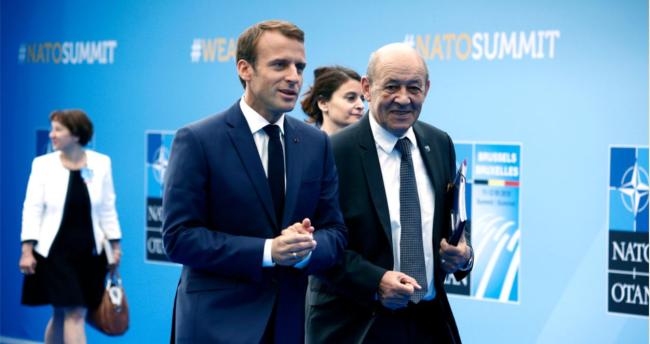
How to Keep France Engaged in NATO
France’s policy vis-à-vis the North Atlantic Treaty Organization (NATO) has always been ambivalent. On paper, France’s strategic culture fits well within NATO’s nature and agenda. Yet, in practice, French membership of NATO has always been uneasy. Several intra-alliance developments will likely affect the quality of French-NATO relations over the next few years.

French Special Operations What Is Their Role in the Context of Great-Power Competition?
The year 2022 marks thirty years since the creation of the Commandement des operations spéciales (COS, Special Operations Command). Those three decades have been dominated by missions carried out in volatile environments, most often against irregular adversaries, primarily terrorist groups.

South Korea and France’s Indo-Pacific Strategies: Potential Partnership and Challenges
Despite some constraints on their Indo-Pacific strategies, South Korea and France could consider bilateral dialogues for partnership in the Indo-Pacific, leading to a high level of confidence and strategic convergence in security.
The Direction of France’s Foreign Policy over the Next Thirty Years
A foreign policy points to a united society that manages its relationships with its surroundings while defending its own interests.
Preparing for 2050: From “Foresight” to “Grand Strategy”
China and the United States both have a “grand strategy”: Beijing aspires to be the world’s leading power in 2049, while Washington plans to remain primus inter pares.
Foreign Policy: France at a Turning Point?
An exceptional issue of Politique étrangère
Confronted with a world in which the fundamentals are being redefined, France’s foreign policy is under scrutiny. In which geographies should France assert its presence? To which major challenges should France be responding in order to survive in tomorrow’s world? What kind of relationship to that world should France be establishing, as thirty years of Western intervention have ended in catastrophic failure in Afghanistan?
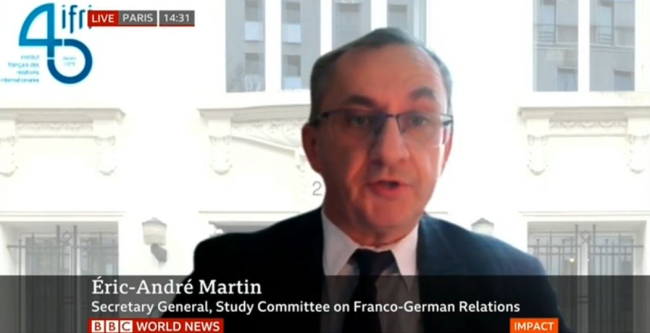
Macron-Scholz meeting - Insights from Éric-André Martin on BBC World
The first meeting between French President Emmanuel Macron and German Chancellor Olaf Scholz occurred on Friday, December 10, 2021, in Paris. An important visit for both Germany and France and an opportunity to relaunch the Franco-German couple since Angela Merkel’s departure from the German chancellery.
Franco-German Civil Society: Object and Actor of Bilateral Relations. Balance and Perspectives after the Signing of the Treaty of Aachen
The treaty signed by France and Germany in Aachen on January 22, 2019 highlights the role of civil society in bilateral cooperation and aims to contribute to "bringing societies [and citizens in both countries] closer together".
Ifri, a foundation recognized as being of public utility, relies largely on private donors – companies and individuals – to guarantee its sustainability and intellectual independence. Through their funding, donors help maintain the Institute's position among the world's leading think tanks. By benefiting from an internationally recognized network and expertise, donors refine their understanding of geopolitical risk and its consequences on global politics and the economy. In 2026, Ifri partners with over 90 French and international companies and organizations.
