



Strategic Calculation: High-Performance Computing and Quantum Computing in Europe’s Quest for Technological Power

Computing power plays a key role in enabling machine learning, for scientific research, and in the military domain. Therefore, the race for computing power has become a key element of the US-China technological competition, and it is also a strategic priority for Europe.

This study focuses on two complementary segments of computing: high-performance computing (HPC, also known as “supercomputing”), and quantum computing. HPC has for several decades been used in scientific research, meteorology, and the military. While states continue to drive the needs for massive computers, the field is also witnessing a diversification of uses in industry. Meanwhile, quantum computing is still at an experimental stage but has highly disruptive potential, as it promises to multiply computing power exponentially. As such, it has become a focal point for government, industry, and investors around the globe.
In the global race, European countries are seeking to pool resources by encouraging the development of federated computing services, data infrastructures, and a local industry. Of course, Europe faces multiple challenges (the design and production of processors, energy consumption constraints, and scarce private investment) and risks (such as export restrictions and company takeovers). Yet, today, quantum computing does offer an opportunity to learn lessons from past developments in the field of classical computing, and to take the right actions early on, to reap the societal, economic and security benefits of this technology.

Available in:
Regions and themes
ISBN / ISSN
Share
This page contains only a summary of our work. If you would like to have access to all the information from our research on the subject, you can download the full version in PDF format.
Strategic Calculation: High-Performance Computing and Quantum Computing in Europe’s Quest for Technological Power


Alice PANNIER
Former Associate Research Fellow, Former Head of Ifri's Center for Geopolitics of Technology, Ifri


Center for Geopolitics of Technology
Artificial intelligence (AI), 5G, cybersecurity, robotics, semiconductors, space…Technologies—particularly digital technologies—now profoundly affect all human activities and, by extension, international relations. The political, strategic, economic, and social stakes that arise from them are expressed across multiple political levels, involving states, international organizations, and private companies alike. International dynamics of competition and cooperation are being reshaped as a result. To address these challenges, Ifri launched its Geopolitics of Technology Center in 2020, offering a distinctly European perspective on the international issues surrounding so-called critical technologies.
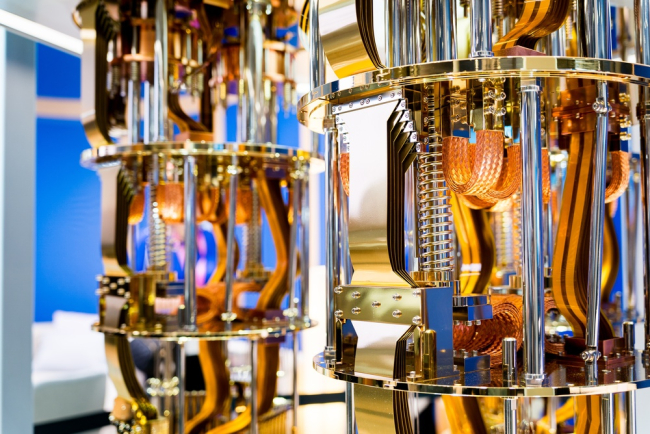
Europe Facing the Quantum Challenge: From Ambitions to Action
The nomination of researchers Alain Aspect and Michel Devoret for the 2022 and 2025 Nobel Prizes in Physics, for their work in quantum physics, attests to the enduring vitality of French and European research in this field. While the deployment of technologies stemming from the second quantum revolution is still in its infancy, one might think that strategic patience is called for, and that we must wait for the proliferation of basic research to give way to innovations ready for deployment. That would be a serious mistake, given that the potential for profound transformation inherent in the quantum sector is directly linked to states and organizations’ strategic autonomy.
Europe at the Crossroads of DefTech: Rethinking the European Defense Innovation Ecosystem
“The way I look at Iron Dome is as the ultimate manifestation of the future of the United States’ role in future conflicts, which is not to be the world police, but to be the world gun store,” said Palmer Luckey in November 2023. Luckey is the founder of Anduril, one of the most prominent DefTech companies. The ambition is clear: to participate in global rearmament by capitalizing on the quality of American innovations and to dominate the arms market—at least in the West—through technological mastery.
How Technology Is Reshaping the World Order
The central role of technology in the competition between the major powers is fueling an ever-more intense rivalry. Artificial intelligence is enabling large corporations to accrue unprecedented power, with consequences for states and even for international conflict. However, states do have tools at their disposal to regulate these developments. In this international competition, Europe has a strong hand, but must be prepared to play its cards in order to create a new kind of international cooperation.
Trump II vs. Digital Governance: A Crusade in the United States and Europe
Since taking office, the Trump II administration has waged a systematic deregulation campaign targeting the tech sector in both the United States and Europe. How can Europe maintain dialogue while preserving its governance framework?