






Trump II vs. Digital Governance: A Crusade in the United States and Europe
Since taking office, the Trump II administration has waged a systematic deregulation campaign targeting the tech sector in both the United States and Europe. How can Europe maintain dialogue while preserving its governance framework?
Titre
Key takeaways
Domestically, this push has led to the dismantling of existing frameworks in Artificial Intelligence (AI), cybersecurity, and content moderation. It is driven by a network of public actors—the president and vice president, White House offices, independent agencies like the Federal Communications Commission (FCC) and Federal Trade Commission (FTC), and legislators—and private stakeholders with powerful tools, though not without dissent within Republican ranks.
In Europe, US pressure has intensified significantly, moving beyond Washington’s traditional criticisms (protectionism, discrimination against American firms) to denounce alleged government censorship and the European Union’s (EU) democratic illegitimacy.
To undermine European regulatory frameworks, the administration has deployed a range of diplomatic, economic, and informational levers: embassy investigations, US entry bans, threats of tariffs, export controls, or market access restrictions, and social media campaigns... In line with the administration’s goal of “cultivating resistance,” this strategy also relies on European actors (such as far-right lawmakers, businesses, or non-governmental organizations).
In response, Europe would benefit from accelerating its efforts toward digital sovereignty and service continuity. European companies should more thoroughly map their vulnerabilities to US leverage. Regulatorily, holding firm is essential: any concession would undermine the EU’s credibility and foster instability. Precise communication—emphasizing, for instance, the Digital Service Act’s (DSA) transparency requirements, not censorship—and consistency—avoiding perceptions of discriminatory enforcement—remain critical.
Pursuing targeted cooperation with the US executive—on cybersecurity, the protection of minors online, or fraud prevention—, engaging with federal and state legislators on AI and data governance, and warning American companies of the counterproductive effects of this offensive could help mitigate some transatlantic tensions.
“Delete, delete, delete”: The deregulation campaign within the United States
Since his first day back in the White House, President Trump has launched an aggressive effort to reduce what he has described as “the ever-expanding morass of complicated Federal regulation”, rolling back many of his predecessors’ policies. The objective is stated in no uncertain terms: for every new regulation adopted, ten existing ones must first be repealed. This sweeping deregulation effort is in line with the Republican Party's tradition of favoring limited government intervention in the economy, as well as with the Trump administration's goal of dismantling the “deep state”.
In the tech sector, this also reflects the criticism shared by Trump and Silicon Valley regarding the Biden administration’s increases in regulatory measures, which have been characterized as “anti-tech”.
This wave of deregulation in the United States is justified through three main narratives, all of which emerged long before the second Trump administration, but have been (re)emphasized and implemented with far greater force over the past year: the stifling of innovation, the Chinese threat, and the fear of censorship.
The pivotal role of the White House and independent agencies
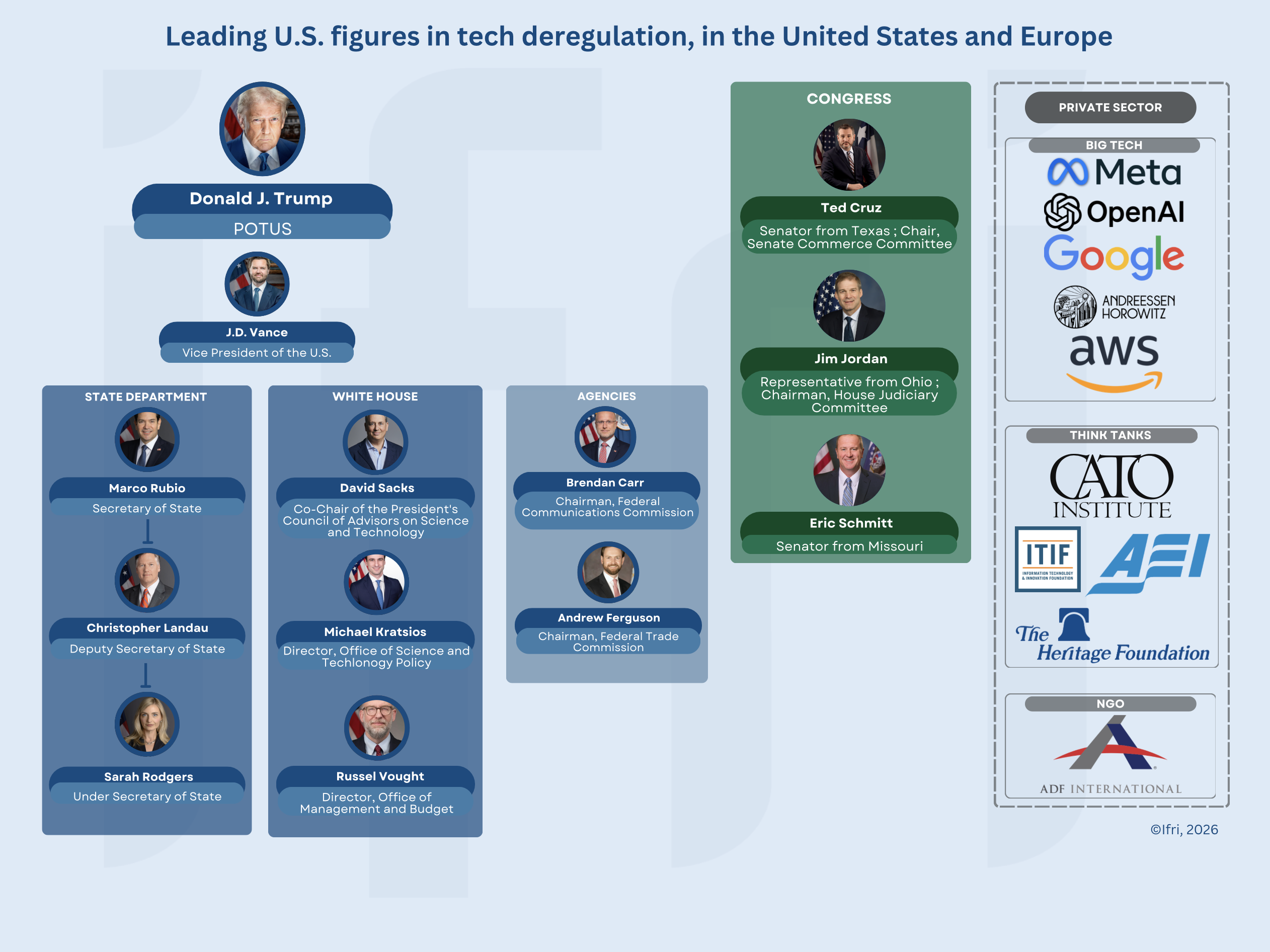
These efforts are spearheaded by President Trump and Vice President Vance, who has played a very active role in this area, as well as by a number of officials within the administration. Some among them espouse libertarian ideals, seeking to minimize the federal government and its regulations, such as Russell Vaught, director of the Office of Management and Budget (OMB).
Others have emerged from Silicon Valley and the venture capital world; they advocate for an optimistic, export-oriented philosophy, with minimal government oversight of tech, and active support from the private sector. In addition to Vice President Vance, this group includes Michael Kratsios, head of the Office of Science and Technology Policy, and David Sacks, the President’s science and technology advisor. On the diplomatic front (primarily targeting European measures), the State Department has been very active, particularly Secretary of State Marco Rubio and Under Secretary of State Sarah Rogers. Outside of the administration itself, the directors of (ostensibly) independent agencies have also taken up this agenda:
- Brendan Carr, who chairs the Federal Communications Commission, has launched a “massive deregulation initiative” dubbed “delete, delete, delete” and;
- Andrew Ferguson, appointed head of the Federal Trade Commission (responsible for combating monopolistic practices), has both recommended the repeal of numerous regulations and launched investigations into issues the president has championed, such as “censorship by technology platforms”.
The administration also has the support of parts of Congress in this effort. Though there is a lack of consensus among Republicans, some elected officials have significant influence on these issues, such as Texas Senator Ted Cruz, who chairs the Senate Commerce Committee and has advocated for the deregulation of AI, and Ohio Representative and Judiciary Committee Chairman Jim Jordan, who is strongly opposed to online content moderation.
Rather than eliminating any and all forms of regulation, the administration aims to reframe their objectives to better align them with the government’s political and ideological priorities.
These deregulation efforts also clash with the desire of states to establish regulatory frameworks for data protection or AI governance. Wanting to avoid a “patchwork” of state regulations, and citing the risk of falling behind China, the Trump administration and some Republican lawmakers have attempted to impose a decade-long moratorium on any state-level AI regulations, with the backing of tech companies such as OpenAI, Google, Meta, and Andreessen Horowitz. First proposed in Congress, this moratorium has faced bipartisan opposition at both the local (governors, attorneys general) and national levels. It was rejected by a vote of 99 to 1 in the Senate, forcing the administration to act by executive order (the legality of which is disputed) in December 2025.
The Trump administration is also putting direct pressure on state lawmakers (including in Utah and Ohio) to push them to abandon their AI bills, prompting 50 local Republican lawmakers to issue an open letter protesting these actions in March 2026. Setting aside the Republican Party’s traditional preference for “states’ rights”, the Trump administration is thus attempting to use its budgetary and regulatory power to prevent the emergence of AI governance at the local level.
“Show respect to America and our amazing tech companies”: opposition to European regulation
Over the past year, however, this opposition has intensified, becoming increasingly aggressive, with the administration deploying new tactics and placing a growing emphasis on accusations of “censorship”.
The U.S. has raised numerous objections to European regulation, some of which echo the arguments outlined above: the negative impact of regulation on innovation, ensuring that U.S. companies are not hindered in their competition with China, and equating content moderation policies with censorship.
A vast array of actors wielding powerful tools
These criticisms are actively amplified by the U.S. executive branch—in particular the offices of the president, vice president, State Department, and FCC—which employs a wide range of tools to pressure Europe into relaxing, suspending, or eliminating its regulations. Members of the administration and Congress repeatedly criticize the regulations in speeches, media statements, and social media posts—J. D.Vance describing them as “a terrible mistake not just for the United States of America but for your own countries”—and declare Washington’s total opposition to these measures. These statements also strongly condemn the fines imposed by the European Commission on U.S. companies for violating European regulations. The €120 million fine imposed on X, in particular, led to a surge in activity on the network by U.S. officials in December 2025
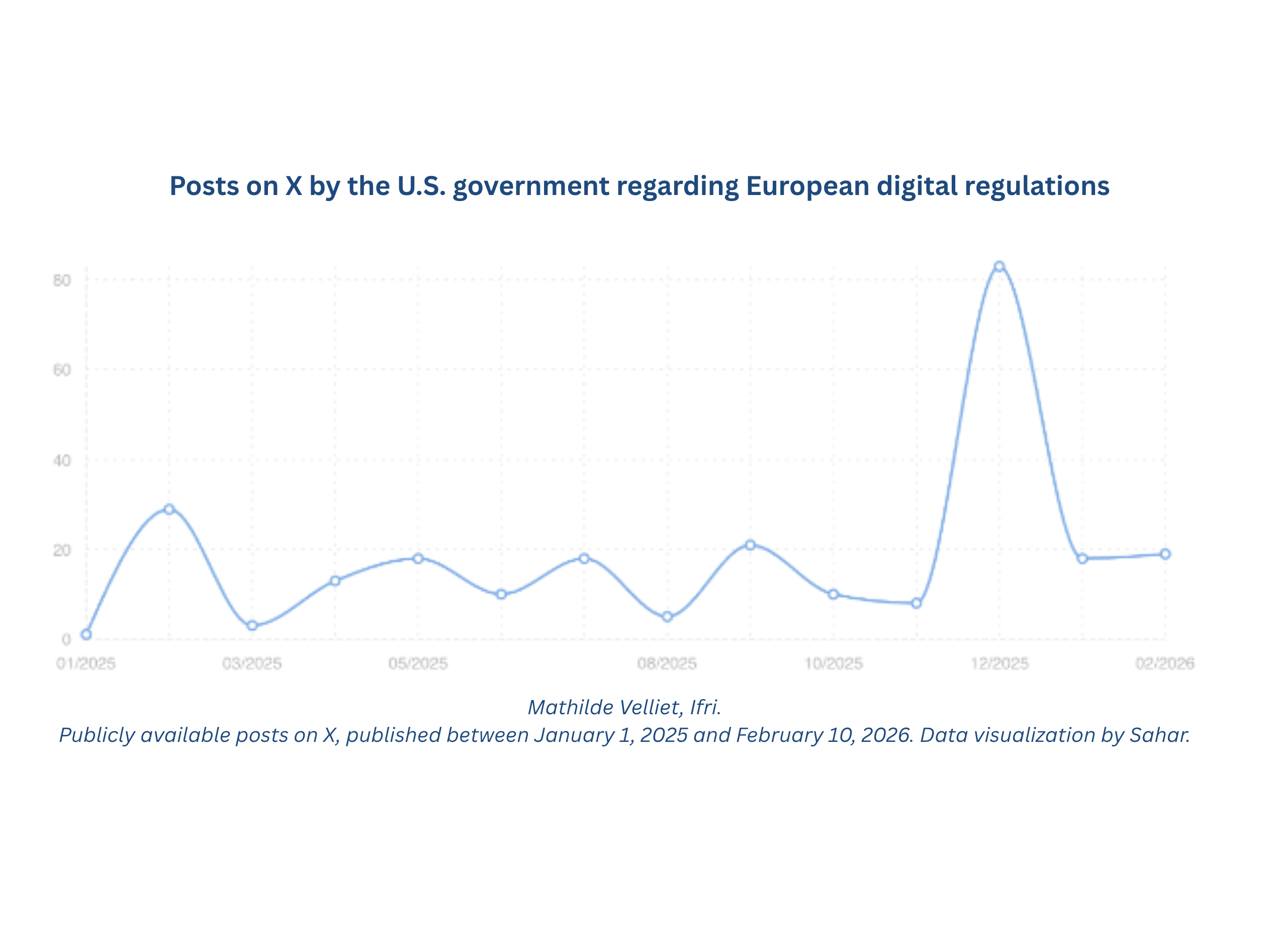
Ranking the government's most active members on X on the issue of European digital regulations helps highlight the involvement of the individuals mentioned above. Both the legislative and executive branches are actively involved, though in different ways: while members of Congress post more messages, those from the undersecretary of state generate significantly more engagement (likes, replies, reposts).
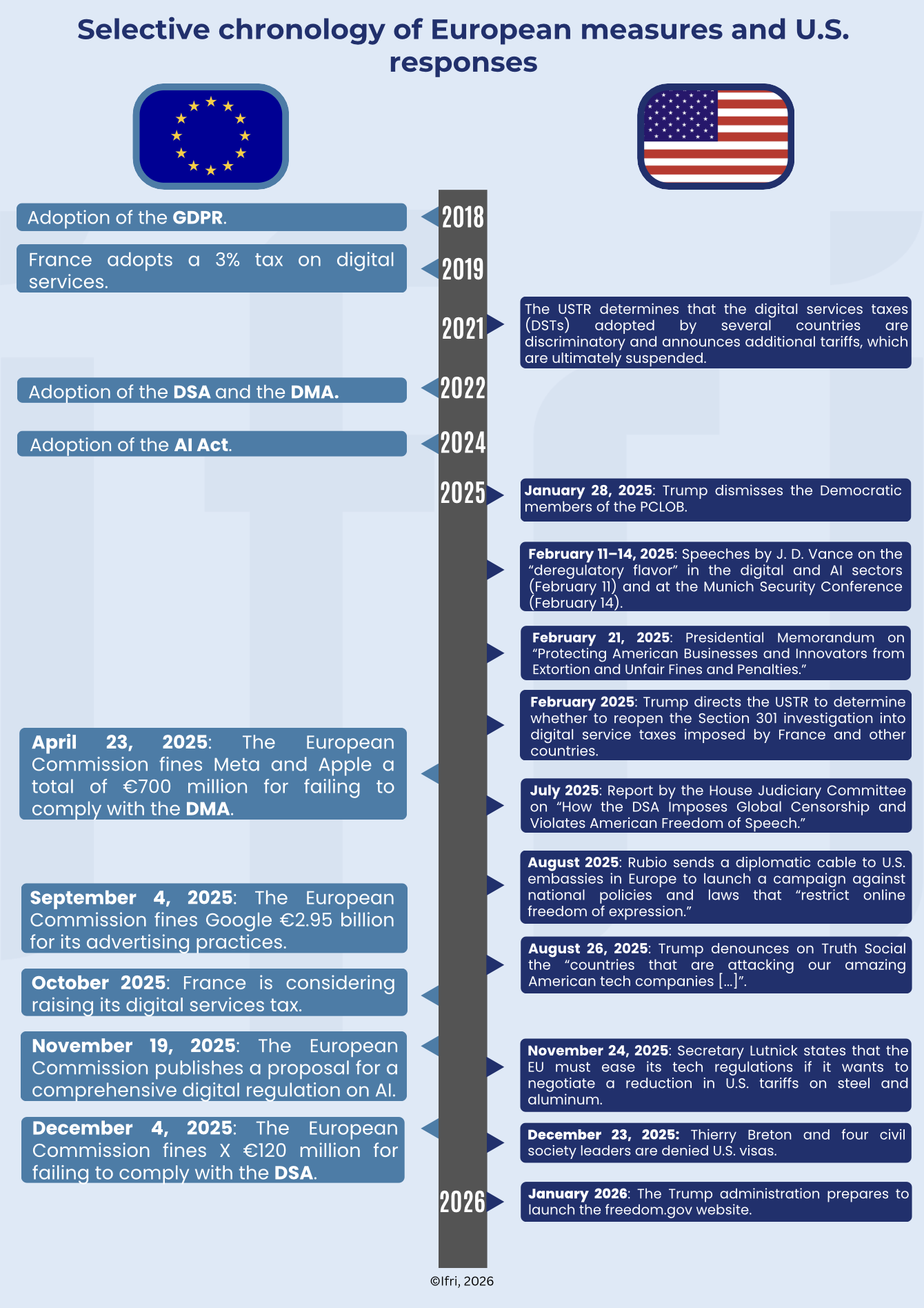
Aside from rhetoric, the administration also attempts to sway Europe through trade restrictions. On several occasions, President Trump has thus threatened to impose tariffs on countries that “attack our incredible American tech companies” by enacting regulations.
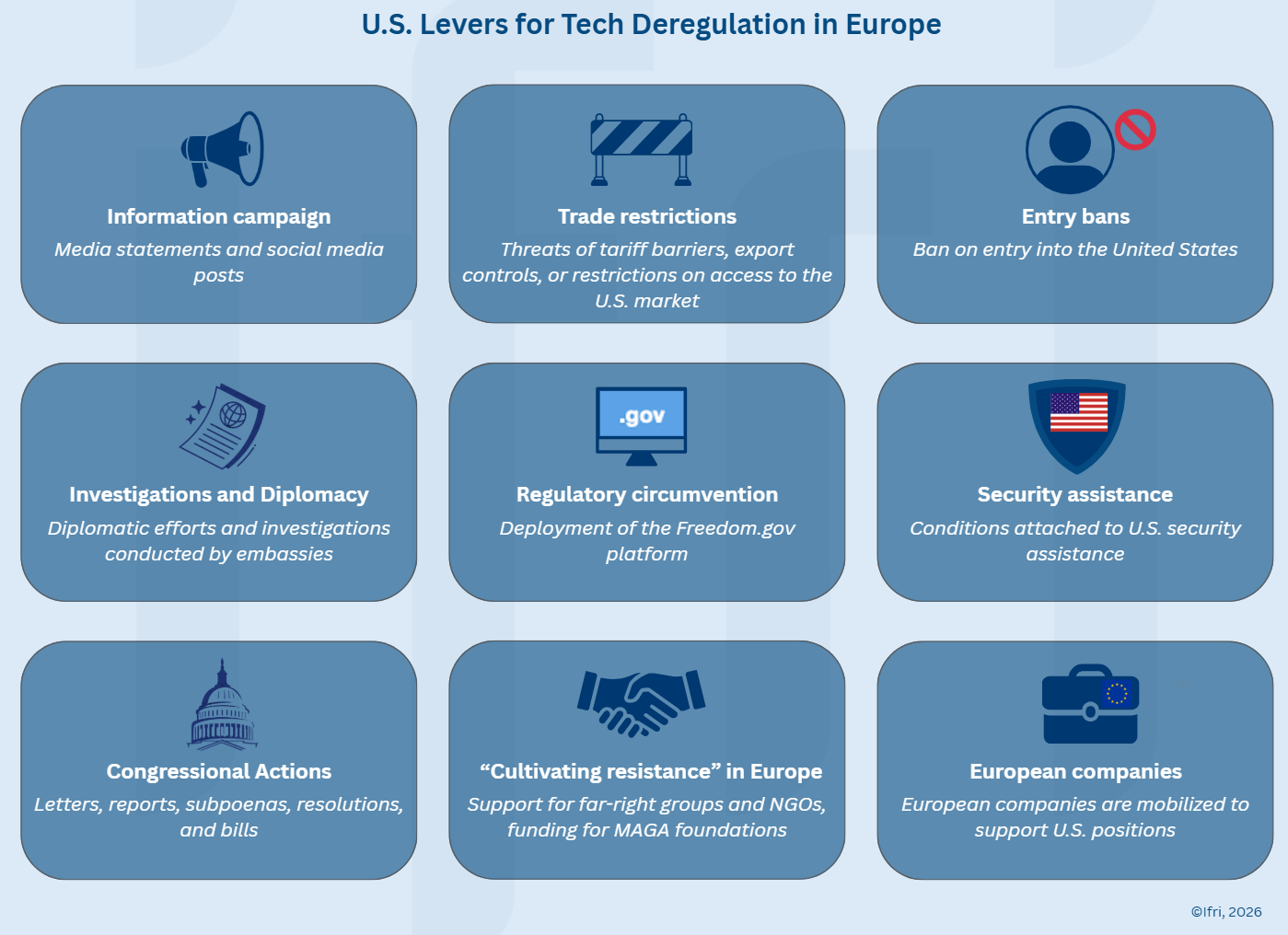
In an effort to ease or eliminate European digital regulations, the Trump administration has thus aggressively pursued a number of strategies, combining public advocacy with diplomatic pressure, threats of trade retaliation, and security concerns. . While it is difficult to measure the individual impact of each approach, as one European diplomat has observed: “it is their combination that makes them effective, and their unpredictability”.
Titre Edito
“Cultivating resistance”: The U.S. strategy relies on European partners
“Cultivating resistance”: The U.S. strategy relies on European partners
Both the White House and Big Tech are enlisting European companies in this effort. The Trump administration is also leveraging its ties with Europe’s far-right movements, with the stated aim of “cultivating resistance to Europe’s current trajectory within European nations” on issues related to digital regulation and far beyond.
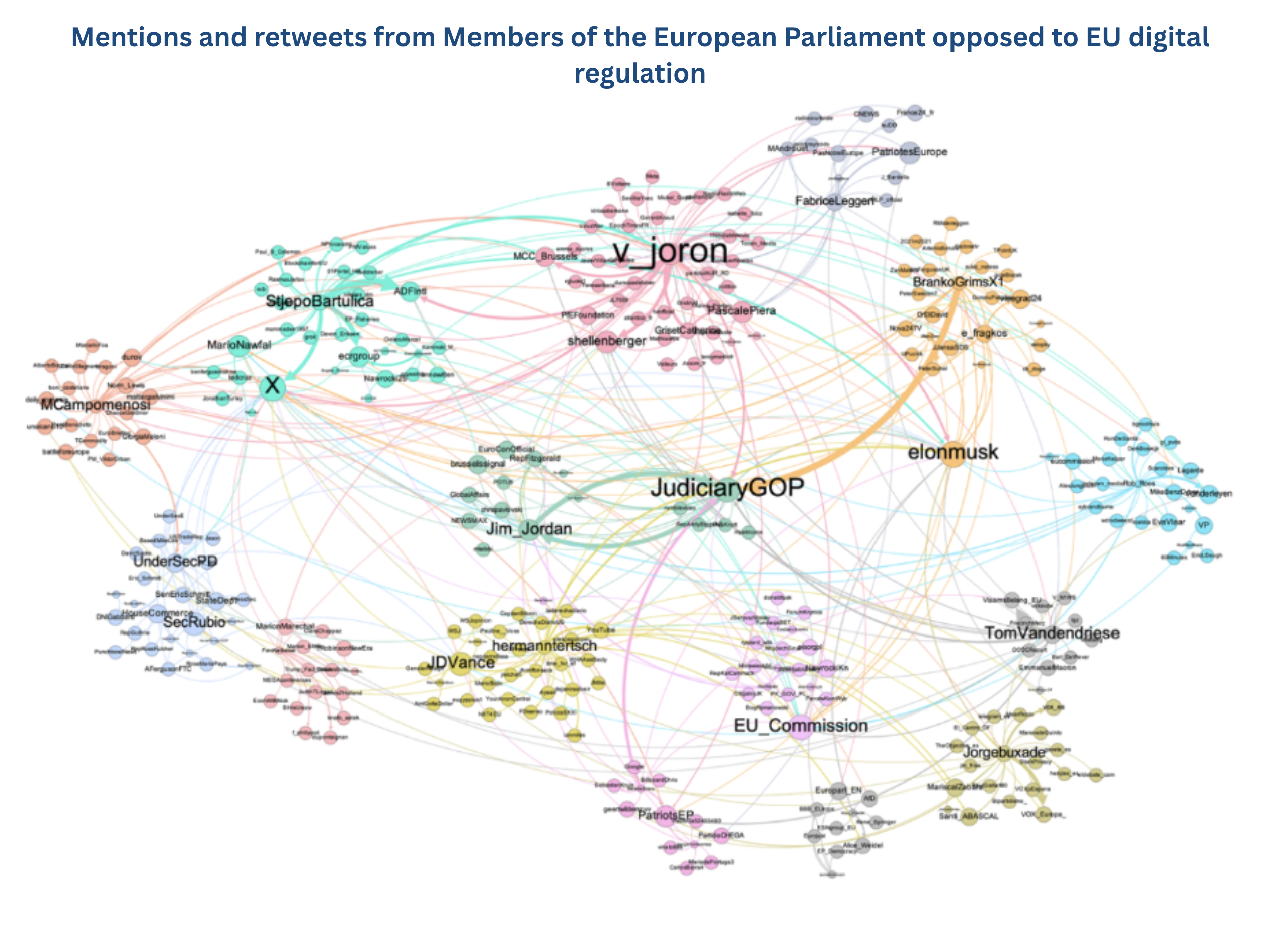
This U.S. campaign is in turn frequently cited by European lawmakers who oppose the regulation of the tech industry, both on social media and in their questions to the Commission. Social media is rife with examples of MEPs who, like German representative Christine Anderson (AfD, Europe of Sovereign Nations group), cite Jim Jordan to stress that he “is right to question the EU’s overreach” with the DSA, or J.D. Vance, saying it is “reassuring to see that the U.S. recognizes the severity of the situation” regarding “censorship”.
These examples are far from isolated. The graphic below—which maps mentions, replies, and retweets from MEPs criticizing European digital regulations—highlights the significant presence of U.S. accounts within this ecosystem.
These EU representatives thus amplify the U.S.'s campaign on two levels: they cite its arguments as definitive, and echo Washington's concerns by warning of the “numerous negative consequences on relations between the European Union and the USA” and the “tensions in transatlantic relations” that the law’s implementation would “cause”.
How should Europe respond?
- Europe should accelerate its initiatives regarding sovereignty and service continuity of digital services.
- European companies would benefit from better identifying their vulnerabilities to U.S. pressure tactics.
- It is essential to maintain a firm regulatory stance: any retreat would undermine the EU’s credibility and encourage instability.
- Explore targeted partnerships with the executive branch (cybersecurity, child protection, and fraud prevention).
- Engage with U.S. federal and state lawmakers on AI and data.
- Warning U.S. companies about the counterproductive effects of this campaign could help bridge some of the differences.
This page shows only excerpts from the study; the full text can be found here.

Available in:
Themes and regions
ISBN / ISSN
Share
This page contains only a summary of our work. If you would like to have access to all the information from our research on the subject, you can download the full version in PDF format.
Trump II vs. Digital Governance: A Crusade in the United States and Europe


Mathilde VELLIET
Research Fellow, Center for Geopolitics of Technology, Ifri


Center for Geopolitics of Technology
Artificial intelligence (AI), 5G, cybersecurity, robotics, semiconductors, space…Technologies—particularly digital technologies—now profoundly affect all human activities and, by extension, international relations. The political, strategic, economic, and social stakes that arise from them are expressed across multiple political levels, involving states, international organizations, and private companies alike. International dynamics of competition and cooperation are being reshaped as a result. To address these challenges, Ifri launched its Geopolitics of Technology Center in 2020, offering a distinctly European perspective on the international issues surrounding so-called critical technologies.

Europe Facing the Quantum Challenge: From Ambitions to Action
The nomination of researchers Alain Aspect and Michel Devoret for the 2022 and 2025 Nobel Prizes in Physics, for their work in quantum physics, attests to the enduring vitality of French and European research in this field. While the deployment of technologies stemming from the second quantum revolution is still in its infancy, one might think that strategic patience is called for, and that we must wait for the proliferation of basic research to give way to innovations ready for deployment. That would be a serious mistake, given that the potential for profound transformation inherent in the quantum sector is directly linked to states and organizations’ strategic autonomy.

Europe at the Crossroads of DefTech: Rethinking the European Defense Innovation Ecosystem
“The way I look at Iron Dome is as the ultimate manifestation of the future of the United States’ role in future conflicts, which is not to be the world police, but to be the world gun store,” said Palmer Luckey in November 2023. Luckey is the founder of Anduril, one of the most prominent DefTech companies. The ambition is clear: to participate in global rearmament by capitalizing on the quality of American innovations and to dominate the arms market—at least in the West—through technological mastery.

How Technology Is Reshaping the World Order
The central role of technology in the competition between the major powers is fueling an ever-more intense rivalry. Artificial intelligence is enabling large corporations to accrue unprecedented power, with consequences for states and even for international conflict. However, states do have tools at their disposal to regulate these developments. In this international competition, Europe has a strong hand, but must be prepared to play its cards in order to create a new kind of international cooperation.
Regulatory Dynamics and Tensions in the Space Sector: Towards and Americanization of Space Law?
The development of space law has gradually evolved from a top-down normative dynamic dominated by the founding impetus of the UN to a bottom-up normativity driven by national and industrial practices. This evolution is now accompanied by growing normative competition, raising the risk of an Americanization of space law and prompting the question of a European response.