





Can Global Governance Be Rebuilt? Japan's Role Seen Key
The Shared Future of Asia and Japan.
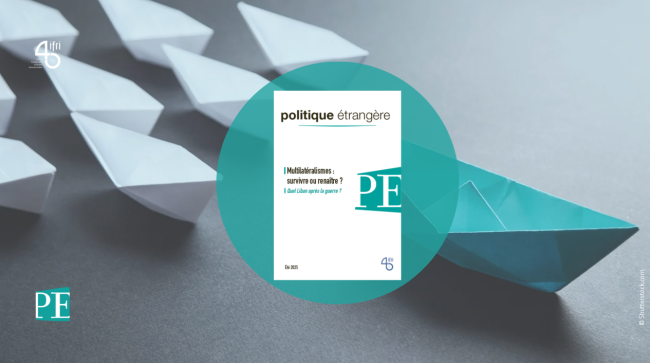
Navigating the Multilateral Seas: Lost in Decomposition? - Politique étrangère, Vol. 90, No. 2, Summer 2025
Institutionalized multilateralism seems to be under threat from power politics, especially within the UN system. There are continuing demands for the UN to be reformed. And flexible forms of consultation are being developed, such as club diplomacy and minilateralism. The reshaping of multilateralism is thus taking place mainly outside the institutional system, and its distance from the liberal international order and the multipolar order makes it less likely that the earth's habitability will be placed at the top of the multilateral agenda.

Populism and International Relations
Populism is flourishing, in Europe and elsewhere: a populist holds power today in Argentina and perhaps tomorrow in the United States. What does its spread say about our societies? And how is it shaping them, where populists rule? Do their economic policies stand any chance of success? Do their foreign policies have a greater impact on the world around them or at home? If “Trump 2.0” comes to be, will he have a free hand? If so, what can we expect?
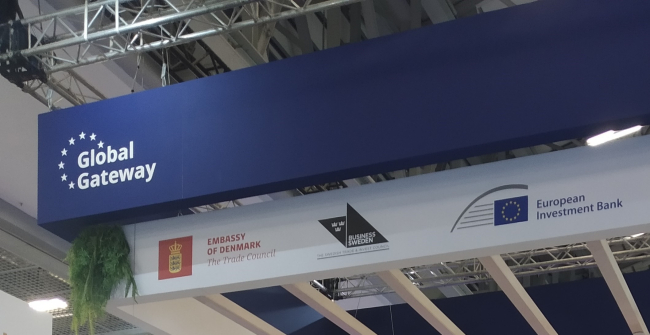
Global Gateway: Towards a European External Climate Security Strategy?
Transport, energy, water and telecommunications infrastructures are vital for economic development. These infrastructures are also fundamental for the achievement of the 2030 Sustainable Development Goals (SDGs), which have suffered a setback notably due to the Covid-19 pandemic, wars, and weak economic performance. Based on the Global Infrastructure Outlook, the world needs 97 trillion dollars ($) in infrastructure investments (energy, water, airports, ports, rail, road, and telecommunications) over 2016-2040, and based on the current investment trends ($79 trillion over the given period), the cumulative global infrastructure investment gap amounts to $18 trillion.
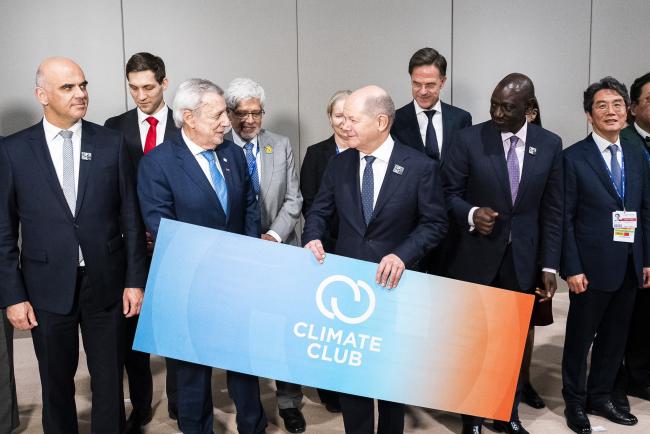
Germany’s Strategy on Climate Foreign Policy: Balancing Sustainable Development and Energy Security
With the war in Ukraine, Germany’s “traffic light” coalition government has had to adapt its climate policy to the upheavals caused by this war, which has turned its economic, energy, and military model upside down. Against a backdrop of high energy costs and increasing calls for reshoring in Europe, German industry is looking at how to maintain its competitiveness while decarbonizing its industry.

Ethics and Responsibility in Space Exploration: The Rise of Soft Law to Regulate New Practices
G20 Energy Transitions and Climate Finance Task Force Report
India is at the helm of the G20 presidency since the 1st of December 2022 for the duration of a year, with energy transition and climate finance being key topics on its agenda. In this context, the Gateway House put in place a G20 Energy Task Force to which Ifri’s Research Fellow, Diana-Paula Gherasim, participated.

Japan’s Africa aid rivals China in terms of ‘quality over quantity’: analysts
Japan has been investing in the continent for longer than China and applies international standards to its infrastructure financing, analysts said. Its pockets may not be as deep, but its support of good governance and democratic principles makes it a tempting development partner for African states.
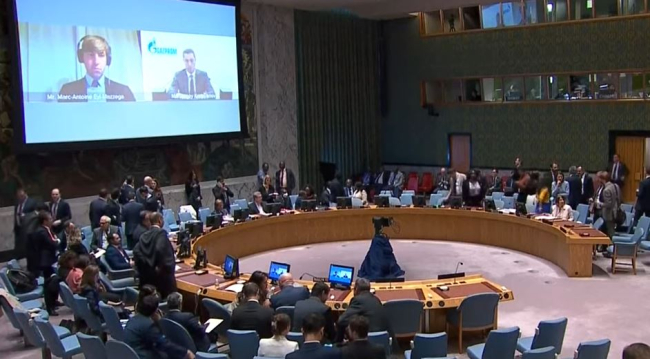
U.N. Security Council meets on Nord Stream at Russia's request
Remarks by Marc-Antoine Eyl-Mazzega, director of Ifri's Center for Energy & Climate, on the occasion of the meeting of the U.N. Security Council on Nord Stream at Russia's request, on September 30, 2022.
Japan resumes its wooing of Africa, a counter to China’s efforts
Japan, which began developmental programmes in the 1990s, has been eclipsed in recent years by China, now Africa’s leading trade partner.Pledge to invest US$30 billion on the continent includes a focus on training Africans to run their economy.
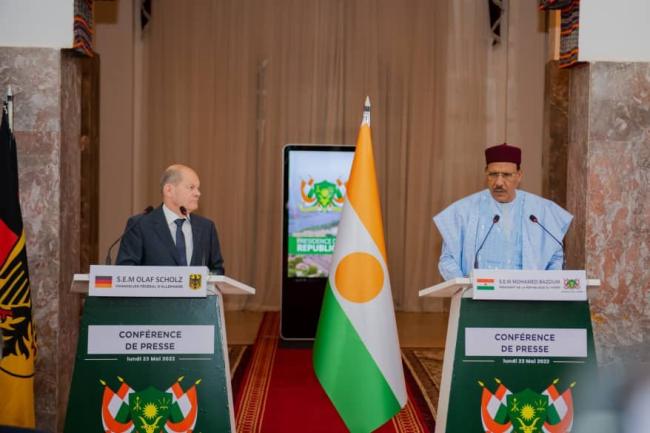
After Mali, what Commitment from Germany in the Sahel?
Germany, despite the reluctance of its public opinion, is committed to supporting security in the Sahel, notably through its participation in the European Union Training Mission in Mali (EUTM) and recently in Niger, and in the United Nations Multidimensional Integrated Stabilization Mission in Mali (MINUSMA).
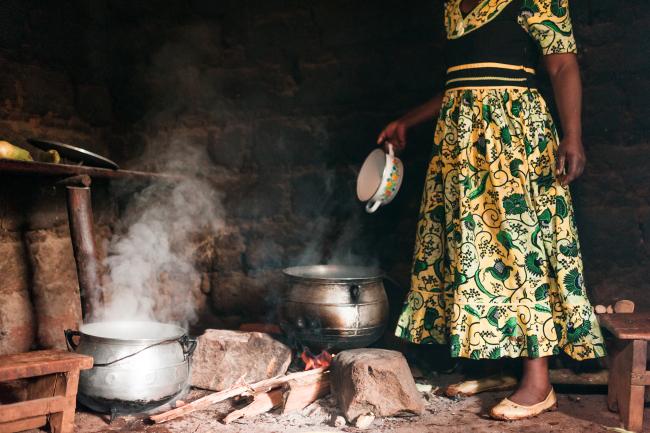
Power to the Cooks! New Clean Cooking Opportunities for Sustainable Development in Sub-Saharan Africa
2.6 billion people globally and 1 billion in Sub-Saharan Africa (SSA) cook using biomass fuel. The detrimental effects on the environment and public health, as well as the time and money lost are considerable. If nothing new is done, this situation will worsen further in SSA.
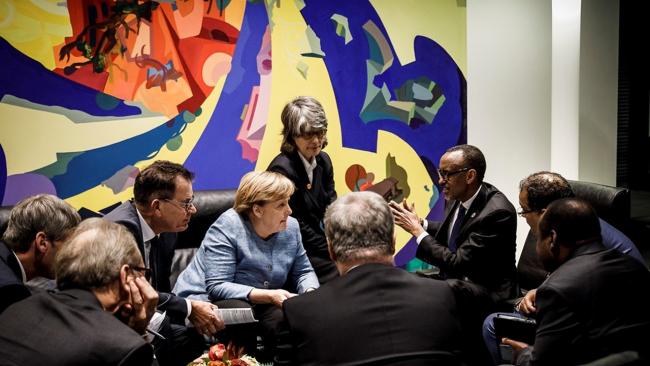
Germany’s Africa Politics: Renewal of an Unequal Cooperation?
In recent years, Germany’s Africa politics have been characterized by proactive international initiatives and the claim for a "partnership at eye level". However, a look at the power constellations of its cooperation indicates that inequalities are – contrary to Germany’s own claims – rather reproduced than reduced.
Poverty: The Rebound
Poverty, a major consequence of the COVID-19 pandemic, is set to increase exponentially throughout the world, even though it was supposed to disappear in its most extreme form by 2030.
Consequences and Lessons of a Virus
As Europeans get ready for their summer holidays, the Covid-19 pandemic seems to be winding down, despite hotspots cropping up here and there. However, we are not safe from the next wave. After so many careless speeches, nobody dares to make any more precise forecasts. In any case, any confirmed lull fosters broader reflections both on the disaster’s consequences and the dysfunctions that allowed it to happen.
Global Public Goods: Beyond Empty Words
As I write these lines, the COVID-19 pandemic seems to be following the pathway forecast by those epidemiologists and virologists, who have been telling us for weeks that the wave is past its peak. If it is, this does not mean that we are safe from a second wave some time later, but only that the first surge is over.
The Franco-German Tandem: Bridging the Gap on Nuclear Issues
The Franco-German couple has long been characterized by divergent trajectories on nuclear matters, and antagonist historical decisions still frame the current relationship.
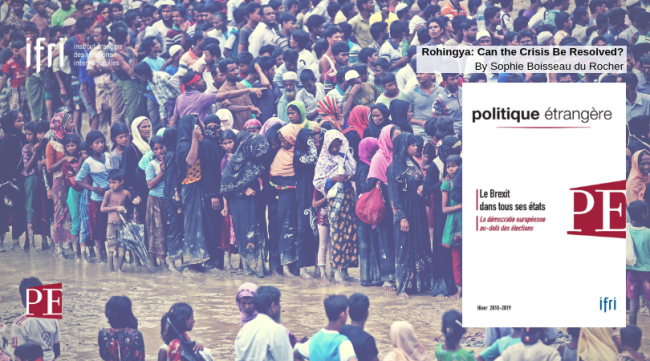
Rohingya: Can the Crisis be Resolved?
The Rohingya issue involves a complex national and regional history.
Where is the U.S. nuclear arsenal headed?
An interview with Jon WOLFSTHAL, nonresident scholar, Nuclear Policy Program, Carnegie Endowment for International Peace
France and Japan in Africa: a Promising Partnership
If some African countries are on their way to achieving dynamic economic growth, many are also still struggling with a lack of economic and social infrastructure, latent governance issues and often complex and risky security environments. In this context, both Japan and European countries, especially France, are making efforts to increase not only their development assistance, but also private investments and security cooperation in Sub-Saharan Africa.
Navigating the Multilateral Seas: Lost in Decomposition? - Politique étrangère, Vol. 90, No. 2, Summer 2025
Institutionalized multilateralism seems to be under threat from power politics, especially within the UN system. There are continuing demands for the UN to be reformed. And flexible forms of consultation are being developed, such as club diplomacy and minilateralism. The reshaping of multilateralism is thus taking place mainly outside the institutional system, and its distance from the liberal international order and the multipolar order makes it less likely that the earth's habitability will be placed at the top of the multilateral agenda.
G20 Energy Transitions and Climate Finance Task Force Report
India is at the helm of the G20 presidency since the 1st of December 2022 for the duration of a year, with energy transition and climate finance being key topics on its agenda. In this context, the Gateway House put in place a G20 Energy Task Force to which Ifri’s Research Fellow, Diana-Paula Gherasim, participated.
The Franco-German Tandem: Bridging the Gap on Nuclear Issues
The Franco-German couple has long been characterized by divergent trajectories on nuclear matters, and antagonist historical decisions still frame the current relationship.
Japan's Revived African Policy
By organising TICAD (Tokyo International Conference on African Development) for the first time in Africa in August 2016, Japan intended to accelerate and deepen its relationship with the continent.
The NPT and the Origins of NATO’s Nuclear Sharing Arrangements
Russia has recently accused the United States and NATO Allies of violating the Treaty on the Non-Proliferation of Nuclear Weapons (NPT) by arguing that NATO's nuclear sharing arrangements are not permitted under the Treaty.
Establishing the Rule of Law: the U.N. Challenge in Kosovo
Created on the 10th July 1999 by Security Council Resolution 1244, UNMIK was responsible for restructuring the institutions of a country devastated by war and establishing democratic governance. The security of people and goods and the existence of a legal system trusted by the population were two crucial prerequisites to the state-building process.
Can Global Governance Be Rebuilt? Japan's Role Seen Key
The Shared Future of Asia and Japan.
Japan’s Africa aid rivals China in terms of ‘quality over quantity’: analysts
Japan has been investing in the continent for longer than China and applies international standards to its infrastructure financing, analysts said. Its pockets may not be as deep, but its support of good governance and democratic principles makes it a tempting development partner for African states.
Japan resumes its wooing of Africa, a counter to China’s efforts
Japan, which began developmental programmes in the 1990s, has been eclipsed in recent years by China, now Africa’s leading trade partner.Pledge to invest US$30 billion on the continent includes a focus on training Africans to run their economy.
Where is the U.S. nuclear arsenal headed?
An interview with Jon WOLFSTHAL, nonresident scholar, Nuclear Policy Program, Carnegie Endowment for International Peace
Ifri, a foundation recognized as being of public utility, relies largely on private donors – companies and individuals – to guarantee its sustainability and intellectual independence. Through their funding, donors help maintain the Institute's position among the world's leading think tanks. By benefiting from an internationally recognized network and expertise, donors refine their understanding of geopolitical risk and its consequences on global politics and the economy. In 2026, Ifri partners with over 90 French and international companies and organizations.
