




Practical information
Between fragmentation and interdependence: rethinking global governance
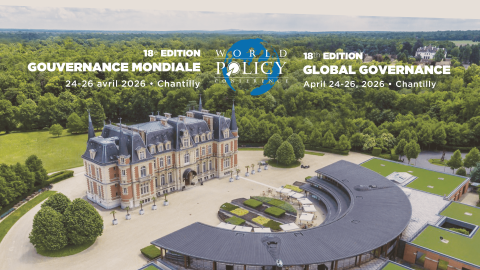
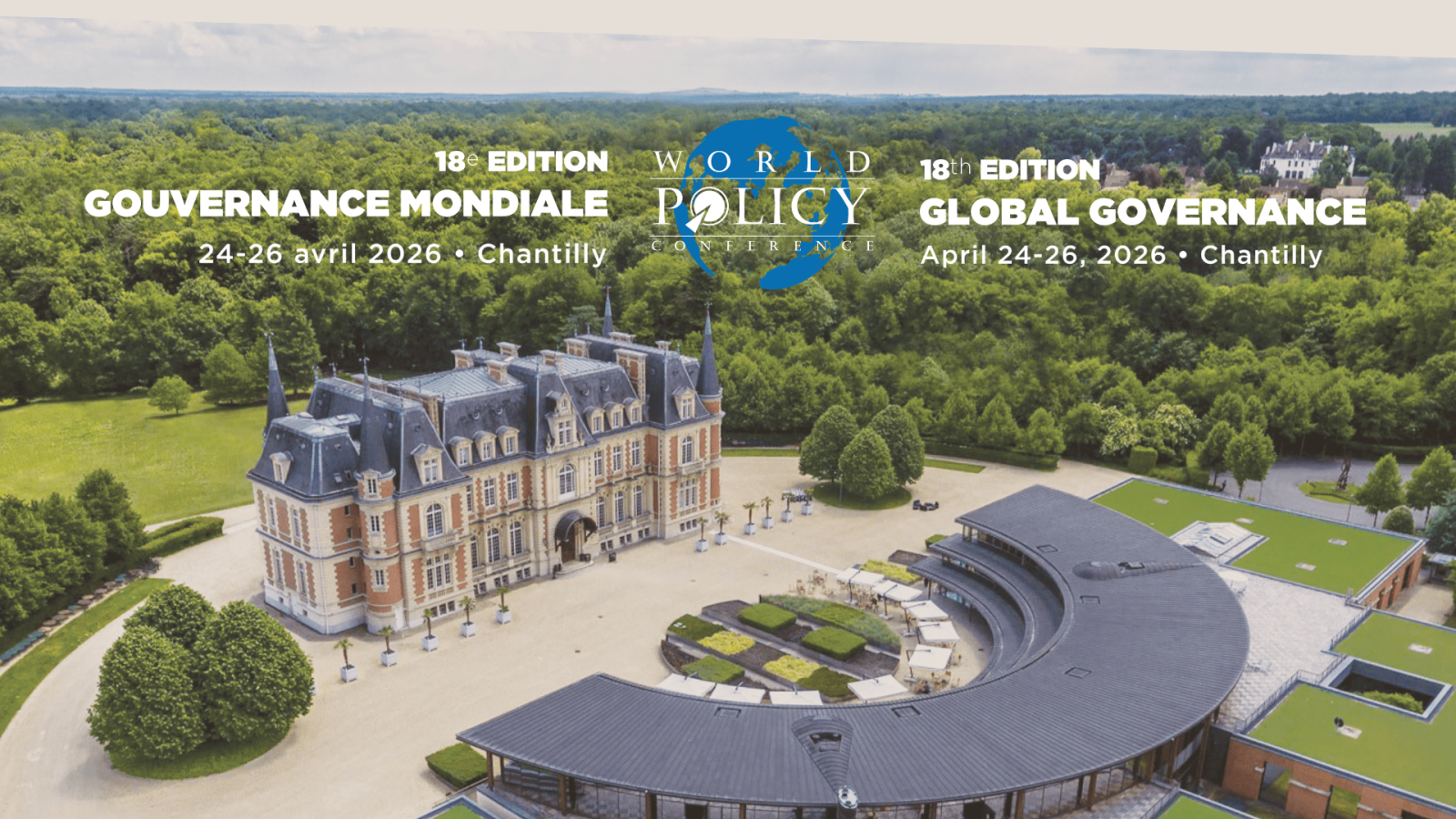
Created by Thierry de Montbrial, founder and executive chairman of the French Institute of International Relations (Ifri), the World Policy Conference (WPC) will hold its 18th edition from April 24 to 26, 2026, at Domaine Les Fontaines in Gouvieux, Chantilly.
Titre Edito
Follow the 1st day of WPC 2026 live (April 24)
Follow the 1st day of WPC 2026 live (April 24)
Watch all the videos on YouTube
Since its first edition in 2008, the WPC has always aimed to help promote a more open, more prosperous, and more just world. Current international affairs give even greater meaning to this universal mission. Unique in its format with a limited number of high-level participants, the WPC provides an essential space for reflection and dialogue on major global governance issues, while also enabling participants to build lasting relationships. It brings together figures from all five continents—political and business leaders, researchers, and journalists—ensuring diversity and plurality in discussions.
Prominent Figures
French President, Emmanuel Macron, will address a message to participants.
This year, the WPC will notably host Gérard Larcher (President of the French Senate), H. H. Bartholomew I (Archbishop of Constantinople-New Rome and Ecumenical Patriarch), Paul Kagame (President of the Republic of Rwanda), Aleksandar Vučić (President of the Republic of Serbia), Nabil Fahmy (designated Secretary-General of the Arab League), Anwar Gargash (Diplomatic Adviser to the President of the United Arab Emirates), Anne-Claire Legendre (President of Institut du Monde arabe), Dmytro Kuleba (former Minister of Foreign Affairs of Ukraine), Patrick Pouyanné (CEO of TotalEnergies), Dominique Senequier (Chair and founder of Ardian), among others…
Topics Covered
Under the general theme “Between Fragmentation and Interdependence: Rethinking Global Governance”, the 18th edition of the WPC will address major issues: global trade in an era where power overrides rules; the geopolitics of digital finance, states’ budgetary challenges; the future of the European Union; wars in Europe and the Middle East and their global repercussions; the revolution of agentic artificial intelligence; new security architectures; financing global public goods in a fragmented world; internal and external perspectives on the United States.
Parallel workshops will deepen reflection around three axes: international economy and finance; the new global energy order; artificial intelligence - a driver of prosperity or an existential threat.
The debates will be broadcast live on the WPC YouTube channel.
Follow the WPC on social media: Instagram, Facebook, LinkedIn, X
More information: www.worldpolicyconference.com
Media contact: [email protected] / [email protected]
Ifri media contact:
Natacha Crance, head of communications and media relations - [email protected]
Dimitri Von Büren, head of digital communications - [email protected]

Contact
Mme Song-Nim Kwon
Executive Director
[email protected]
Media Contact:
[email protected] / [email protected]
Related Subjects
Other events
COP31 in Antalaya: State of the Global Climate Governance, Issues, Perspectives
COPs have become a year-end marathon to revigorate a world now entering the era of climate overshoot. While Türkiye exhibits the largest coal-fired power generation in OECD Europe, it has embraced the electrification agenda and aims at joining forces with Australia on fostering action and implementation. This is an unusual de facto co-presidency arrangement, but one that could yield promising results. This webinar will take stock of what climate governance has achieved and of the issues still to be negotiated, and explore what impetus this Turkish–Australian partnership could provide.
A New Moment for Central Europe? Regional Cooperation in a Time of European Strategic Choices
Recent political developments in Central Europe have revived the debate about the future of regional cooperation and the Visegrád Group. Changes in Hungary, Poland, the Czech Republic and Slovakia, together with Austria’s growing interest in closer cooperation with its neighbours, could create new opportunities for dialogue and coordination around shared priorities.