



France and NATO: An History
Relations between France and NATO have been through ups and downs. France was a founding member of the Alliance, then a protestor within the system, before moving to the margins of the Alliance – and finally returning home.

The North Atlantic Treaty Organization’s 60th anniversary summit, on 3rd and 4th April 2009, marked France’s return to the integrated military command structure. This had been announced by President Sarkozy on 17th June 2008 when the new French White Paper on Defense and National Security (Livre blanc sur la défense et la sécurité ) was presented: “There is no reason why we should not be a part of NATO’s military structures.” France had parted ways with NATO 43 years earlier. The new move has been described alternatively as ‘treason’, the return of the prodigal son, and the end of the ‘French exception.’ What truth is there behind these characterizations? The fact of the matter is that France’s involvement with NATO has varied over the years: it was a founding member which then became an inside protester, before voluntarily exiling itself and finally returning to the ‘motherland’.
A founding role within the new Atlantic order
After 1945, in the context of the Cold War, France obtains what it had wished for during both world wars: the United States, early on, takes a stand in Europe. Confronted with the Soviet threat, France is forced to take stock of its powerlessness and the inadequacy of its military means – even within the Western union, which is largely subordinate to the imperious Albion. In the event, France chooses to trust the great American ally, which – as soon as peace comes about – agrees to join with the Europeans in an Alliance restricted to the North Atlantic. France signs the Washington Treaty on 4th April 1949, thus becoming one of the founding members of the Atlantic Alliance. The Alliance’s development into an organization in the early 1950s makes France an essential member by virtue of its geographical location – at a crossroads. Because of this, American and Canadian military bases are set up in France. Command structures such as Supreme Headquarters Allied Powers Europe (SHAPE), which is directed by an American general, the Supreme Allied Commander Europe (SACEUR), are also set up in France.
Simultaneously confronted with decolonization, the leaders of the IVth Republic demand that the solidarity between allies not be confined to the Atlantic but apply everywhere that Western interests are concerned, particularly in the Mediterranean and in the Near East. The leaders of the IVth Republic also demand participation in the strategic direction of the Alliance in equal measure to France’s role in NATO. […]
Outline
- A founding role within the new Atlantic order
- Choosing independence: the emergence of modern Atlantic security
- An Atlantic Europe versus a European Europe
- France and the Atlantic Alliance: integration with preferential treatment?
Maurice Vaïsse is professor emeritus at Sciences Po, specialist in French foreign and military policy. Professor emeritus at Sciences Po, specialist in French foreign and military policy.
This paper is translated in English by Clémence Sebag.
This page contains only a summary of our work. If you would like to have access to all the information from our research on the subject, you can download the full version in PDF format.
France and NATO: An History


Iran: Anatomy of a Power at War
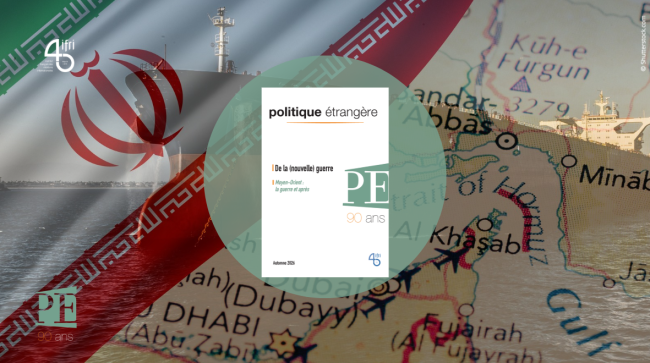
The elimination of Supreme Leader Ali Khamenei and several high-ranking officials at the outset of the 2026 American-Israeli operation did not succeed in bringing down the Iranian regime. The regime had prepared for such a scenario, notably by decentralizing its structures. Moreover, it continues to adapt to war. The power of the Islamic Revolutionary Guard Corps is growing at the expense of the Shiite clergy. The security apparatus defends the country’s sovereignty and justifies its actions in the name of raison d’état.

“Remodeling” the Middle East?
Chaos continues to spread, seemingly without end, across the Middle East. The Israeli-American attack on Iran has resulted in a clear military and diplomatic failure, but it is paving the way for a regional realignment, the consequences of which remain uncertain. New regional groupings are taking shape, either centered around Israel or built on the prospect of coexistence with Tehran, alongside a decline in American influence and the marginalization of Europe, while China maintains a low-key presence.

Silicon Valley and War: Lessons from Ukraine
Over the course of international conflicts, and particularly in Ukraine, major tech companies have emerged as central actors. Initially subject to wartime maneuvering, they have since become decisive actors in their own right, privatizing a significant share of wartime exchanges, shaping the information flows of societies, and presenting themselves as providers of security. This situation raises important questions about states’ autonomy in making decisions and taking action.

Does Artificial Intelligence Change the Nature of War?
From Gaza to Ukraine and Iran, current conflicts are being shaped by the arrival of artificial intelligence and robots on the battlefield. The changes under way are so profound that humans risk rapidly losing control over entire aspects of the conduct of military operations. While these technological developments are altering the character of war, their impact on the very nature of war itself remains a matter of debate.