






France’s “Return” to NATO: An Inopportune Decision
The French decision to re-enter NATO’s integrated military structure is merely the confirmation of a series of shifts that started a long time ago. But it is no less questionable a decision. It is a symbolic decision that affects France’s image internationally. It by no means guarantees that the Alliance will evolve in a way that corresponds to France’s national interests; nor does it shed light on France’s ambiguous future. It does, however, in a very real way, risk diminishing France’s will to defend itself.

The decision of French President Sarkozy that France re-enter NATO’s integrated military structure is, as his supporters have pointed out, the confirmation of a series of earlier shifts. The validity of these changes was debatable at the time, but they are now a fixture of the French political landscape.
Indeed, France played a part in NATO’s survival after the Cold War by agreeing to an intervention in 1994-1995 in Bosnia-Herzegovina, and, later, in 1999 – this time without a UN mandate – in Kosovo and more generally in Yugoslavia. As early as December 1995, France re-entered NATO’s Military Committee. France had agreed to intervene outside its original sphere of influence.
At the beginning, the Atlantic Alliance, of which France never ceased to be a part, was a defensive alliance, restricted to the Euro-Atlantic zone. Over the years, and particularly since 1999 (Kosovo) and 2001 (Afghanistan), it has become a global alliance committed to stabilization and peace-enforcement operations. This is effectively a shift in the organization’s stated purpose. NATO is now portrayed as ‘the UN’s military arm,’ yet this has not always been the case. During the Kosovo conflict, NATO bombed Yugoslavian cities, supplanting the UN whose Security Council had not issued a mandate for intervention. We can only hope that this regrettable situation will not be repeated. It is worth noting, however, that the manner in which the Kosovo conflict was dealt with set a precedent that led to the invasion of Iraq by a ‘coalition of volunteers’ led by the United States and, for the most part, recent or older members of NATO. In opposing the invasion of Iraq, France was a minority within the United States-dominated organization, as well as within the European Union.
Furthermore, France has now become one of the main contributors to NATO’s ‘stabilization operations.’ As such, was it necessary to take things further by re-entering NATO’s Defense Planning Committee (DPC) as well as its Chief of Staff ranks? In other words, France is once again a part of NATO’s integrated military structure, which remains, from an operational point of view, under the supreme command of an American general. Justifying this decision is no small task because it is a political and symbolic decision whose importance should by no means be played down.
What are France and NATO’s common interests?
The expected benefits do not, in my view, outweigh the disadvantages that this decision involves. The French President’s justification (“We are a part of the Western family”) can only be the result of a hasty assessment. The decline of the American superpower is indeed on the cards. The United States is living beyond its means. […]
Outline
- What are France and NATO’s common interests?
- Current challenges facing the Alliance
- Is this decision putting France in danger?
Jean-Pierre Chevènement holds the title of Honorary Member of Parliament and was previously a Minister.
This paper is translated in English by Clémence Sébag.
This page contains only a summary of our work. If you would like to have access to all the information from our research on the subject, you can download the full version in PDF format.
France’s “Return” to NATO: An Inopportune Decision


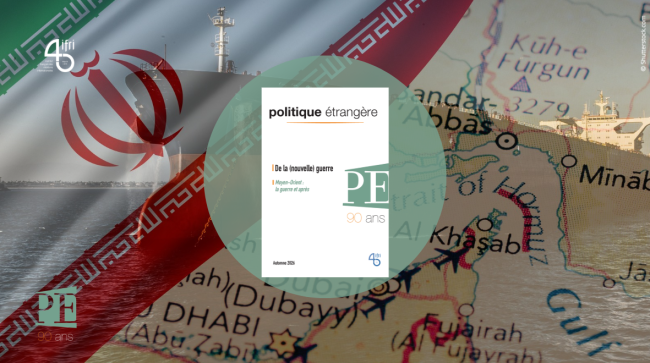
Iran: Anatomy of a Power at War
The elimination of Supreme Leader Ali Khamenei and several high-ranking officials at the outset of the 2026 American-Israeli operation did not succeed in bringing down the Iranian regime. The regime had prepared for such a scenario, notably by decentralizing its structures. Moreover, it continues to adapt to war. The power of the Islamic Revolutionary Guard Corps is growing at the expense of the Shiite clergy. The security apparatus defends the country’s sovereignty and justifies its actions in the name of raison d’état.

“Remodeling” the Middle East?
Chaos continues to spread, seemingly without end, across the Middle East. The Israeli-American attack on Iran has resulted in a clear military and diplomatic failure, but it is paving the way for a regional realignment, the consequences of which remain uncertain. New regional groupings are taking shape, either centered around Israel or built on the prospect of coexistence with Tehran, alongside a decline in American influence and the marginalization of Europe, while China maintains a low-key presence.

Silicon Valley and War: Lessons from Ukraine
Over the course of international conflicts, and particularly in Ukraine, major tech companies have emerged as central actors. Initially subject to wartime maneuvering, they have since become decisive actors in their own right, privatizing a significant share of wartime exchanges, shaping the information flows of societies, and presenting themselves as providers of security. This situation raises important questions about states’ autonomy in making decisions and taking action.

Does Artificial Intelligence Change the Nature of War?
From Gaza to Ukraine and Iran, current conflicts are being shaped by the arrival of artificial intelligence and robots on the battlefield. The changes under way are so profound that humans risk rapidly losing control over entire aspects of the conduct of military operations. While these technological developments are altering the character of war, their impact on the very nature of war itself remains a matter of debate.