






The Future of Think Tanks

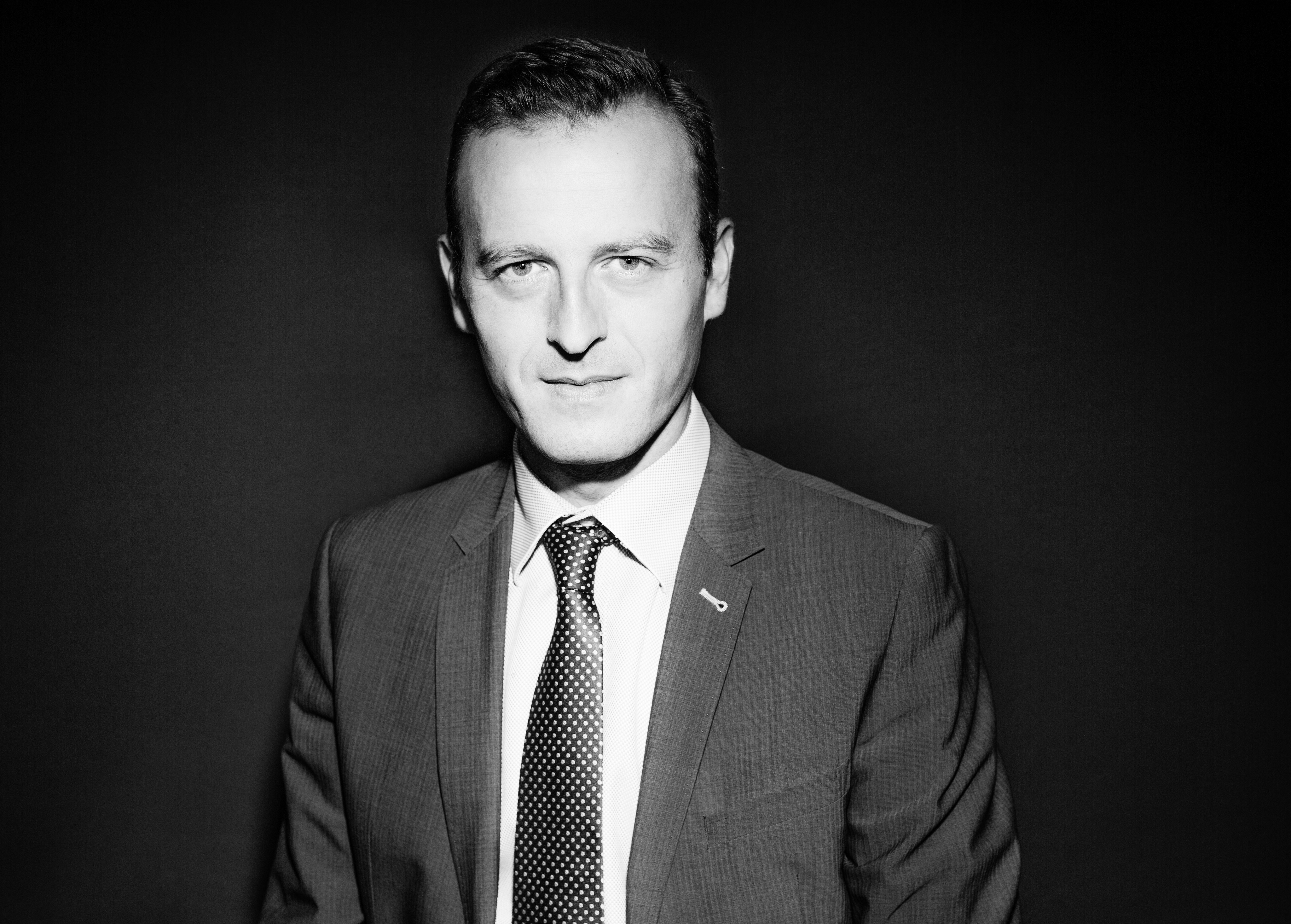
In this special issue of Politique étrangère devoted to the proceedings of the conference organized by Ifri on April 10, 2019, in the Grand Amphitheater of the Sorbonne, on the occasion of its fortieth anniversary, discover the debate moderated by Bassma Kodmani between Thomas Bagger, Thomas Gomart, Robin Niblett, and Daniela Schwarzer.

Bassma Kodmani
We will talk about the role of think tanks, their uncertainties and their future. Any leader of a think tank wonders each day about what they must do to preserve its credibility, independence and influence. Do you think that we, the think tank community, are doing something; and also, what? And if a think tank's role is to make international questions intelligible and to recommend a certain number of directions for political decision-making, my first question would be the following: how explain to politicians that it is in their interest to work with think tanks? This is an even more important question now that we are dealing with political leaders for whom the world of think tanks is not presumably of crucial interest...
Who listens to think tanks?
Robin Niblett
What Bruno Le Maire said this morning, quoting Xi Jinping, who noted that the Europeans had taken three centuries to build what the Chinese built in forty years, particularly struck me. The most difficult thing is to think about the future of think tanks. We are now experiencing a proliferation of think tanks around the world (more than 1,000 in the United States and more than 500 in China...), which seem to be experiencing a golden age. They seem necessary because we are in a turbulent world. And yet, the paradox is that we are uncertain of our credibility in our role. Normally, our main public is governments and governing elites in the private and public sectors. We are making forecasts and the most objective analyses possible; we are trying to give advice, which is sometimes difficult because we are not elected – but we can also sometimes say what others cannot say... Governments are now, doubtless, paying less attention to what we are saying because they live in a media world where the news dominates every moment (see the example of Brexit).
How can we prove the importance of think tanks to governments today? We need to show that we are in contact with spheres that the government does not necessarily reach. We could also communicate via the media. But the public also looks at us in a somewhat skeptical manner, as a number of us are seen as managers of globalization, illustrating the positive sides of it without seeing the dangers. Hence, the public's skepticism can be combined with a lack of government attention. We can naturally assert ourselves by renewing major themes of the international debate, by developing multidisciplinary or interdisciplinary studies, by involving more individuals, NGOs, and various partners. […]
Thomas Bagger is Director of Foreign Policy in the Office of the Federal President (Federal Republic of Germany)
Thomas Gomart is Director of Ifri
Robin Niblett is Director of the Royal Institute for International Affairs (RIIA, Chatham House, London)
Daniela Schwarzer is Director of the Deutsche Geselschaft für Auswärtige Politik (DGAP, Berlin)
Bassma Kodmani is Director of the Arab Reform Initiative

Available in:
Themes and regions
Share
This page contains only a summary of our work. If you would like to have access to all the information from our research on the subject, you can download the full version in PDF format.
The Future of Think Tanks

Iran: Anatomy of a Power at War
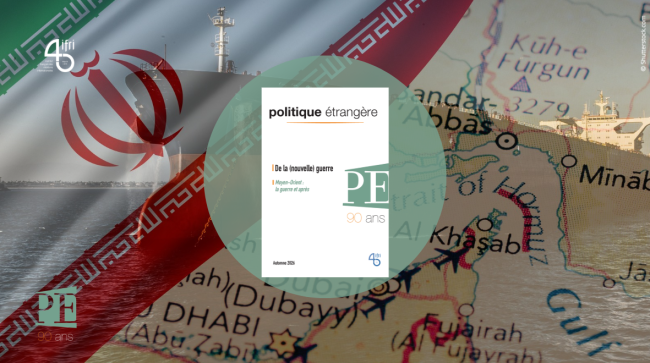
The elimination of Supreme Leader Ali Khamenei and several high-ranking officials at the outset of the 2026 American-Israeli operation did not succeed in bringing down the Iranian regime. The regime had prepared for such a scenario, notably by decentralizing its structures. Moreover, it continues to adapt to war. The power of the Islamic Revolutionary Guard Corps is growing at the expense of the Shiite clergy. The security apparatus defends the country’s sovereignty and justifies its actions in the name of raison d’état.

“Remodeling” the Middle East?
Chaos continues to spread, seemingly without end, across the Middle East. The Israeli-American attack on Iran has resulted in a clear military and diplomatic failure, but it is paving the way for a regional realignment, the consequences of which remain uncertain. New regional groupings are taking shape, either centered around Israel or built on the prospect of coexistence with Tehran, alongside a decline in American influence and the marginalization of Europe, while China maintains a low-key presence.
Silicon Valley and War: Lessons from Ukraine
Over the course of international conflicts, and particularly in Ukraine, major tech companies have emerged as central actors. Initially subject to wartime maneuvering, they have since become decisive actors in their own right, privatizing a significant share of wartime exchanges, shaping the information flows of societies, and presenting themselves as providers of security. This situation raises important questions about states’ autonomy in making decisions and taking action.

Does Artificial Intelligence Change the Nature of War?
From Gaza to Ukraine and Iran, current conflicts are being shaped by the arrival of artificial intelligence and robots on the battlefield. The changes under way are so profound that humans risk rapidly losing control over entire aspects of the conduct of military operations. While these technological developments are altering the character of war, their impact on the very nature of war itself remains a matter of debate.