



Macron’s China Policy: Dropping Illusions and Bringing Back Realpolitik
One may regret that France has not upgraded its China policy sooner, but it seems that the French president is now clear-eyed that it is not enough to only have a good relationship with Beijing, it is also necessary to reinstate the balance of power.

With reasonable expectations prior to the visit, one can assess that Xi Jinping’s May 6-7 state visit to France was a success — at least not a failure.
While the visit may not have yielded tangible results on issues such as Ukraine or trade disputes, it does mark a significant shift in President Emmanuel Macron’s approach to China.
Just a year ago, in April 2023, the French president went to China with a positive agenda in order to bring the bilateral relationship back on track after three years of COVID-19 pandemic. Apart from Ukraine, the priority of the visit was business, regardless of the meager crop of contracts France eventually signed. In addition, Macron’s “friendship” with Xi was overexposed during a visit where China’s propaganda had a full hand. Finally, on his way back to France, the French president made highly controversial comments blaming the United States for fueling tensions in East Asia, and sounding like he disregarded the consequences that a crisis in the region would have for France’s interests.
In stark contrast, this year’s visit was marked by a more austere tone. Macron, respectful and cordial with his counterpart, was no longer overly friendly and overly smiling compared to last year. He was more distant and straightforward, refraining from making any controversial statement or aiming friendly fire at France’s allies and partners. The agenda was heavily political, even when dealing with economic issues, underscoring the gravity of the issues at stake.
Yet, Macron did invite Xi to the land of his childhood, the Pyrenees Mountains in southern France. Macron wanted to show his counterpart that he values high-level dialogue with him and remains open and constructive to China, but that France’s interests in terms of security and economics will be preserved at all costs.
Ukraine
On Ukraine, the Elysée surprisingly maintained the same twofold contradictory goal to convince Xi to use his leverage on Putin on the one hand, and to deter him from providing weapons or direct military aid to Russia on the other. A more accurate analysis indicates that China’s main interest is to stay out of the war. Therefore, it is not going to help the EU against its Russian strategic partner, and it is unlikely to provide arms to Putin and face economic sanctions from the West.
In Paris, Xi sounded annoyed by the Europeans’ attempts to involve China in the war. During a press meeting at the Elysée, he stated he opposed: “the use of the Ukrainian crisis to blame others, smear a third country and start a new Cold War,” an even stronger wording compared to what he wrote in his op-ed in Le Figaro: “China is neither at the origin of the crisis, nor a party to it.”
Although China does not provide lethal weapons to Russia, France has no illusion that China’s overall economic support is critical for the Russian war effort in Ukraine. The French president and European Commission President Ursula von der Leyen called China to curtail delivery of dual-use goods to Russia that eventually end up on the Ukrainian front. They also made clear that this was affecting EU-China relations.
At least, Xi has supported Macron’s proposal of a truce during the Paris Olympics this summer. He also agreed to coordinate with the French president before he hosts Vladimir Putin in China in the coming weeks. These are meager outcomes and empty of commitments, but China seems to take Paris more seriously when it says the war in Ukraine is an existential threat to the EU’s security, and that Ukraine cannot lose.
Hence, there was no joint declaration on Ukraine, although there was a rather interesting one on the situation in the Middle East, where shared positions are clearer: protection of civilians, opposition to the Israeli offensive on Rafah and forced displacement of civilians, immediate ceasefire, and the promotion of a two-state solution.
No illusion on trade
The most significant shift lies in Macron’s economic bilateral relationship with China. Drifting away from the previous engagement and business-oriented policy, the French president emphasized imbalances in trade, investment and market access, as well as unfair competition.
[...]
Macron now knows that there is no alternative to an economic balance of power with China. A trade war is undesirable, but France and the EU must be ready and are getting ready for it.
>>> The whole article is available on The Prospect Foundation's website.

Available in:
Regions and themes
Share


Center for Asian Studies
Asia is a nerve center for multiple global economic, political and security challenges. The Center for Asian Studies provides documented expertise and a platform for discussion on Asian issues to accompany decision makers and explain and contextualize developments in the region for the sake of a larger public dialogue.
The Center's research is organized along two major axes: relations between Asia's major powers and the rest of the world; and internal economic and social dynamics of Asian countries. The Center's research focuses primarily on China, Japan, India, Taiwan and the Indo-Pacific, but also covers Southeast Asia, the Korean peninsula and the Pacific Islands.
The Centre for Asian Studies maintains close institutional links with counterpart research institutes in Europe and Asia, and its researchers regularly carry out fieldwork in the region.
The Center organizes closed-door roundtables, expert-level seminars and a number of public events, including an Annual Conference, that welcome experts from Asia, Europe and the United States. The work of Center’s researchers, as well as that of their partners, is regularly published in the Center’s electronic journal Asie.Visions.
China as an ambivalent supporter of the WTO and the multilateral trading system
Amid rising trade tensions between Europe and China and broader uncertainty in the international rules-based trade regime, Beijing has worked to preserve and bolster the multilateral trading system while at the same time failing to reform the domestic policies that have served to undermine that same system.
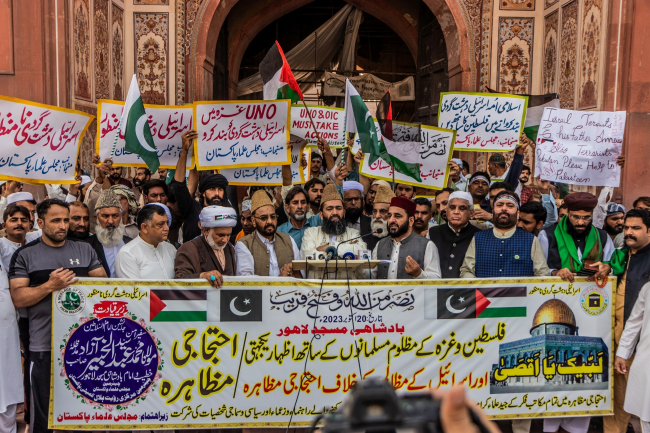
Pakistan and the Israel-Palestine Conflict: Transformation in Pakistan’s Approach After the War in Gaza
Pakistan has long combined vocal support for the Palestinian cause with covert engagement with Israel. Since the war in Gaza, this balance has become untenable: public opinion is united against Israel, joining Trump’s Board of Peace has drawn rare cross-party criticism, and new regional alignments put normalization out of reach.
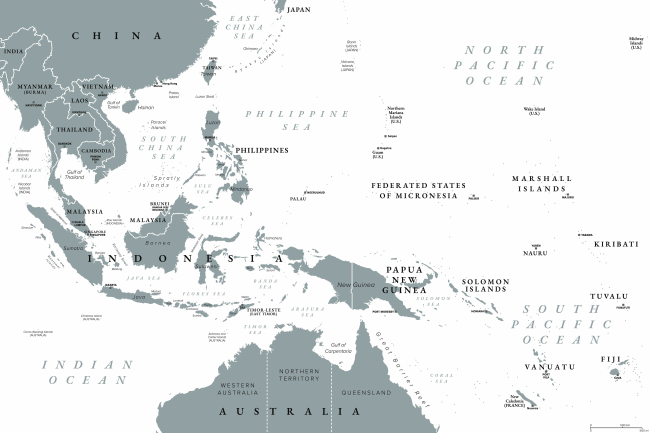
The Oceania Factor in France’s Evolving Indo-Pacific Strategy
This paper examines the two-way relationship between France’s Indo-Pacific strategy and developments in Oceania. Oceania was not a priority in the initial years of France’s Indo-Pacific strategy, as the region was largely treated as secondary to major strategic hotspots and key partnerships, while overseas territories were primarily handled as domestic issues and recipients of a top-down strategy.
France’s View: From Diplomacy to Public-Private Action
France has emerged as the EU’s IMEC forerunner, combining port infrastructure, diplomatic alliances and public-private cooperation. With Marseille Fos at its core, the country brings a strategic hub for logistics, energy and digital connectivity to the corridor.