
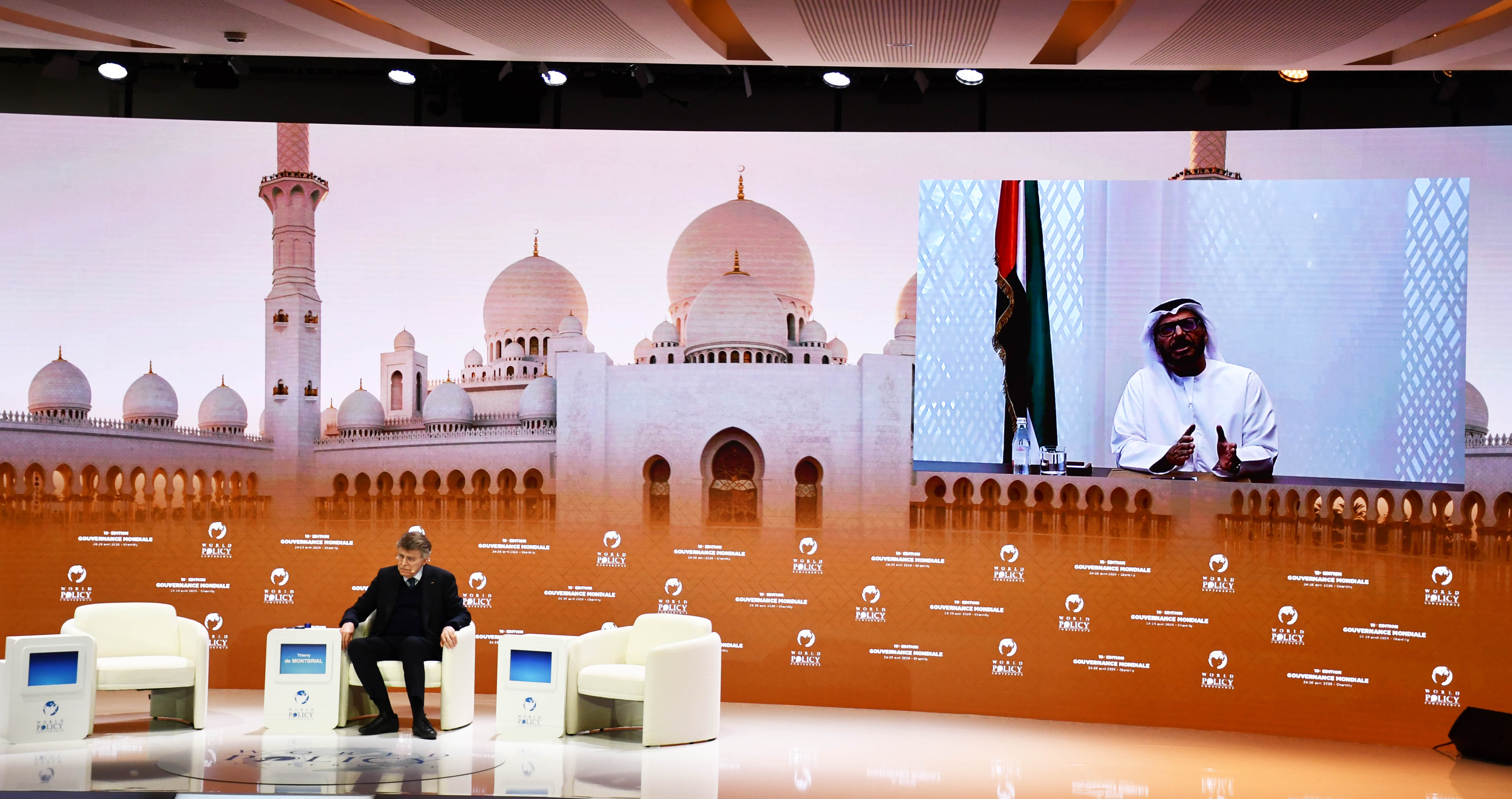
A conversation with Anwar Gargash, Diplomatic Advisor to the President of the United Arab Emirates
In an exceptional debate with Thierry de Montbrial, Anwar Gargash, Diplomatic Advisor to the President of the United Arab Emirates shares his perspective on the ongoing war with Iran in the Middle East.
Many of the crises that have affected the Gulf region have also touched upon broader regional dynamics. The diplomatic attempts, as well as the military confrontations, have not been conclusive.
After 15 years of recurring crises, we have witnessed one of the more serious confrontations. The UAE has worked seriously to address these challenges diplomatically. We have consistently maintained that diplomacy is the way forward.
Iran's strategy has been to enlarge the war, with very little consideration for its longer-term relations in the region. In the long term, this will affect Iran's position and posture regionally. It is very clear to us and our neighboring countries that Iran represents a long-term threat.
The nature of this threat also depends on the character of bilateral and regional relations.
The attack on Iran was a US-Israeli operation, but Iran chose to enlarge the war to other countries, showing very little consideration for its Arab neighbors and the broader religious and cultural ties that bind the region.
In the short term, the immediate risk is a situation where Iran's interpretation of victory, defined as the regime still standing, and the blockade of the Strait of Hormuz become direct consequences of this posture. This calculation can last for weeks, but not indefinitely.
This has to bring us back either to the beginning of a political agreement or to a new confrontation.
From 1988 to 2026, Iran has been under a religious regime governed by the authority of the Ayatollah. That era, as we knew it, will not be recreated. We see this clearly today.
The current standstill cannot continue forever. I don't see negotiations being successful unless we have a genuine return to reality.
Long-term considerations:
- Iran is clearly the strategic threat today, regardless of diplomatic relations. Countries that have attempted to maintain ties, commercial relations, or even signed strategic agreements with Iran were targeted nonetheless.
- This will mean that the US footprint in the region will be more prominent, not less. This concerns equipment, alliances, training, and political and diplomatic approaches. In my opinion, we already have evidence of US commitment in this regard.
- I foresee a growing decoupling between Gulf security concerns and those of other Arab countries, such as Syria, Lebanon, and Egypt.
- While Syria, Lebanon, and Egypt continue to view Israel as a threat, and despite the Gulf countries' continued solidarity with the Palestinian cause, many Gulf analysts do not perceive Israel as a primary threat.
- What we will witness in Iran, I believe, will be a different version of the Islamic Republic. This will be a matter not only of regime survival but also of economic survival.
LEARN MORE:
Discover the latest analyses and news from Ifri on North Africa and the Middle East.

Media:

Share
Authors

Thierry de MONTBRIAL
Founder and Executive Chairman of Ifri - Member of the Institut de France (Académie des Sciences morales et politiques)