



Challenges and Opportunities of a EU-Taiwan ECA: A Review of Political-Economic Perspectives

Concerns over becoming marginalized in the course of East Asian economic integration are driving a proactive regional trade agreement (RTA) strategy on the part of Taiwan. Three factors explain this concern: Competing visions of economic integration in the region from both the United States and China, the success of Korea in concluding a large number of important RTAs, and the increasing number of overlapping agreements that crowd out countries and economies such as Taiwan that do not have proactive RTA strategies.
Taiwan has completed free trade agreements (FTAs) with five countries in Central America, as well as an Economic Cooperation Framework Agreement (ECFA) with China. In the case of a EU-Taiwan economic cooperation agreement (ECA), however, predictions that such an agreement will favor the EU have led to a lack of enthusiasm in Taiwan. Attention has largely been focused on follow-up negations with China concerning post-ECFA arrangements and on potential agreements with the US and partners in a Trans-Pacific Partnership (TPP). The successful negotiation of a EU-Taiwan ECA crucially depends on generating both the motivation for bilateral collaboration and incentives for signing such an agreement.
For Europe, a EU-Taiwan ECA could be seen as a safety valve for EU access to the Chinese market, creating an optimal path for balancing competitive pressure from Korea in the EU market following the EU-Korea FTA. Europe also risks being crowded out of East Asian trade by various initiatives for regional integration. In this sense, a EU-Taiwan ECA presents an opportunity. As the conditions for a RTA between the EU and China are not yet ripe, such an agreement with Taiwan could use the cross-strait ECFA to access the Chinese market, making Taiwan a kind of buffered corridor for bilateral collaboration with China. Furthermore, it could also increase the possibility of ASEAN's renewed efforts at seeking collaboration with the EU. Finally, a EU-Taiwan ECA not only would help lower the impact on European companies from the EU-Korea FTA, but could also serve as a significant tool for creating checks against Korean companies in the EU market.
In the end, Taiwan and the EU share common ground. They have both worked hard to overcome being marginalized in the course of broader Asia-Pacific regionalism, and they both have common objectives and share various common trade interests that have yet to be recognized. This paper concludes that it is necessary for the EU to further its understanding of the East Asian situation. It should reevaluate the blueprints of its existing RTA strategy and rethink its place in the broader political and economic context of the Asia-Pacific region in order to reorient its trade interests in the area, as well as its role in the regional integration process.

Available in:
Regions and themes
ISBN / ISSN
Share
This page contains only a summary of our work. If you would like to have access to all the information from our research on the subject, you can download the full version in PDF format.
Challenges and Opportunities of a EU-Taiwan ECA: A Review of Political-Economic Perspectives

Center for Asian Studies
Asia is a nerve center for multiple global economic, political and security challenges. The Center for Asian Studies provides documented expertise and a platform for discussion on Asian issues to accompany decision makers and explain and contextualize developments in the region for the sake of a larger public dialogue.
The Center's research is organized along two major axes: relations between Asia's major powers and the rest of the world; and internal economic and social dynamics of Asian countries. The Center's research focuses primarily on China, Japan, India, Taiwan and the Indo-Pacific, but also covers Southeast Asia, the Korean peninsula and the Pacific Islands.
The Centre for Asian Studies maintains close institutional links with counterpart research institutes in Europe and Asia, and its researchers regularly carry out fieldwork in the region.
The Center organizes closed-door roundtables, expert-level seminars and a number of public events, including an Annual Conference, that welcome experts from Asia, Europe and the United States. The work of Center’s researchers, as well as that of their partners, is regularly published in the Center’s electronic journal Asie.Visions.

Pakistan and the Israel-Palestine Conflict: Transformation in Pakistan’s Approach After the War in Gaza
Pakistan has long combined vocal support for the Palestinian cause with covert engagement with Israel. Since the war in Gaza, this balance has become untenable: public opinion is united against Israel, joining Trump’s Board of Peace has drawn rare cross-party criticism, and new regional alignments put normalization out of reach.
The Oceania Factor in France’s Evolving Indo-Pacific Strategy
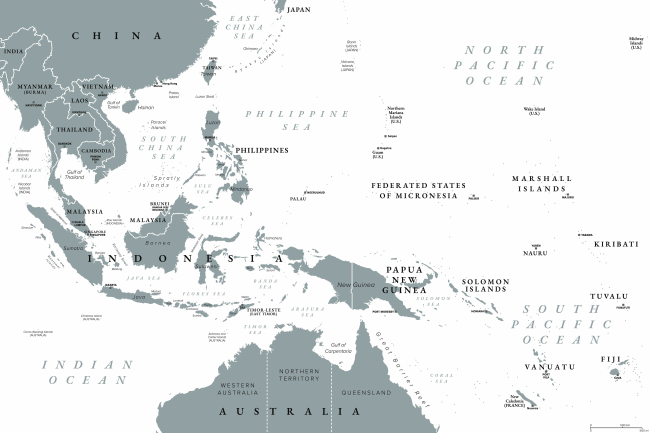
This paper examines the two-way relationship between France’s Indo-Pacific strategy and developments in Oceania. Oceania was not a priority in the initial years of France’s Indo-Pacific strategy, as the region was largely treated as secondary to major strategic hotspots and key partnerships, while overseas territories were primarily handled as domestic issues and recipients of a top-down strategy.

France’s View: From Diplomacy to Public-Private Action
France has emerged as the EU’s IMEC forerunner, combining port infrastructure, diplomatic alliances and public-private cooperation. With Marseille Fos at its core, the country brings a strategic hub for logistics, energy and digital connectivity to the corridor.
Trump II, the Crisis of the Rules-Based Order and Europe’s Indo-Pacific Strategy
This article examines the implications of Trump II for Europe’s engagement in the Indo-Pacific. The piece contends that Trump II is accelerating the erosion of the rules-based order and undermining the relevance of the Free and Open Indo-Pacific (FOIP) concept, while forcing Europe to refocus on its own continental security amid US retrenchment. Paradoxically, these very constraints create conditions for a more autonomous, pragmatic, and explicitly interest-driven European engagement in the Indo-Pacific, rather than outright withdrawal.