

Politique étrangère
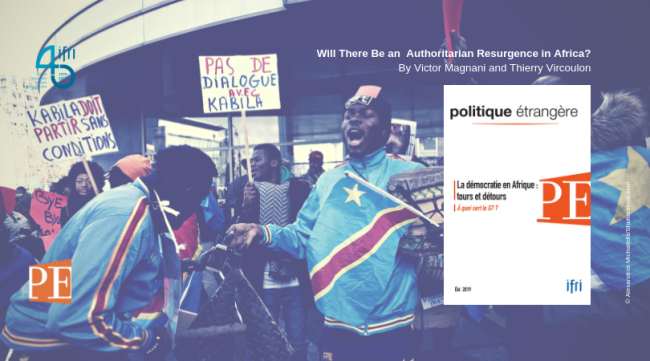
Will There Be an Authoritarian Resurgence in Africa?
Elections are held on a regular basis in various African countries, but democracy is far from flourishing.
Between the Lines of Questionable Battles
This text was published in Politique étrangère in 1979, the year in which the French Institute of International Relations (Ifri) was created.
2019-2029: The World in 10 Years
The last four decades have witnessed the profound transformation of the very foundations of the international system: the globalization of trade, technical revolutions, the upheaval of the hierarchy of powers, the emergence of China, the explosion of the Middle-East, the mutation of conflicts and threats, climate concerns, etc.
The Waning of Universalism
During the 19th century, Westerners provided ideological justifications for their colonization, namely spreading the Enlightenment across the globe. This project was received favorably until the second half of the 20th century. Over the last 20 years, it has met new hostility. The “universal values” promoted by the West are viewed today as a form of imperialism to be opposed – especially by China, Russia and Turkey.
Between Concentration and Dispersion: A Promising Future for Power Relations
The notion of power has long been a topic of study in international relations. In the coming decade, the evolution of power will be characterized by the dynamics of concentration and dispersion. On the one hand, the global system will be marked by the clash of two superpowers, the United States and China. On the other hand, capacity for individual action will proliferate through information and communication technologies.
2029, the Great Asian Renaissance
Asians were dominated and sometimes humiliated by Westerners during the last two centuries. Today, they look to the future with confidence. In 2050, the world’s two leading powers are likely to be China and India. The great Asian Renaissance will lead to geopolitical upheavals. China-US tensions are already visible and conflicts may emerge between Asian powers. Yet the clash of civilizations is not inevitable.
The Middle East in 2029
The wars ravaging the Middle East are not destined to continue forever and the region is not condemned to being governed by autocrats. A transition to a more just order for the region’s populations is possible, but will take time. It is unlikely to happen by 2029. Progress will be gradual, pushed by civil society. New revolutions are possible, although it is not sure they will lead to greater democracy.
Support independent French research
Ifri, a foundation recognized as being of public utility, relies largely on private donors – companies and individuals – to guarantee its sustainability and intellectual independence. Through their funding, donors help maintain the Institute's position among the world's leading think tanks. By benefiting from an internationally recognized network and expertise, donors refine their understanding of geopolitical risk and its consequences on global politics and the economy. In 2026, Ifri partners with over 90 French and international companies and organizations.