



The Middle East in 2029

The wars ravaging the Middle East are not destined to continue forever and the region is not condemned to being governed by autocrats. A transition to a more just order for the region’s populations is possible, but will take time. It is unlikely to happen by 2029. Progress will be gradual, pushed by civil society. New revolutions are possible, although it is not sure they will lead to greater democracy.
In the past decade the Middle East has experienced a historic transformation. The tectonic plates are shifting. The status quo has been shattered beyond repair. Today, there is a multifaceted struggle unfolding in the Greater Middle East, particularly in the Arab world, over the future of the nation state, the role of the sacred in the political, and the relationship between rulers and citizens. This struggle is more than territorial; it is ideological and institutional. At heart, it is an existential battle between a multitude of actors, including conservatives, progressives, Islamists, and nationalists. A fierce regional cold war between the three pivotal powers (Iran, Saudi Arabia and Turkey) pours gasoline on this internal struggle and exacerbates it. The implications of this struggle have already been felt far beyond the region. The eventual outcome will define the character and identity of the nation states and their relations with the wider world.
Historically in the Greater Middle East and beyond, the notion of borders and boundaries has shifted in time and space. The current all-too-apparent divisions in the Arab world between national identity and tribal, religious, and sectarian identities are contentious and violent. These secondary identities have emerged because of failed state institutions and the lack of legitimacy of the ruling elites. They now threaten to wreck the entire state system.
However, redrawing the map will not, in itself, resolve the crisis facing the system. The recent experience of South Sudan serves as a warning for the violence, instability and bloodshed that can flow from such efforts. The fracturing of the territorial map is a symptom of a deeper, and more systemic, crisis of failed governance. The economic and political vulnerabilities of this failure fuel structural instability by stoking the fires of identity dislocation, sectarianism, and geopolitical rivalry.
Against this backdrop of swift and uncertain change, the Middle East state system is experiencing a profound transition. Competing visions of the nation-state and of the contract between power and the people are being promoted across the region. This will be a long, drawn-out process, the outcome of which remains unclear. This struggle to reform the nation-states of the Middle East reflects the experiences of other regions on the long, and often bloody, path to nation-building, which takes decades. […]
OUTLINE
- From the politics of the past to the politics of the future
- The Middle East in the global context
- The durability of the state system
- Constitutionalism
- The reinvention of authoritarian populism in the Middle East
- Empowering change from the bottom up
Fawaz A. Gerges is Professor of International Relations at the London School of Economics. He is the author of several books, including Making the Arab World, Princeton, Princeton University Press, 2018 and ISIS: A History, Princeton, Princeton University Press, 2016.

Available in:
Themes and regions
Share
This page contains only a summary of our work. If you would like to have access to all the information from our research on the subject, you can download the full version in PDF format.
The Middle East in 2029

Iran: Anatomy of a Power at War
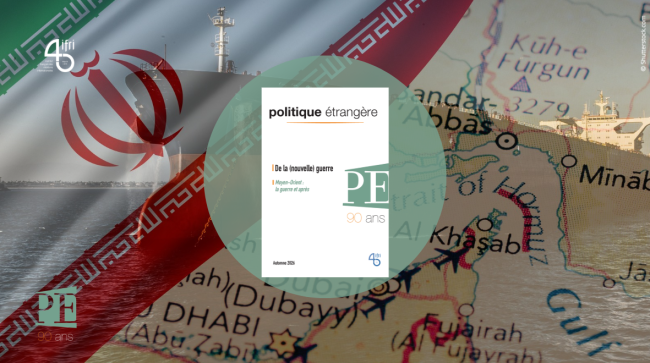
The elimination of Supreme Leader Ali Khamenei and several high-ranking officials at the outset of the 2026 American-Israeli operation did not succeed in bringing down the Iranian regime. The regime had prepared for such a scenario, notably by decentralizing its structures. Moreover, it continues to adapt to war. The power of the Islamic Revolutionary Guard Corps is growing at the expense of the Shiite clergy. The security apparatus defends the country’s sovereignty and justifies its actions in the name of raison d’état.
“Remodeling” the Middle East?
Chaos continues to spread, seemingly without end, across the Middle East. The Israeli-American attack on Iran has resulted in a clear military and diplomatic failure, but it is paving the way for a regional realignment, the consequences of which remain uncertain. New regional groupings are taking shape, either centered around Israel or built on the prospect of coexistence with Tehran, alongside a decline in American influence and the marginalization of Europe, while China maintains a low-key presence.
Silicon Valley and War: Lessons from Ukraine
Over the course of international conflicts, and particularly in Ukraine, major tech companies have emerged as central actors. Initially subject to wartime maneuvering, they have since become decisive actors in their own right, privatizing a significant share of wartime exchanges, shaping the information flows of societies, and presenting themselves as providers of security. This situation raises important questions about states’ autonomy in making decisions and taking action.
Does Artificial Intelligence Change the Nature of War?
From Gaza to Ukraine and Iran, current conflicts are being shaped by the arrival of artificial intelligence and robots on the battlefield. The changes under way are so profound that humans risk rapidly losing control over entire aspects of the conduct of military operations. While these technological developments are altering the character of war, their impact on the very nature of war itself remains a matter of debate.