



Between Concentration and Dispersion: A Promising Future for Power Relations
The notion of power has long been a topic of study in international relations. In the coming decade, the evolution of power will be characterized by the dynamics of concentration and dispersion. On the one hand, the global system will be marked by the clash of two superpowers, the United States and China. On the other hand, capacity for individual action will proliferate through information and communication technologies.
Far from being an absolute, power “is a human relationship”, one conceivable in both theoretical and political terms. Both an analytical concept and a policy principle, power is now understood in all its different forms, and is either celebrated or criticized in the academic on the topic.
We must start from a distinction between power, which presupposes an accumulation of means, and the exercise of power, which demands a will of its own. The former develops, and gains or loses value, over the long term; by contrast, the latter inevitably runs up against the existing order, and consequently has a more short-term character. They must be understood on different time scales: no power is born great. To become great, it must possess a portfolio of (human, moral, and material) resources, bringing these to fruition through projects that vary, not only under the influence of internal and external forces, but in terms of the direction (i.e., the aim) given to them. Their potential is the set of virtually possible reconfigurations. Using this approach, we can define power as “the combination of potential and acting out”.
As an analysis of the topic reminds us, “the factors of power are not the same from century to century”. For instance, the Defence and National Security Strategic Review presented to Emmanuel Macron in October 2017 underscored the fact that military competition has once again raised its head: “The international balance of power is changing rapidly. The uncertainty, the anxiety, or, on the contrary, the new ambitions generated by this unstable situation are all risk factors. Competition, initially economic and technological, is increasingly extending to the military realm”. This way of approaching the topic emphasizes an often forgotten fact: the opposition between economic and diplomatic-strategic conduct. The goal of the former is relatively limited, whereas the second develops “in the shadow of war”. The whole art of politics consists in knowing how to distinguish these in order to better combine them.
Any discussion of power that considers the next ten years must raise the question of hierarchy. In the early 1980s, Fernand Braudel (1902-1985) claimed that “capitalism needs a hierarchy”, and that “capitalism does not invent hierarchies […] it merely uses them” – a very useful claim, if we believe that capitalism will continue to govern economic exchanges. Any discussion about power, then, will be based on a wager over the future course of globalization. Rivalry between nations is one factor among others that will guide globalization. Is it the main one? Perhaps not, given the environmental damage caused by our current modes of consumption. Still, such rivalry is the aspect closest to us, and it is this that I aim to shed light on here. […]
OUTLINE
- China at the top of the global hierarchy
- The chessboard and the Web: the fusion of power
Thomas Gomart is Director of the French Institute of International Relations (Ifri).

Available in:
Regions and themes
Share
This page contains only a summary of our work. If you would like to have access to all the information from our research on the subject, you can download the full version in PDF format.
Between Concentration and Dispersion: A Promising Future for Power Relations

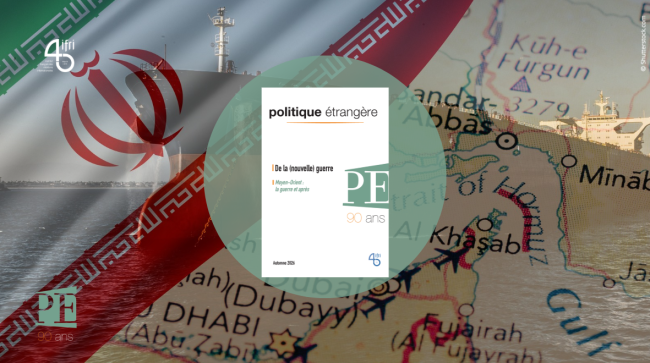
Iran: Anatomy of a Power at War
The elimination of Supreme Leader Ali Khamenei and several high-ranking officials at the outset of the 2026 American-Israeli operation did not succeed in bringing down the Iranian regime. The regime had prepared for such a scenario, notably by decentralizing its structures. Moreover, it continues to adapt to war. The power of the Islamic Revolutionary Guard Corps is growing at the expense of the Shiite clergy. The security apparatus defends the country’s sovereignty and justifies its actions in the name of raison d’état.
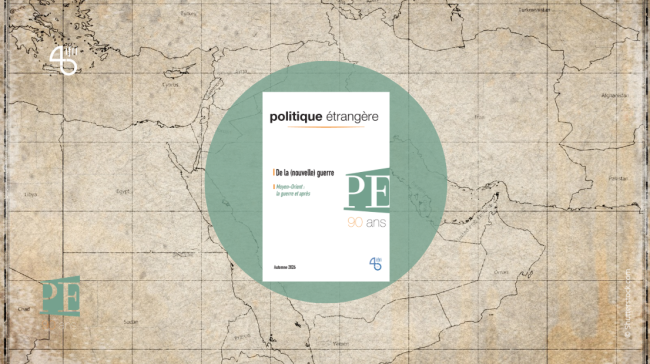
“Remodeling” the Middle East?
Chaos continues to spread, seemingly without end, across the Middle East. The Israeli-American attack on Iran has resulted in a clear military and diplomatic failure, but it is paving the way for a regional realignment, the consequences of which remain uncertain. New regional groupings are taking shape, either centered around Israel or built on the prospect of coexistence with Tehran, alongside a decline in American influence and the marginalization of Europe, while China maintains a low-key presence.
Silicon Valley and War: Lessons from Ukraine
Over the course of international conflicts, and particularly in Ukraine, major tech companies have emerged as central actors. Initially subject to wartime maneuvering, they have since become decisive actors in their own right, privatizing a significant share of wartime exchanges, shaping the information flows of societies, and presenting themselves as providers of security. This situation raises important questions about states’ autonomy in making decisions and taking action.
Does Artificial Intelligence Change the Nature of War?
From Gaza to Ukraine and Iran, current conflicts are being shaped by the arrival of artificial intelligence and robots on the battlefield. The changes under way are so profound that humans risk rapidly losing control over entire aspects of the conduct of military operations. While these technological developments are altering the character of war, their impact on the very nature of war itself remains a matter of debate.