




The Future of Europe in the Context of Sino-American Competition - Conclusions

In this special issue of Politique étrangère devoted to the proceedings of the conference organized by Ifri on April 10, 2019, at the Grand Amphitheater of the Sorbonne, on the occasion of its 40th anniversary, read the speech by Jean-Yves Le Drian, French Minister of Europe and Foreign Affairs.
Since 1979, the international system has experienced major changes that have constituted and still constitute challenges for politicians. Thierry de Montbrial reminded us this morning of everything that separates the world of then from the world of today, a world really far from the hastily announced end of history, marked by the return of geopolitics and new technological changes, which we are just beginning to take full measure of.
Ifri plays a valuable role in helping the government and its officials to decipher and anticipate developments, and it gives us the resources to ask the right questions at the right moment. I welcome the dialog that has been established in recent years between Ifri and the Ministry of Foreign Affairs' Policy Planning Staff. In order to understand that an obvious link unites us – almost a bond of kinship – it is sufficient to recall the founding role played by Thierry de Montbrial in the establishment of what was called in 1974 the Centre for Analysis, Planning and Stategy.
New balances of power
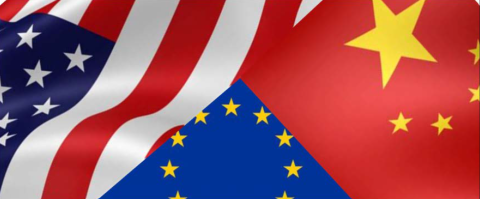
This anniversary is taking place in an atmosphere of forward thinking, by asking ourselves about the future of Europe in the context of Sino-American competition. Less than two months from critical European elections, Europe is at a crossroads – and you give us a vital opportunity to examine some of the main challenges that we face.
The question you raise is one of those that determines the role of the European project and our Union in tomorrow's world. Will this world be dominated by balances of power? Or will it be regulated by law? Will the logics of confrontation finally take precedence over the logics of cooperation? Will their organization help to collectively respond to the major challenges of our time or condemn everyone to powerlessness? At the Sorbonne, where in September 2017 the French President called for Europe to be rebuilt, I would like to tell you what France intends to do to defend the interests of the European Union in the face of the new geopolitical order, and how it wants to give our continent a leading role in the renewal of a multilateral system whose very foundations are now being challenged.
The past few decades have seen China establishing itself as a major and essential actor in international relations. It's an understatement to say that it has developed dramatically – the numbers are well known. Since the country's economic reform and opening-up in 1978, its GDP has grown on average by 9.5% per year. China, which accounted for less than 2% of global GDP in 1978, now produces 15% of global wealth. In four decades, 700 million Chinese have emerged from poverty, and, as a result of this remarkable growth, we can say that China “no longer hides its strength while biding its time”, to use Deng Xiaoping's famous phrase. [...]
Jean-Yves Le Drian is the French Minister of Europe and Foreign Affairs.

Available in:
Themes and regions
Share
This page contains only a summary of our work. If you would like to have access to all the information from our research on the subject, you can download the full version in PDF format.
The Future of Europe in the Context of Sino-American Competition - Conclusions

Iran: Anatomy of a Power at War
The elimination of Supreme Leader Ali Khamenei and several high-ranking officials at the outset of the 2026 American-Israeli operation did not succeed in bringing down the Iranian regime. The regime had prepared for such a scenario, notably by decentralizing its structures. Moreover, it continues to adapt to war. The power of the Islamic Revolutionary Guard Corps is growing at the expense of the Shiite clergy. The security apparatus defends the country’s sovereignty and justifies its actions in the name of raison d’état.

“Remodeling” the Middle East?
Chaos continues to spread, seemingly without end, across the Middle East. The Israeli-American attack on Iran has resulted in a clear military and diplomatic failure, but it is paving the way for a regional realignment, the consequences of which remain uncertain. New regional groupings are taking shape, either centered around Israel or built on the prospect of coexistence with Tehran, alongside a decline in American influence and the marginalization of Europe, while China maintains a low-key presence.
Silicon Valley and War: Lessons from Ukraine
Over the course of international conflicts, and particularly in Ukraine, major tech companies have emerged as central actors. Initially subject to wartime maneuvering, they have since become decisive actors in their own right, privatizing a significant share of wartime exchanges, shaping the information flows of societies, and presenting themselves as providers of security. This situation raises important questions about states’ autonomy in making decisions and taking action.
Does Artificial Intelligence Change the Nature of War?
From Gaza to Ukraine and Iran, current conflicts are being shaped by the arrival of artificial intelligence and robots on the battlefield. The changes under way are so profound that humans risk rapidly losing control over entire aspects of the conduct of military operations. While these technological developments are altering the character of war, their impact on the very nature of war itself remains a matter of debate.