





The Future of Europe from the US and Asian Point of View

In this special issue of Politique étrangère devoted to the proceedings of the conference organized by Ifri on April 10, 2019, in the Grand Amphitheater of the Sorbonne, on the occasion of its fortieth anniversary, discover the debate moderated by Sylvie Kauffmann between John Allen and Kishore Mahbubani.

Sylvie Kauffmann
This panel is about the future of Europe seen from the US and Asia. I will say a few words about how we in Europe see the US and China. We see these two giants as two rival superpowers engaging in a new great power conflict. There is an even darker image, which is that some member states of the EU are being used as pawns in this competition, which could destroy the whole international order on which the EU is based. Listening to the previous panels, everyone loves the EU, but somehow, they all try to divide us – maybe they would like to have several EUs.
Kishore Mahbubani is from Singapore and is probably the most famous Singaporean diplomat. John Allen does not necessarily agree with every decision the US President makes. However, both are astute observers and practitioners in security issues and diplomacy, and we are eager to hear your views on the EU from Asia and the US. Each will make short preliminary remarks, and then we will engage in a discussion about this very interesting topic.
View from the US
John Allen
Ifri is a towering think tank in the world, and one for which Brookings has great respect. It is great to be back in France, and I have great affection for its military, with which I have served on many occasions.
About EU
The Brookings Institution talks about the US relationship with China as probably being the consequential relationship for the US in the 21st century. The relationship with India is probably the indispensable relationship. We have to reconcile the relationship with Russia; it is an adversarial and hostile one now, and we will have to find a way forward with that. However, it is clear that the essential relationship for the US going forward is the relationship with Europe – the transatlantic relationship and alliance.
Therefore, we are concerned about the health of the EU at any given time, and recognize the battering it has taken as a result not just of US policy but also of Brexit, which has had an effect on the morale of the institution. However, we hope the institution comes through intact and sound. […]
John Allen is President of the Brookings Institution.
Kishore Mahbubani is Senior Advisor in the Practice of Public Policy, National University, Singapore.
Sylvie Kauffmann is Editorial Director, Le Monde.

Available in:
Themes and regions
Share
This page contains only a summary of our work. If you would like to have access to all the information from our research on the subject, you can download the full version in PDF format.
The Future of Europe from the US and Asian Point of View

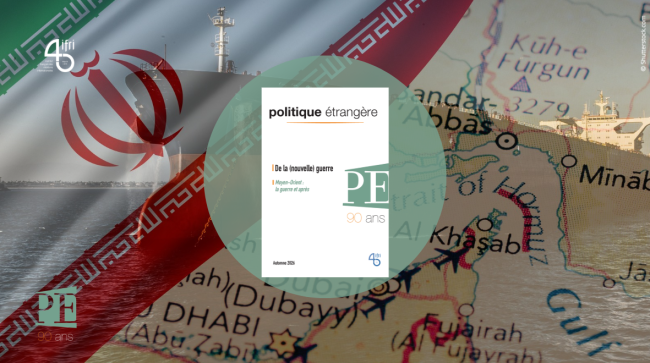
Iran: Anatomy of a Power at War
The elimination of Supreme Leader Ali Khamenei and several high-ranking officials at the outset of the 2026 American-Israeli operation did not succeed in bringing down the Iranian regime. The regime had prepared for such a scenario, notably by decentralizing its structures. Moreover, it continues to adapt to war. The power of the Islamic Revolutionary Guard Corps is growing at the expense of the Shiite clergy. The security apparatus defends the country’s sovereignty and justifies its actions in the name of raison d’état.

“Remodeling” the Middle East?
Chaos continues to spread, seemingly without end, across the Middle East. The Israeli-American attack on Iran has resulted in a clear military and diplomatic failure, but it is paving the way for a regional realignment, the consequences of which remain uncertain. New regional groupings are taking shape, either centered around Israel or built on the prospect of coexistence with Tehran, alongside a decline in American influence and the marginalization of Europe, while China maintains a low-key presence.

Silicon Valley and War: Lessons from Ukraine
Over the course of international conflicts, and particularly in Ukraine, major tech companies have emerged as central actors. Initially subject to wartime maneuvering, they have since become decisive actors in their own right, privatizing a significant share of wartime exchanges, shaping the information flows of societies, and presenting themselves as providers of security. This situation raises important questions about states’ autonomy in making decisions and taking action.

Does Artificial Intelligence Change the Nature of War?
From Gaza to Ukraine and Iran, current conflicts are being shaped by the arrival of artificial intelligence and robots on the battlefield. The changes under way are so profound that humans risk rapidly losing control over entire aspects of the conduct of military operations. While these technological developments are altering the character of war, their impact on the very nature of war itself remains a matter of debate.