



Towards a Security Web
There is no global mechanism that can guarantee security effectively in the face of the growing threat of political chaos, stemming from the recent political awakening of humanity. There is no global mechanism that can guarantee security effectively in the face of the growing threat of political chaos, stemming from the recent political awakening of humanity.

In assessing NATO’s evolving role, one has to take into account the historical fact that, in the course of its 60 years, the Alliance has institutionalized three truly monumental transformations in world affairs: first, the end of the centuries-long ‘civil war’ within the West for transoceanic and European supremacy; second, the United States’ post–Second World War commitment to the defense of Europe against Soviet domination (resulting from either a political upheaval or even a third world war); and third, the peaceful termination of the Cold War, which ended the geopolitical division of Europe and created the preconditions for a larger democratic European Union.
These successes, however, give rise to a legitimate question: What next? Given the current and likely future, the coming new Strategic Concept will have to deal with at least four fundamental challenges: first, how to attain a politically acceptable outcome for NATO’s deepening engagement in the overlapping Afghan and Pakistani conflicts; second, how to update the meaning and obligations of “collective security” as embodied in Article 5 of the Alliance’s treaty; third, how to engage Russia in a binding and mutually beneficial relationship with Europe and the wider North Atlantic community; and fourth, how to respond to novel global security dilemmas.
Uniting the West
For the last 500 years, world politics has been dominated by states located on the shores of the North Atlantic. As these states competed with one another for treasure and power, they in effect established the North Atlantic region’s worldwide imperial supremacy. But that supremacy was not stable. It was periodically undermined by violent rivalries among the North Atlantic states themselves. In changing combinations, Portugal, Spain, France, the Netherlands, and the United Kingdom competed, fought, and replaced one another as the pre-eminent overseas imperial power.
Over the course of the last two centuries, the global hierarchy changed dramatically even as the scope of the rivalry expanded, under Napoleon’s France, from oceanic control to domination over Europe as well. Napoleon’s challenge further transformed the geopolitics of the North Atlantic rivalry by precipitating the entry of two non-Atlantic powers – central European Prussia (which later became Germany) and Eurasian Russia (later the Soviet Union) – into the competition for the first time. A century later, the First World War, which in fact was largely a European war, drew in the United States from across the Atlantic. […]
Outline
- Uniting the West
- Enlarging the West
- Adjusting to a transformed world
- Sustaining Alliance credibility
- Reaffirming collective security
- Engaging Russia
- Reaching out to Asia
- The center of the web
Zbigniew Brzezinski is Advisor to the Center for Strategic and International Studies, and was President Jimmy Carter's National Security Advisor from 1977 to 1981. His most recent book is Strategic Vision: America and the Crisis of Global Power (Basic Books, 2012).

Available in:
Share
This page contains only a summary of our work. If you would like to have access to all the information from our research on the subject, you can download the full version in PDF format.
Towards a Security Web

Iran: Anatomy of a Power at War
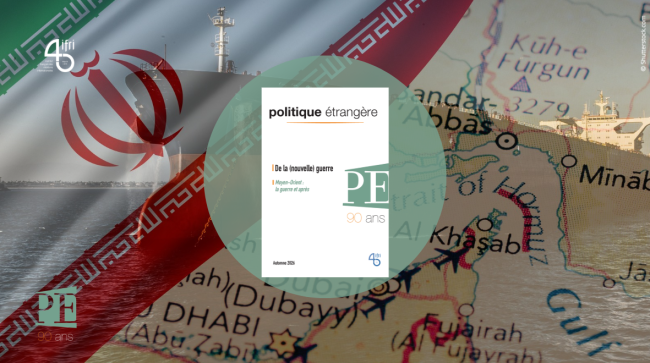
The elimination of Supreme Leader Ali Khamenei and several high-ranking officials at the outset of the 2026 American-Israeli operation did not succeed in bringing down the Iranian regime. The regime had prepared for such a scenario, notably by decentralizing its structures. Moreover, it continues to adapt to war. The power of the Islamic Revolutionary Guard Corps is growing at the expense of the Shiite clergy. The security apparatus defends the country’s sovereignty and justifies its actions in the name of raison d’état.
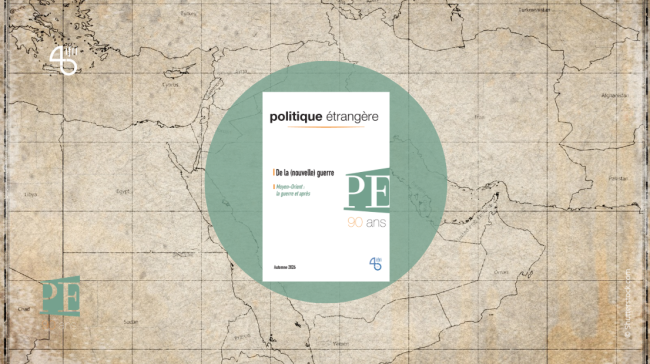
“Remodeling” the Middle East?
Chaos continues to spread, seemingly without end, across the Middle East. The Israeli-American attack on Iran has resulted in a clear military and diplomatic failure, but it is paving the way for a regional realignment, the consequences of which remain uncertain. New regional groupings are taking shape, either centered around Israel or built on the prospect of coexistence with Tehran, alongside a decline in American influence and the marginalization of Europe, while China maintains a low-key presence.

Silicon Valley and War: Lessons from Ukraine
Over the course of international conflicts, and particularly in Ukraine, major tech companies have emerged as central actors. Initially subject to wartime maneuvering, they have since become decisive actors in their own right, privatizing a significant share of wartime exchanges, shaping the information flows of societies, and presenting themselves as providers of security. This situation raises important questions about states’ autonomy in making decisions and taking action.

Does Artificial Intelligence Change the Nature of War?
From Gaza to Ukraine and Iran, current conflicts are being shaped by the arrival of artificial intelligence and robots on the battlefield. The changes under way are so profound that humans risk rapidly losing control over entire aspects of the conduct of military operations. While these technological developments are altering the character of war, their impact on the very nature of war itself remains a matter of debate.