


What Can Europe Hope to Achieve in Tomorrow's World?

In this special issue of Politique étrangère devoted to the proceedings of the conference organized by Ifri on April 10, 2019, in the Grand Amphitheater of the Sorbonne, on the occasion of its fortieth anniversary, discover the debate moderated by Christine Ockrent between Franziska Brantner, Jean-Louis Boulanges, Bernardino Leon, and Igor Yurgens.
Christine Ockrent
Thank you for being so many in this splendid place and for listening so attentively to the Minister of Economy, and the Executive Chairman and founder of Ifri. Thierry de Montbrial has encouraged us to undertake psychoanalysis as it were, but it seems to me that, after the rather optimistic and dynamic picture painted by Bruno Le Maire, and the rather dark picture painted by Thierry de Montbrial, we can congratulate Ifri once again for having chosen to celebrate its fortieth anniversary in the aftermath of a summit that brought China and the European Union together in Brussels. Today, a summit of heads of state and government is also opening, which has to decide, or not, on a new timetable for the endless chaos of Brexit. The coincidence of the two events leads us to think about what Europe is today, Euro-power. We are going to talk about Europower, because it is a major economic and commercial entity; but we could also talk about a weakened Europe, weakened from within by its doubts, its identity problem, its inward-looking attitudes, as well as by destabilization attempts by neighbors who are not always benevolent and also about this often cowardly Europe that we all regret, which seems indecisive, so unsure of its ability to make its mark on history.
I would like to start by asking Franziska to give us her reaction to the speeches of this morning, and how, as a Bundestag member and a young politician of the future, she sees this Europe.
What is the purpose of Europe?
Franziska Brantner
I share Thierry de Montbrial's and the Minister's assessments on the choice the Europeans have to make today. Do we want to remain at the center of a pingpong process between the Americans and the Chinese, or do we want to define our own future? The question applies to all areas, and I am thinking specifically about the topic of digitalization: we have hardly talked about it, but it is very important. Do we accept the idea of US or Chinese digitalization, of private or state monopoly, with the risk of total censorship, or of a private monopoly that defines what we have the right to do or not? For example, at the moment, there is a big debate in Germany about the issue of 5G: do we want to retain European ability to control the infrastructure of the economy of the future, or do we decide to hand everything over to the Chinese? […]
Franziska Brantner is a Bundestag member.
Jean-Louis Bourlanges is a member of the National Assembly and Vice-Chair of the European Affairs Committee.
Bernardino Leon, a former EU Special Representative for the Southern Mediterranean, is Director General of the Emirates Diplomatic Academy.
Igor Jurgens is Chair of the Institute of Contemporary Development (Russian Federation).
Christine Ockrent is a journalist and a writer.

Available in:
Themes and regions
Share
Download the full analysis
This page contains only a summary of our work. If you would like to have access to all the information from our research on the subject, you can download the full version in PDF format.
What Can Europe Hope to Achieve in Tomorrow's World?

Author(s)
Find out more
Discover all our analyses
Digital Revolution, Economic Upheaval
The digital revolution is profoundly shaking up the economy, with the impact felt well beyond the digital sector itself. Indeed, it is transforming the very concept of value creation. Artificial intelligence represents a new phase that requires a colossal investment in physical infrastructure like data centers. Europe failed to grasp the scale of these changes in time, but it does have certain advantages.
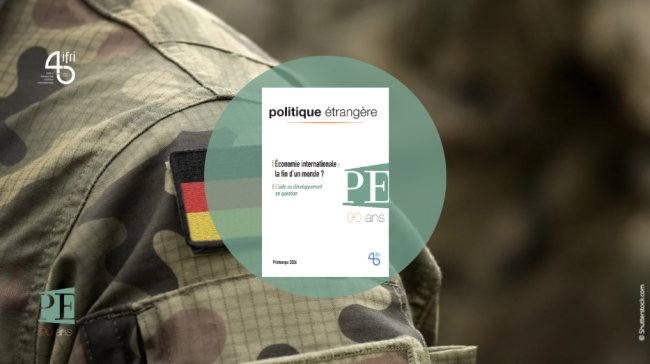
Germany: The Return of Military Service?
Abolished in 2011, conscription returned to Germany in 2025, albeit in a new, voluntary form. The decision in 2011 was broadly supported. Public opinion, like the political sphere, is more divided now. The reintroduction of voluntary service for men reflects the demands of the geopolitical landscape and the Bundeswehr’s need for troops. It remains to be seen whether the model chosen will fulfill the requirements of defense chiefs.
Foreword
In this special issue of Politique étrangère devoted to the proceedings of the conference organized by Ifri on April 10, 2019, in the Grand Amphitheater of the Sorbonne, on the occasion of its fortieth anniversary, read the foreword by Thierry de Montbrial, founder and president of Ifri.
Europe and Africa
In this special issue of Politique étrangère devoted to the proceedings of the conference organized by Ifri on April 10, 2019, in the Grand Amphitheater of the Sorbonne, on the occasion of its fortieth anniversary, discover the conversation between Louise Mushikiwabo, Secretary General of La Francophonie and Thierrry de Montbrial, Founder and Executive Chairman of Ifri.