



1936-2026: 90th Anniversary of the Journal "Politique étrangère"
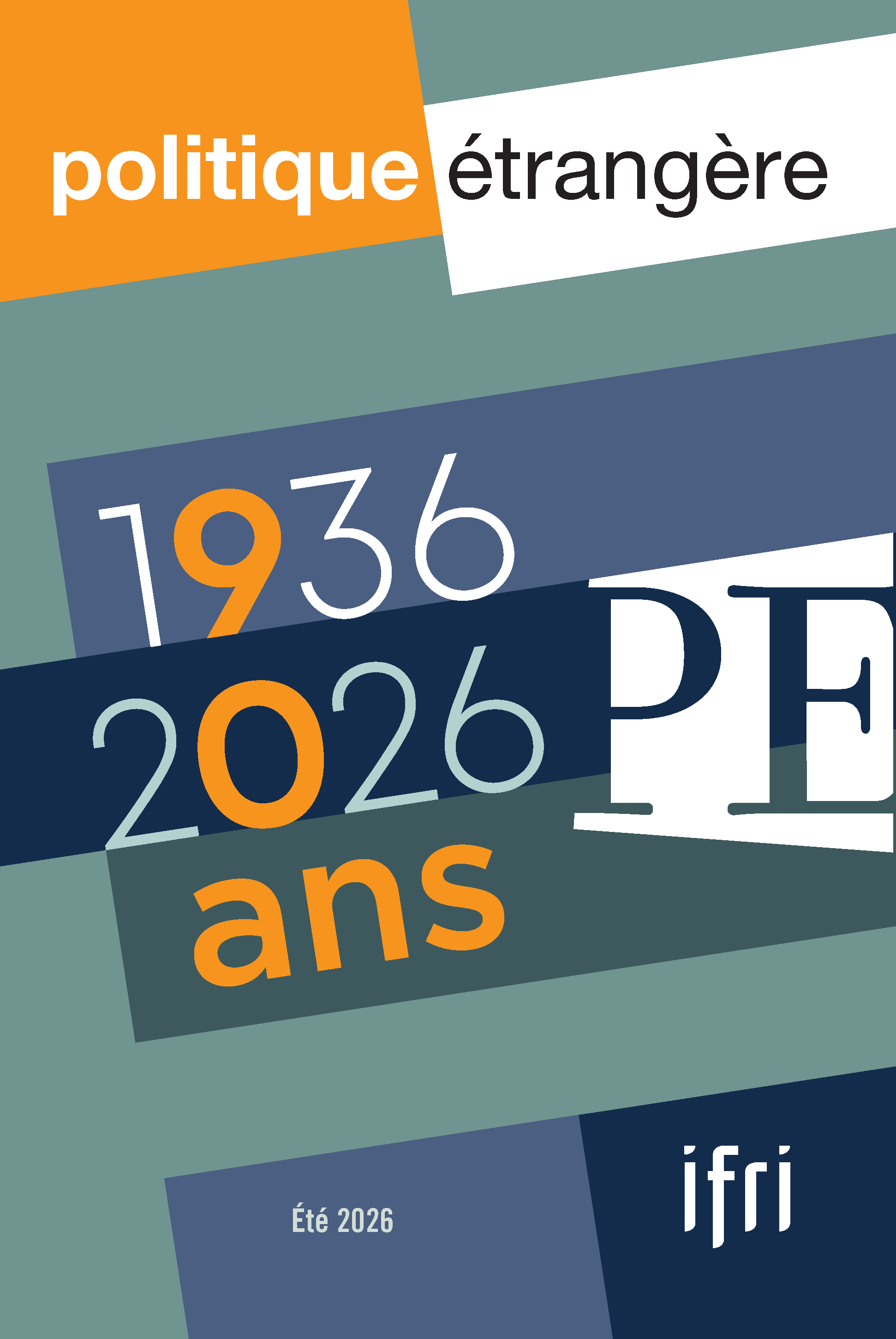
Founded in 1936 and published by the French Institute of International Relations (Ifri), Politique étrangère, France’s longest-running journal of international relations, is set to publish a special issue in early June 2026. Bringing together distinguished French and international contributors, this issue aims to provide an overview of an uncertain world and its possible futures. In an unprecedented undertaking, Politique étrangère brings together a wide range of international contributions in an effort to grasp a global landscape that is at once open and fragmented, in all its diversity and dynamism. Through in-depth analyses of cross-cutting challenges, reflections on methods and structures of governance, and projections into futures feared or envisioned by creators from around the world—ranging from alternative histories to speculative thought experiments—the various approaches complement and challenge one another, opening up broad avenues for reflection.
[Excerpt] There are spirited nonagenarians… Out of respect, we won’t describe Politique étrangère that way: yet there it is, more vibrant than ever, observing and deciphering our worlds.
She has seen many worlds come and go. From the 1930s of the 20th century, with open or looming conflicts, nascent upheavals in the South, and plans for European alliances, to the threshold of the 2020s, marked by parallel, comparable obsessions: the war that is coming or is already here, the shifting balance of power, a Europe uncertain of itself, a Middle East still ablaze...
Same obsessions, same observers, same powerlessness? Undoubtedly, in that the tools wielded on the international stage have not fundamentally changed—the resources of human ingenuity: strength, wealth, cunning, diplomacy, and provisional agreements… Yes, again, because international problems are rarely resolved: they ultimately depend on human factors that, naturally, die and change. And yet no, because similar problems manifest differently as their environment and the broader contexts surrounding them change.
It is the task of Politique étrangère to bring these two levels of knowledge together: the enduring nature of international challenges and their transformations in response to changes in human societies. [...] - Dominique David, chief editor of Politique étrangère.
TABLE OF CONTENTS
Editorial, by Dominique David (read it in French here)
LIVING IN THE FUTURE WORLD
The foundations (demography, food, health, etc.) and the frameworks (technological dynamics, faith and beliefs, etc.) of international coexistence in a time of profound transformation.
World Population in the Twenty-First Century, by Hervé Le Bras
Food Security: How Can The World Population Be Fed?, by Akiko Suwa-Eisenmann
From African Health Sovereignty to Global Health Security, by Jean Kaseya
Energy in the Era of the New Geopolitics, by Laura Cozzi and Thomas Spencer
How Technology Is Reshaping the World Order, by Anu Bradford (read it in French here)
Religion, Moral Order, and the Resacralization of International Politics, by Peter Mandaville
GOVERNING THE FUTURE WORLD
How to reconcile interests and strategies: the weight of power, the role of law, the impact of inequalities, the regulation of trade, the management of armed conflict, and the role of Europe.
A New Path for Europe, by Thierry de Montbrial (read it in French here)
Reflections on A Darkening World, by Jean-Marie Guéhenno (read it in French here)
Law and International Order, by Philippa Webb and Daisy Peterson
The Crises Testing Arms Control, by Patricia M. Lewis
War and Technology: An Approaching Military Revolution?, by Hew Strachan
Governing World Trade: Plutus, Midas, or Agnostos Theos?, by Jean-Marie Paugam
Governability, Inequality, and the Welfare State, by Anton Hemerijck and Waltraud Schelkle
Finance and the World: A European Perspective, by Sylvie Goulard
DREAMS OF A FUTURE WORLD
Beyond political and diplomatic strategies, what can creators—writers from all backgrounds and all continents—through their inventiveness and humor— tell us about the future of the world? From the narrowest communities to the broadest horizons?
The Jungle, by Tash Aw
A Time Capsule: Future Experiences in Russia, by Mikhaïl Shishkin (read it in French here)
Address by the 48th President of the United States of America, Davos, January 25, 2029, by Philippe Claudel
Intimate Cartographies, by Velibor Čolić
A Hundred Years of Uncertainty, by David Diop
The Tshakapesh School, by Naomi Fontaine
The Future Has Arrived, by Leila Guerriero
A Small Valley, by Charif Majdalani
The Year He Woke, by Vikas Swarup
This issue is available in French only: Politique étrangère, vol. 91, n° 2, 2026.
Find all issues and articles of Politique étrangère here: https://www.ifri.org/fr/revue-politique-etrangere
This page contains only a summary of our work. If you would like to have access to all the information from our research on the subject, you can download the full version in PDF format.
1936-2026: 90th Anniversary of the Journal "Politique étrangère"

Iran: Anatomy of a Power at War
The elimination of Supreme Leader Ali Khamenei and several high-ranking officials at the outset of the 2026 American-Israeli operation did not succeed in bringing down the Iranian regime. The regime had prepared for such a scenario, notably by decentralizing its structures. Moreover, it continues to adapt to war. The power of the Islamic Revolutionary Guard Corps is growing at the expense of the Shiite clergy. The security apparatus defends the country’s sovereignty and justifies its actions in the name of raison d’état.
“Remodeling” the Middle East?
Chaos continues to spread, seemingly without end, across the Middle East. The Israeli-American attack on Iran has resulted in a clear military and diplomatic failure, but it is paving the way for a regional realignment, the consequences of which remain uncertain. New regional groupings are taking shape, either centered around Israel or built on the prospect of coexistence with Tehran, alongside a decline in American influence and the marginalization of Europe, while China maintains a low-key presence.
Silicon Valley and War: Lessons from Ukraine
Over the course of international conflicts, and particularly in Ukraine, major tech companies have emerged as central actors. Initially subject to wartime maneuvering, they have since become decisive actors in their own right, privatizing a significant share of wartime exchanges, shaping the information flows of societies, and presenting themselves as providers of security. This situation raises important questions about states’ autonomy in making decisions and taking action.
Does Artificial Intelligence Change the Nature of War?
From Gaza to Ukraine and Iran, current conflicts are being shaped by the arrival of artificial intelligence and robots on the battlefield. The changes under way are so profound that humans risk rapidly losing control over entire aspects of the conduct of military operations. While these technological developments are altering the character of war, their impact on the very nature of war itself remains a matter of debate.