




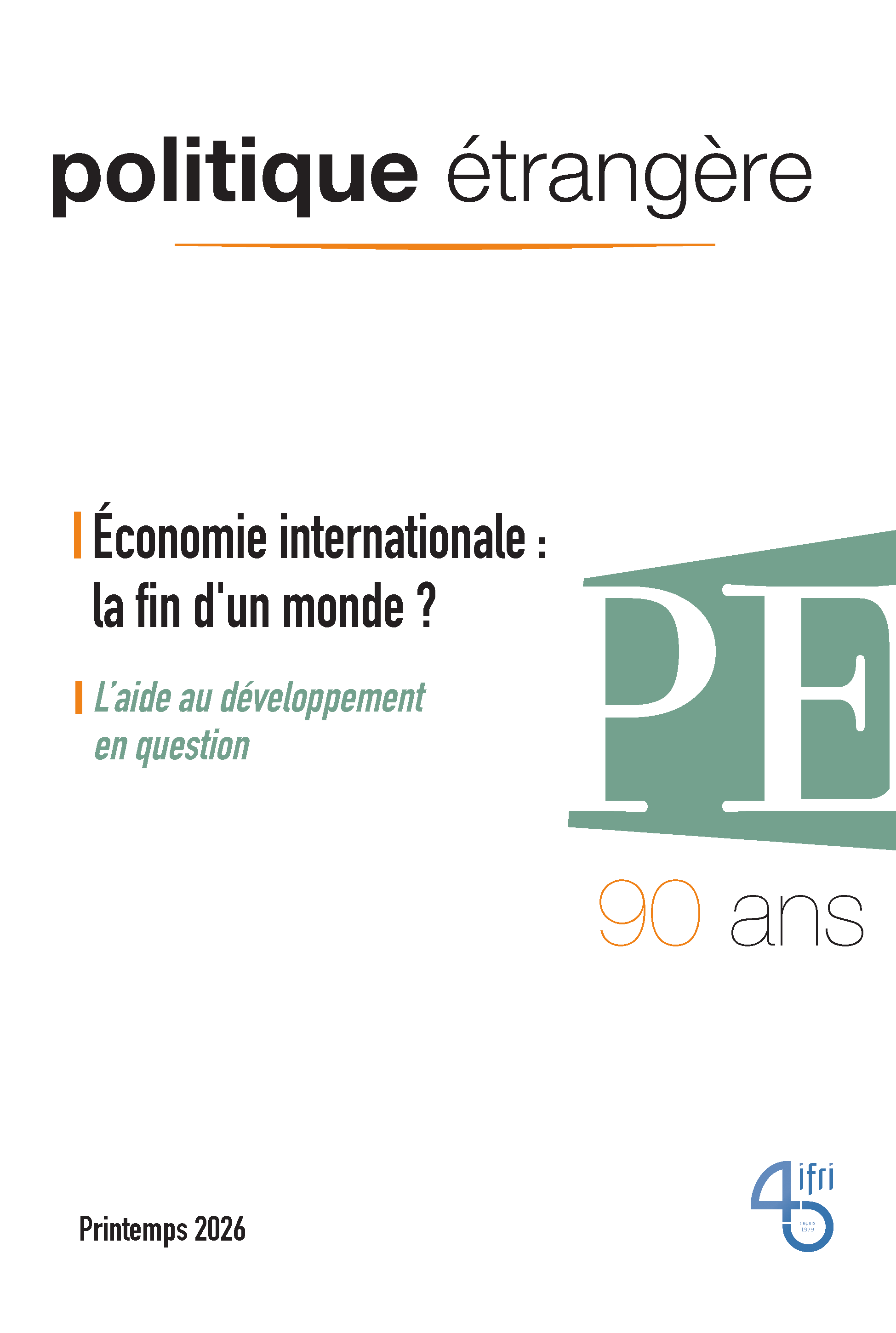
The Global Economy: Caught in the Storm / Politique étrangère, Vol. 91, No. 1, 2026
The global economy has become the primary arena for the clash of power ambitions in a world where understanding, coordination, and concerted multilateralism seem to have been permanently marginalized. In this fragmented landscape, how will American and Chinese strategies interact? Will the European Union manage to break out of its decades-old framework in order to face new competition? And will it be able, like others, to integrate the announced shift from a production economy to a digital, information economy? And what role will financial institutions, and central banks in particular, play in this transitioning international economy?

The pressing challenges of the present day should not, however, cause us to forget some decisive markers. What does the widespread reduction in development aid tell us about our conception of North/South economic relations? Beyond the daily political debates, are we fully grasping the scale of the problems posed by large-scale migratory movements, which, incidentally, do not primarily concern Europe? Half a decade after Covid-19, have we made any progress in developing measures to combat infectious diseases? In Africa, the Middle East, and Ukraine: what lessons can we learn from the latest armed conflicts to help us shape the world of tomorrow?
This issue is available in French only: Économie internationale: la fin d'un monde ?
THE GLOBAL ECONOMY: CAUGHT IN THE STORM
The Global Economy in the Face of Geopolitical Upheaval, by Norbert Gaillard
From Trump to Xi Jinping: Globalization's Great Rupture, by Sébastien Jean
The European Union: A Lagging Economy and a Software Update, by Sébastien Maillard
Digital Revolution, Economic Upheaval, by Hugo Le Picard
What Can Central Banks Do?, by Christian de Boissieu
CURRENT AFFAIRS
Official Development Assistance in the Age of Deglobalization, by Jean-Michel Severino
Migration: The European Union's Dilemma, by Didier Leschi
India-United States Relations under Threat from Trump II, by Jean-Luc Racine
Germany: The Return of Military Service?, by Paul Maurice
BAROMETERS
Sudan in Search of an Unlikely Peace, by Roland Marchal
Israel and the New Middle East: Between Normalization, Deterrence and Messianism, by Jean-Loup Samaan
Ten Years On: Brexit Up for Debate, by Marie-Claire Considère-Charon
REFLECTIONS
Why Russia Wages War, by Bernard Chappedelaine
The Sahel: The Operational Legacy of Barkhane, by Tewfik Hamel
Eradicating Infectious Diseases: A Multilateral Utopia, by Antoine Flahault, Johanna Elbel and Agnès Buzyn
BOOK REVIEWS
Editor: Marc Hecker
Climat. Les énergies de l'espoir, by Cédric Philibert
From Crisis to Action: Climate Change Through the Eyes of the Most Vulnerable, by Abena Takyiwaa Asamoah-Okyere, Christina Natalia Widjaja and Tim Smedley
Économie de l'(in)action climatique, by Christian Gollier
Reviewed by Christian de Perthuis
248 pages. 23 euros.
March 5th, 2026.
Diffusion : Pollen/Dif'Pop.
Subscription: Armand Colin.
To buy an issue: leslibraires.fr.
To buy the Epub (in French): Immatériel.fr.
Have a look on Politique étrangère's blog: Politique étrangère.

Available in:
Themes and regions
ISBN / ISSN
Share
Iran: Anatomy of a Power at War
The elimination of Supreme Leader Ali Khamenei and several high-ranking officials at the outset of the 2026 American-Israeli operation did not succeed in bringing down the Iranian regime. The regime had prepared for such a scenario, notably by decentralizing its structures. Moreover, it continues to adapt to war. The power of the Islamic Revolutionary Guard Corps is growing at the expense of the Shiite clergy. The security apparatus defends the country’s sovereignty and justifies its actions in the name of raison d’état.
“Remodeling” the Middle East?
Chaos continues to spread, seemingly without end, across the Middle East. The Israeli-American attack on Iran has resulted in a clear military and diplomatic failure, but it is paving the way for a regional realignment, the consequences of which remain uncertain. New regional groupings are taking shape, either centered around Israel or built on the prospect of coexistence with Tehran, alongside a decline in American influence and the marginalization of Europe, while China maintains a low-key presence.
Silicon Valley and War: Lessons from Ukraine
Over the course of international conflicts, and particularly in Ukraine, major tech companies have emerged as central actors. Initially subject to wartime maneuvering, they have since become decisive actors in their own right, privatizing a significant share of wartime exchanges, shaping the information flows of societies, and presenting themselves as providers of security. This situation raises important questions about states’ autonomy in making decisions and taking action.
Does Artificial Intelligence Change the Nature of War?
From Gaza to Ukraine and Iran, current conflicts are being shaped by the arrival of artificial intelligence and robots on the battlefield. The changes under way are so profound that humans risk rapidly losing control over entire aspects of the conduct of military operations. While these technological developments are altering the character of war, their impact on the very nature of war itself remains a matter of debate.