Europe Express: Macron and Merz move on from fighter jet heartbreak
The threat of a Le Pen presidency has provided an incentive for Paris and Berlin to come together.
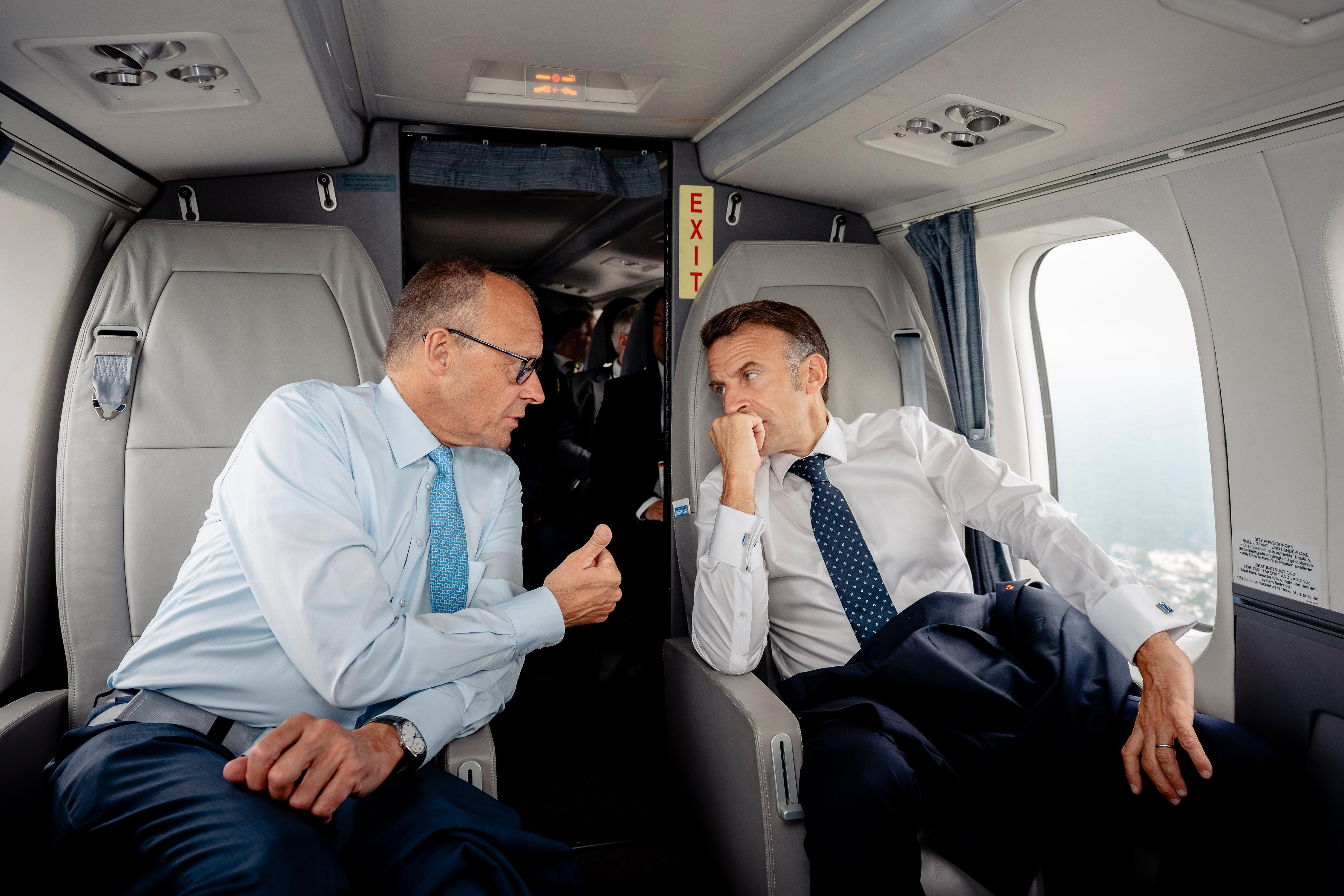
German Chancellor Friedrich Merz and French President Emmanuel Macron met in the Rhine Valley last week to try and repair relations after the acrimonious collapse of their flagship fighter jet project.
FCAS is likely to serve as a cautionary tale, prompting Paris and Berlin to pursue smaller, more clearly defined forms of co-operation, according to Paul Maurice at the French Institute of International Relations. Such an approach would better suit Germany’s growing defence ambitions. “2017 — the era of the big speeches, the grand visions — is over,” Maurice said. “The world has completely changed.”
[...]
Texte citation
“It’s gradual, but we can see that Germany is starting to shift on the issue of European measures in the face of Chinese industry and its subsidies,” Maurice said.

Secretary General of the Study Committee on Franco-German Relations (Cerfa), Ifri
[...]
The possible victory of Marine Le Pen in next year’s French presidential elections hung over the discussions. “It’s the elephant in the room,” Maurice said.
Macron insisted his offer to associate Germany more closely with France’s nuclear doctrine had no financial implication for Berlin.
“The goal is to improve the continent’s security deterrence by fuelling even more uncertainty in our adversaries,” he said.
[...]
- Read the article on the website of Financial Times. (For subscribers only).
>> >> Read the joint publication by The Cerfa/Security Studies Center of Johanna Möhring "Bundeswehr: From Zeitenwende (historic turning point) to Epochenbruch (epochal shift)". Ifri Papers, Notes du Cerfa, No. 189, February 2026.

Media:

Reporter(s):
Format
Share
Authors
Paul MAURICE
Secretary General of the Study Committee on Franco-German Relations (Cerfa), Ifri