France and Germany seek to showcase military cooperation after FCAS collapse
President Emmanuel Macron and Chancellor Friedrich Merz were to hold a joint defense council and the traditional French-German Council of Ministers on Friday in North Rhine-Westphalia.
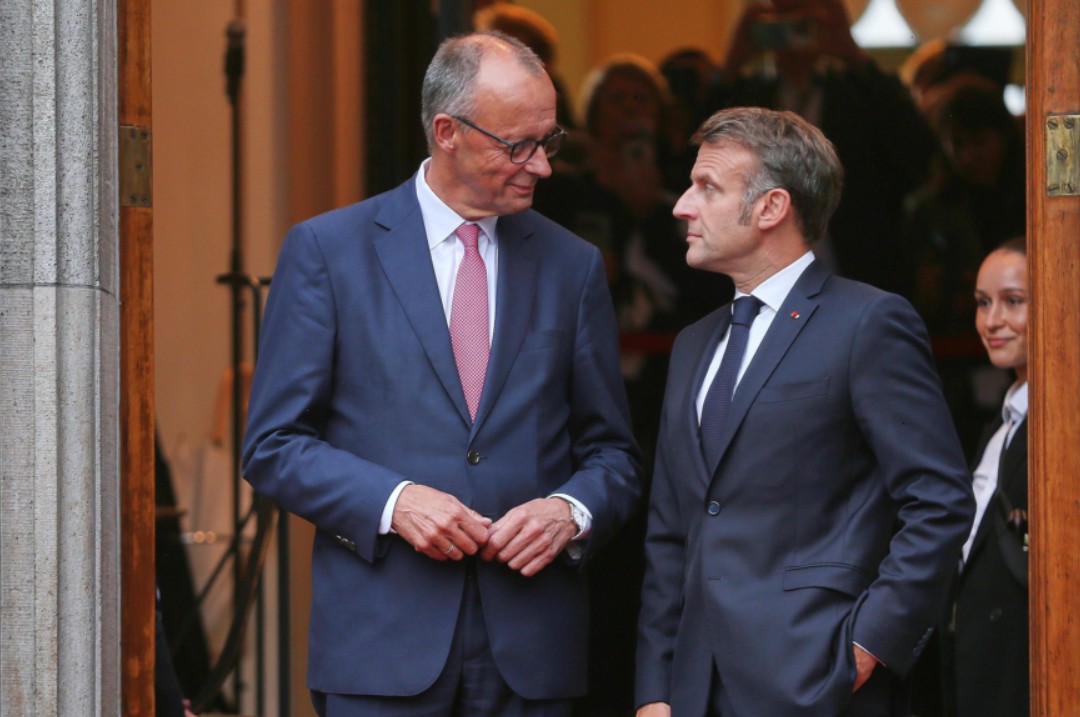
The two leaders walked through the gates of Bensberg Castle side by side, maintaining the measured pace of a long-standing partnership that could weather temporary disagreements. In the small German town in North Rhine-Westphalia, where they dined one-on-one Thursday, July 16, before presiding the following day in Brühl, near Cologne, over a joint defense council and then the traditional French-German Council of Ministers, President Emmanuel Macron and Chancellor Friedrich Merz aimed to clear up months of misunderstanding to, as the Elysée put it, “reinvigorate” the relationship between the two countries. “We have no time to lose,” urged a German diplomat, noting that this would be the French president's last Franco-German council before the presidential election scheduled for next spring.
The return of war to Europe made building a European defense a top priority, in both Paris and Berlin. The presence of German troops among the “coalition of the willing” supporting Ukraine in the July 14 military parade on the Champs-Elysées was a first gesture. It was an example, Macron said from Bensberg, of “a powerful Europe that combines our strengths.”
[...]
Germany, staunchly Atlanticist since 1949, made a dramatic shift in recent months, distancing itself from Washington and investing heavily in its armed forces. With the historic debt brake lifted, Merz declared in February that he aimed to make the Bundeswehr “Europe's most powerful conventional army.” Yet, beyond reviving ghosts of the past, this clumsily worded statement – which, according to a German diplomat, was intended to challenge Putin – caused concern in several European capitals, including Paris. Germany was no longer pursuing a European project, but instead going it alone, favoring its own defense industry at a time when its economy was struggling.
'Germany First'
[...]
Texte citation
“The German logic is 'Germany First': Since our allies are no longer reliable, we will determine for ourselves how to defend the country while pursuing our own interests. That can include alliances with the French, notably on advanced nuclear deterrence [proposed by Macron in March], but also agreements with the Americans on defense industry issues,” analyzed Paul Maurice, secretary general of the Study Committee on Franco-German Relations (Cerfa) at the French Institute of International Relations (IFRI).

Secretary General of the Study Committee on Franco-German Relations (Cerfa), Ifri
[...]
>>> >>> Read the full article in Le Monde (subscribers only)

Media:
Reporter(s):
Share
Authors
Paul MAURICE
Secretary General of the Study Committee on Franco-German Relations (Cerfa), Ifri