



Between political crisis and European recovery attempt: German interrogations
Even though the CDU-CSU led Grand Coalition was renewed following the German legislative elections of 24 September 2017, and even though Angela Merkel was re-elected chancellor a fourth consecutive term, the country has entered a period of growing political uncertainty. The formation of a new government took much longer than after previous elections for a number of different reasons: after negotiations, the liberal party refused to join a coalition with the CDU-CSU and the Green party, the SPD was reluctant to continue in government, and, above all, the internal divisions of the two sister parties CDU et CSU, that nearly caused the fall of the new government three months after its investiture.
These recurrent crises are due to the strengthening of the national-populist party AfD that became Germany’s third party, to the reorientation of the liberal party, but also and in particular to the erosion of traditional parties that are reflecting upon their own ideological profile. The union of CDU-CSU is torn between opposing political trends while the SPD, whose crisis falls within the decline of European socialist parties, is fighting for survival.
In this context, Germany is focusing on internal political and public issues rather than on major European issues that divide the governing parties. Currently, there is no majority in favour of wide-ranging European reforms in Germany. Due to a lack of internal consensus, Berlin will therefore in the coming months not be able to take up, together with France, a leading role in the European integration.
Since 1991, Hans Stark has been General Secretary of the Committee for Studies of Franco-German Relations (Cerfa) at the French Institute of International Relations (Ifri), where his main interests are German foreign politics and German European politics.
This contents is available in french only: Entre crise politique et tentative de relance européenne : interrogations allemandes.


Hans STARK
Advisor, Study Committee on French-German Relations (Cerfa), Ifri


The Study Committee on Franco-German Relations (Cerfa)
The Study Committee on Franco-German Relations (Cerfa) was created in 1954 by an inter-governmental agreement between the Federal Republic of Germany and France, in order to raise awareness of Germany in France and analyze Franco-German relations, including in their European and international dimensions. In its conferences and seminars, which bring together experts, political leaders, senior decision-makers and representatives of civil society from both countries, Cerfa develops the Franco-German debate and stimulates political proposals. It regularly publishes studies through two collections: Cerfa notes and studies as well as Franco-German visions.
Cerfa maintains close relations with the network of German foundations and think tanks. In addition to its research and debate activities, Cerfa promotes the emergence of a new Franco-German generation through original cooperation programs. This is how in 2021-2022, Cerfa led a program on multilateralism with the Konrad Adenauer Foundation in Paris. This program is aimed at young professionals from both countries interested in the issues of multilateralism in the context of their activities. It covered a wide range of themes relating to multilateralism, such as international trade, health, human rights and migration, non-proliferation and disarmament. Previously, Cerfa had participated in the Franco-German future dialogue, co-led with the DGAP from 2007 to 2020, and supported by the Robert Bosch Foundation and the Daniel Vernet group (formerly the Franco-German Reflection Group) which was founded in 2014 upon the initiative of the Genshagen Foundation.

MAGA and AfD: Toward a Transatlantic Alliance of Nationalist Right-Wing Parties
The rapprochement between Donald Trump’s MAGA movement and Germany’s AfD has accelerated significantly since Trump’s return to the White House.
Volkswagen, Mercedes, and BMW Face Off Against Donald Trump
The German automotive industry faces a threefold challenge: competition from China; a difficult transition to electric vehicles; and US tariffs.
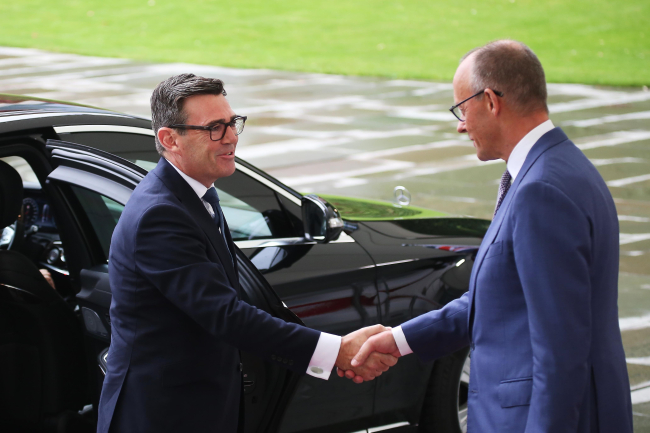
A Partnership Built on Security: Post-Brexit Rapprochement between Germany and the United Kingdom
Since the UK’s withdrawal from the EU, UK-German relations have undergone a remarkable transformation: from Berlin’s deliberate distancing from London during the Brexit negotiations, when Germany consistently prioritised EU-27 unity over bilateral arrangements, to a gradual rapprochement, culminating, for the time being, in the 2025 Kensington Treaty of Friendship.
Recalibrating Europe’s Security: Building Partnerships in an Era of ‘Wrecking-Ball Politics
The 2026 Munich Security Conference report observes that “the world has entered a period of wrecking-ball politics.” Indeed, the era of Western predominance, dependable alliances and capable multilateral institutions has given way to shifting balances of power and deepening uncertainty.