



Between „Strategic Autonomy” and „Zeitenwende”: The Importance of Trade Between The EU and Mercosur
This policy paper analyses the geopolitical and economic significance of the EU-Mercosur agreement for the European Union (EU) in the context of the EU’s new European Economic Security Strategy.
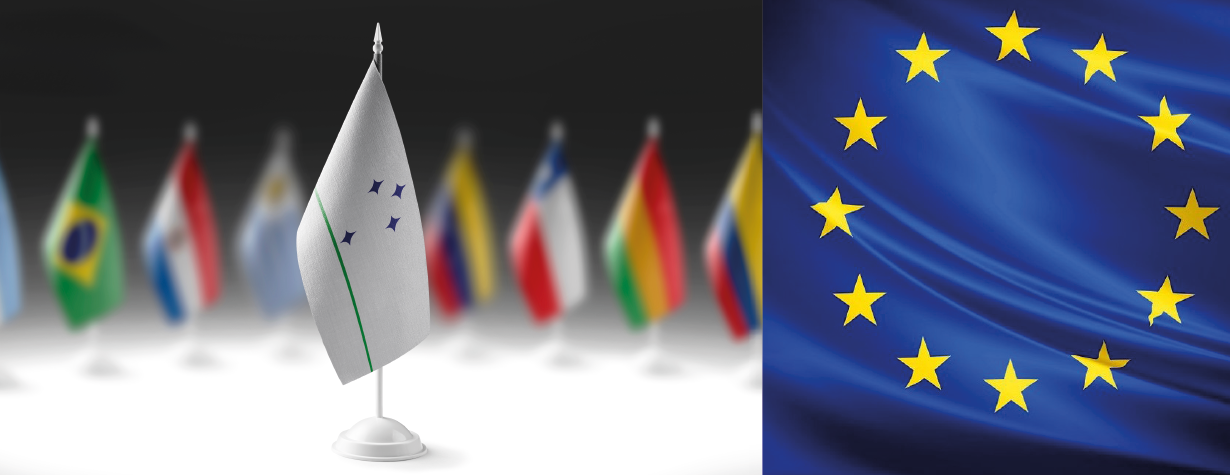
In view of geopolitical changes and growing protectionist tendencies of large economies such as China and the USA, closer co-operation with the Global South, including the Mercosur countries, is considered necessary. Germany and France have reorganized their trade policies, in particular through a joint industrial strategy and a derisking strategy to reduce economic vulnerabilities, which could represent an opportunity to bring together traditionally different views of trade policy.
The Mercosur agreement offers the EU the opportunity to deepen its economic relations with South America and reduce dependencies on other global trading powers. This could be achieved by opening up European markets for South American agricultural commodities and the export of European industrial goods. The aim is to promote bilateral trade and investment and reduce trade barriers, also in order to position the EU as a serious alternative trading partner to China.
The policy paper concludes that the Mercosur agreement could be an essential building block for the EU’s economic security in a fragmented world, provided that the different national interests within the EU are harmonized and a clear strategy is developed to overcome geopolitical challenges.
- This note was written in partnership with the IW Köln. The German Economic Institute (IW) is a private economic research institute in Germany, which is an advocate of a liberal economic and social order. We work to improve understanding of how business and society function and interact.
Simon Gerards Iglesias, Economist and Economic Historian, The Institut der deutschen Wirtschaft, Cologne.
Marie Krpata, Research Fellow at the Study Committee on Franco-German Relations (Cerfa) at the French Institute of International Relations – Ifri.
Ana Helena Palermo Kuss, Economist and Advisor to the President at ZEW - Leibniz-Zentrum für Europäische Wirtschaftsforschung, Mannheim.
This publication is available in:
German: "Zwischen „strategischer Autonomie” und „Zeitenwende”: Die Bedeutung des Handels zwischen der EU und Mercosur" on the Website of Institut der deutschen Wirtschaft (IW).

Available in:
Themes and regions
Share
This page contains only a summary of our work. If you would like to have access to all the information from our research on the subject, you can download the full version in PDF format.
Between „Strategic Autonomy” and „Zeitenwende”: The Importance of Trade Between The EU and Mercosur

Marie KRPATA
Research Fellow, Study Committee on Franco-German Relations (Cerfa), Ifri


The Study Committee on Franco-German Relations (Cerfa)
The Study Committee on Franco-German Relations (Cerfa) was created in 1954 by an inter-governmental agreement between the Federal Republic of Germany and France, in order to raise awareness of Germany in France and analyze Franco-German relations, including in their European and international dimensions. In its conferences and seminars, which bring together experts, political leaders, senior decision-makers and representatives of civil society from both countries, Cerfa develops the Franco-German debate and stimulates political proposals. It regularly publishes studies through two collections: Cerfa notes and studies as well as Franco-German visions.
Cerfa maintains close relations with the network of German foundations and think tanks. In addition to its research and debate activities, Cerfa promotes the emergence of a new Franco-German generation through original cooperation programs. This is how in 2021-2022, Cerfa led a program on multilateralism with the Konrad Adenauer Foundation in Paris. This program is aimed at young professionals from both countries interested in the issues of multilateralism in the context of their activities. It covered a wide range of themes relating to multilateralism, such as international trade, health, human rights and migration, non-proliferation and disarmament. Previously, Cerfa had participated in the Franco-German future dialogue, co-led with the DGAP from 2007 to 2020, and supported by the Robert Bosch Foundation and the Daniel Vernet group (formerly the Franco-German Reflection Group) which was founded in 2014 upon the initiative of the Genshagen Foundation.
Franco-German Relations Through the Lens of Donald Trump’s Second Term: Between Strategic Realignments, European Sovereignty, and the Enduring Transatlantic Bond
Donald Trump’s return to the presidency of the United States in 2025 acts as a powerful catalyst for the Franco-German relationship. Faced with growing uncertainty over the reliability of US security guarantees, Germany, more directly affected by the questioning of the transatlantic relationship, is gradually moving closer to the French position in favor of strengthening European strategic sovereignty.
MAGA and AfD: Toward a Transatlantic Alliance of Nationalist Right-Wing Parties
The rapprochement between Donald Trump’s MAGA movement and Germany’s AfD has accelerated significantly since Trump’s return to the White House.
VW, Mercedes, and BMW in the Face of Donald Trump—A Tightrope Walk Between Investing in the U.S., Maintaining Operations in Europe, and Catching Up in Electric Mobility
The German automotive industry faces a threefold challenge: competition from China; a difficult transition to electric vehicles; and US tariffs.
A Partnership Built on Security: Post-Brexit Rapprochement between Germany and the United Kingdom
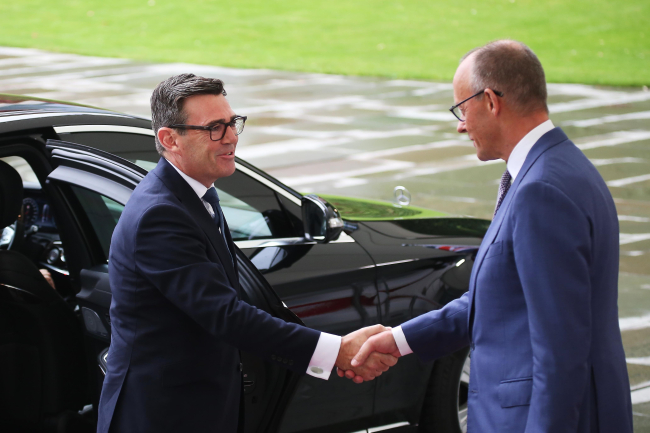
Since the UK’s withdrawal from the EU, UK-German relations have undergone a remarkable transformation: from Berlin’s deliberate distancing from London during the Brexit negotiations, when Germany consistently prioritised EU-27 unity over bilateral arrangements, to a gradual rapprochement, culminating, for the time being, in the 2025 Kensington Treaty of Friendship.