



Questions of Fact: India’s Aadhaar Matter and the Limits of the Supreme Court
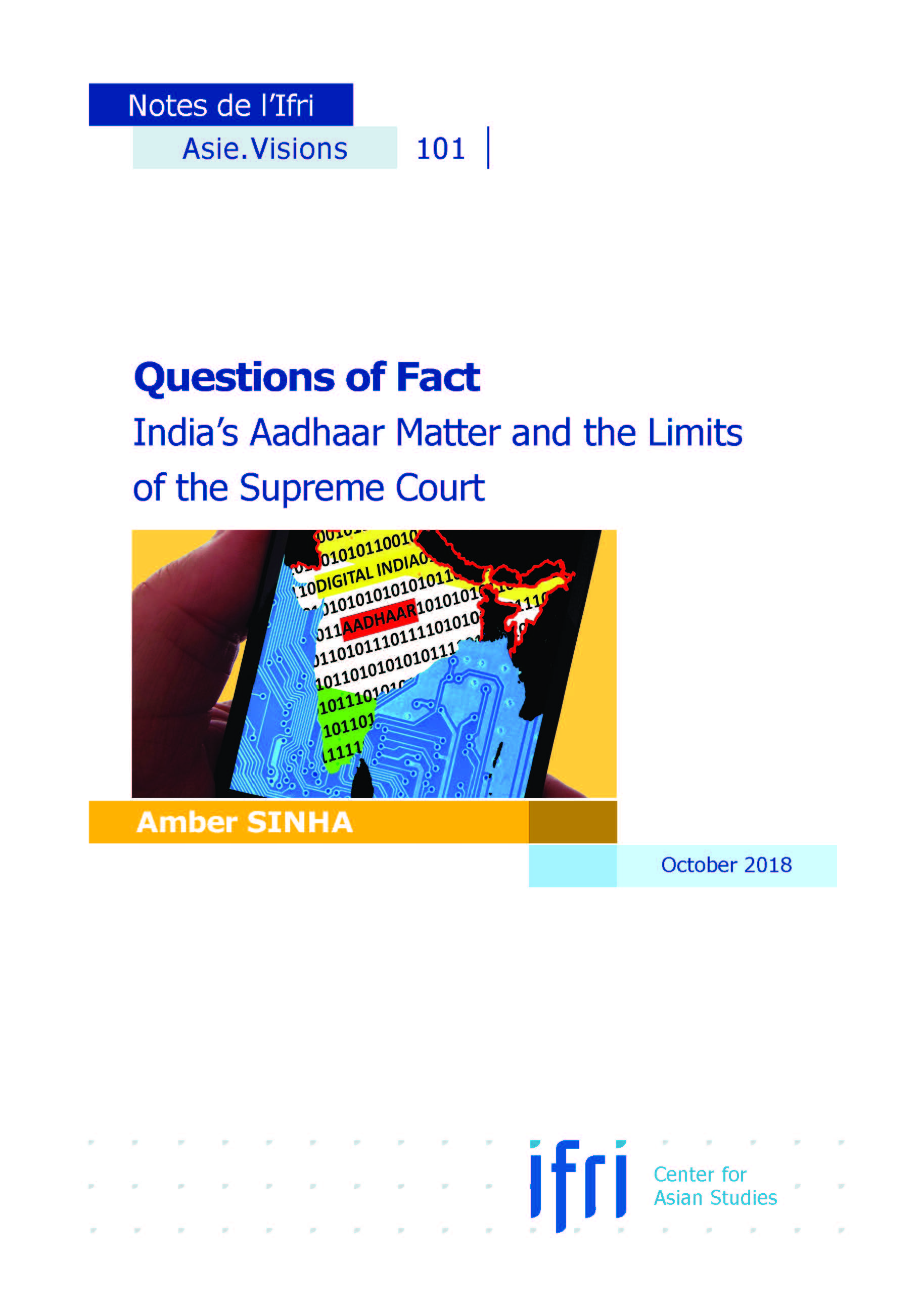
In September 2018, the Supreme Court of India rendered its verdict in a landmark case with major implications for the Aadhaar biometric identification project as well as the application of right to privacy in India, but the Aadhaar Matter raises important questions about the shortcomings of the Supreme Court’s practice of judicial review.

On May 10, 2018, the Supreme Court of India concluded its hearings on a landmark case with major implications for the Aadhaar biometric identification project as well as the application of right to privacy in India. In K.S. Puttaswamy and others vs. Union of India (“Aadhaar Matter”), a five-judge bench led by Chief Justice Mishra heard arguments surrounding the creation of the largest biometric identification system in the world – a 12-digit “unique identification” number, or Aadhaar Number generated for every Indian resident using data including iris scans, 10-digit fingerprints and a picture of the face. Proponents of the project argued that the new ID number would resolve issues such as welfare leakages and a lack of access to social benefits from India’s poor (arguments which have been largely been dismantled by social welfare researchers). Detractors have pointed to questions of inequality and more generally raised the point that the system violates core rights to privacy for the people of India.
The hearings spanned 38 days over five months and were the second longest in the nearly 70 years of the Indian Supreme Court’s history. While five months is in itself a long time, the Aadhaar Matter began six years earlier, in 2012, when Retired judge K.S. Puttaswamy filed a petition before the Supreme Court for the scrapping of the Aadhaar project. Over the next six years, twenty-nine other petitions were tagged together, contesting different aspects of the Aadhaar project and, after 2016, of its legislation under the Aadhaar (Subsidies, Benefits and Services) Act. Between 2013 and 2015, the Supreme Court also passed up to five different interim orders directing that no individual must suffer from not having an Aadhaar Number and that its use must be limited to a few specific government schemes. In the court’s final decision, delivered on September 26, 2018, justices ultimately ruled 4-1 in favour of upholding the Aadhaar program within certain constraints – for instance, it cannot be made mandatory for obtaining a bank account or mobile phone, nor in registering for school.
The Aadhaar project raises important questions about the shortcomings of the Supreme Court’s practice of judicial review. The problem is largely linked to the nature of Public Interest Litigations, which put the higher judiciary in a peculiar position of being the court of first instance as well as the final court of appeals. As such, India’s higher court system is required it to look into questions of fact without the tools that a trial court needs to have at its disposal. The effect of this oddity is especially pronounced in cases such as the Aadhaar Matter, which involves several complicated questions of fact. Moreover, the practice of affidavit-based evidence that the Supreme Court often uses compromises the justice system as the Court is unable to ascertain the veracity of the facts presented before it. The effect of this practice is all the more pronounced in light of the fact that the Supreme Court passes judgements which are binding on lower courts, and often deal with issues of great social, economic and political import.
This page contains only a summary of our work. If you would like to have access to all the information from our research on the subject, you can download the full version in PDF format.
Questions of Fact: India’s Aadhaar Matter and the Limits of the Supreme Court


Center for Asian Studies
Asia is a nerve center for multiple global economic, political and security challenges. The Center for Asian Studies provides documented expertise and a platform for discussion on Asian issues to accompany decision makers and explain and contextualize developments in the region for the sake of a larger public dialogue.
The Center's research is organized along two major axes: relations between Asia's major powers and the rest of the world; and internal economic and social dynamics of Asian countries. The Center's research focuses primarily on China, Japan, India, Taiwan and the Indo-Pacific, but also covers Southeast Asia, the Korean peninsula and the Pacific Islands.
The Centre for Asian Studies maintains close institutional links with counterpart research institutes in Europe and Asia, and its researchers regularly carry out fieldwork in the region.
The Center organizes closed-door roundtables, expert-level seminars and a number of public events, including an Annual Conference, that welcome experts from Asia, Europe and the United States. The work of Center’s researchers, as well as that of their partners, is regularly published in the Center’s electronic journal Asie.Visions.

Pakistan and the Israel-Palestine Conflict: Transformation in Pakistan’s Approach After the War in Gaza
Pakistan has long combined vocal support for the Palestinian cause with covert engagement with Israel. Since the war in Gaza, this balance has become untenable: public opinion is united against Israel, joining Trump’s Board of Peace has drawn rare cross-party criticism, and new regional alignments put normalization out of reach.
The Oceania Factor in France’s Evolving Indo-Pacific Strategy
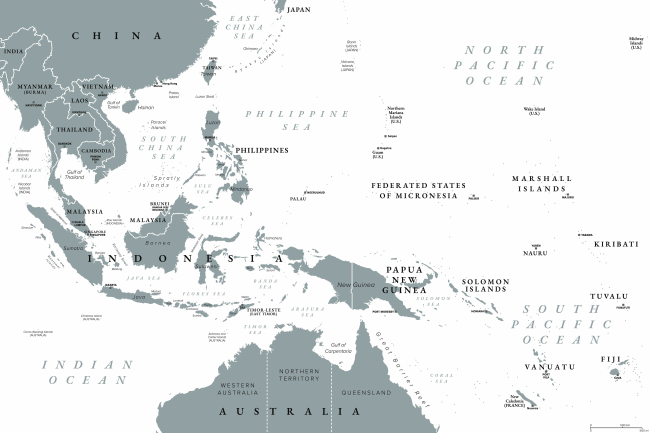
This paper examines the two-way relationship between France’s Indo-Pacific strategy and developments in Oceania. Oceania was not a priority in the initial years of France’s Indo-Pacific strategy, as the region was largely treated as secondary to major strategic hotspots and key partnerships, while overseas territories were primarily handled as domestic issues and recipients of a top-down strategy.

France’s View: From Diplomacy to Public-Private Action
France has emerged as the EU’s IMEC forerunner, combining port infrastructure, diplomatic alliances and public-private cooperation. With Marseille Fos at its core, the country brings a strategic hub for logistics, energy and digital connectivity to the corridor.

Trump II, the Crisis of the Rules-Based Order and Europe’s Indo-Pacific Strategy
This article examines the implications of Trump II for Europe’s engagement in the Indo-Pacific. The piece contends that Trump II is accelerating the erosion of the rules-based order and undermining the relevance of the Free and Open Indo-Pacific (FOIP) concept, while forcing Europe to refocus on its own continental security amid US retrenchment. Paradoxically, these very constraints create conditions for a more autonomous, pragmatic, and explicitly interest-driven European engagement in the Indo-Pacific, rather than outright withdrawal.