




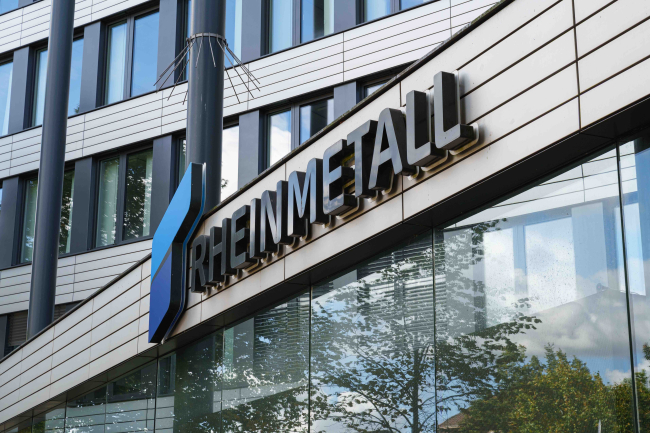
"The US’s Trojan horse in Europe": Rheinmetall, the German defence giant with an insatiable appetite
Top secret. Land, sea, air and even space… Armin Papperger, the very powerful head of the German defence group, has grand ambitions—to the point of irritating France.
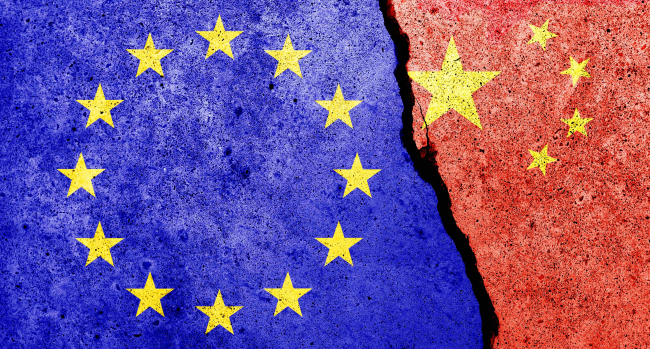
Fragmented Europe: Dealing with China as a technology and innovation power
How is Europe navigating China’s ascension as a technological power? The latest report by the European Think-tank Network on China (ETNC) provides a nuanced account of a converging, yet still fragmented approach across 22 countries.

Replay - Geopolitical Stakes of the New Moon Race
As the United States, China, and India solidify their lunar ambitions, Europe is still seeking to define its stance: should it be a reliable partner or an autonomous strategic player? This conference examines the stakes of this new race to the Moon and Europe’s interest in asserting itself as a lunar power through partnerships, industrial ambitions, and whether its participation in the new lunar race serves as a lever for strategic autonomy and internal cohesion, or an illustration of its dependence.

Trump's Anthropic Crackdown Sets Off AI Alarms for US Allies — The latest ban, which hits Anthropic’s Mythos and Fable models, affects software that banks, law firms and government offices are rushing to adopt. According to Mathilde Velliet, "that decision materializes a risk that had been on everyone’s mind outside of the US. [...] Mistral stands to gain from Anthropic’s restrictions in the long run, as Europe’s only large developer of AI models."

quoted by Mark Bergen and Ania Nussbaum for Bloomberg

France opens Space Command to Japanese officer as ties deepen under new road map — "A key aim [of France-Japan defense cooperation] is to reduce critical vulnerabilities as well as to strengthen sovereign capabilities and reduce reliance on U.S.-provided data. New opportunities are emerging in advanced technologies, including AI-enabled systems, autonomous platforms and space applications."

quoted by Gabriel Dominguez in the Japan Times
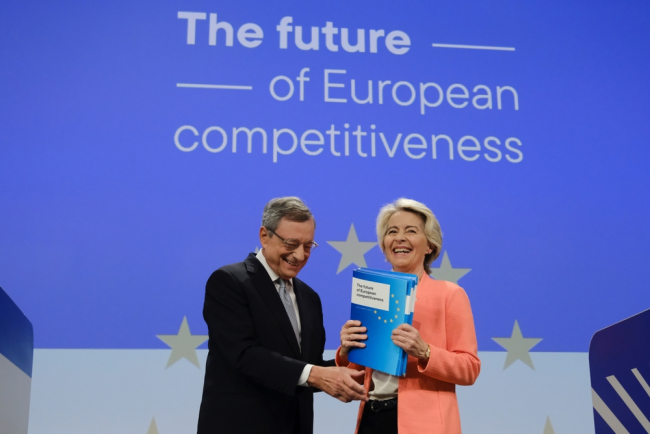
Under construction: Europe’s economic repositioning in a fragmented international order
„Under Destruction“– this was this year’s motto at the Munich Security Conference. A motto that applies both to security and economy in an increasingly fragile international system. In 2024, Mario Draghi’s report on the EU’s competitiveness rang the alarm bell: Europe is slipping behind the US and China, European companies struggle with Brussels' bureaucracy, and the internal market is too fragmented. However, two years later only about 15 % of his recommendations were implemented: the wake-up call was not heard.
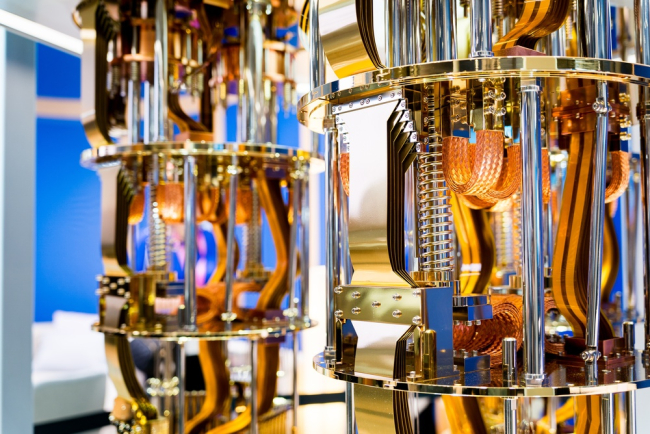
Europe Facing the Quantum Challenge: From Ambitions to Action
The nomination of researchers Alain Aspect and Michel Devoret for the 2022 and 2025 Nobel Prizes in Physics, for their work in quantum physics, attests to the enduring vitality of French and European research in this field. While the deployment of technologies stemming from the second quantum revolution is still in its infancy, one might think that strategic patience is called for, and that we must wait for the proliferation of basic research to give way to innovations ready for deployment. That would be a serious mistake, given that the potential for profound transformation inherent in the quantum sector is directly linked to states and organizations’ strategic autonomy.
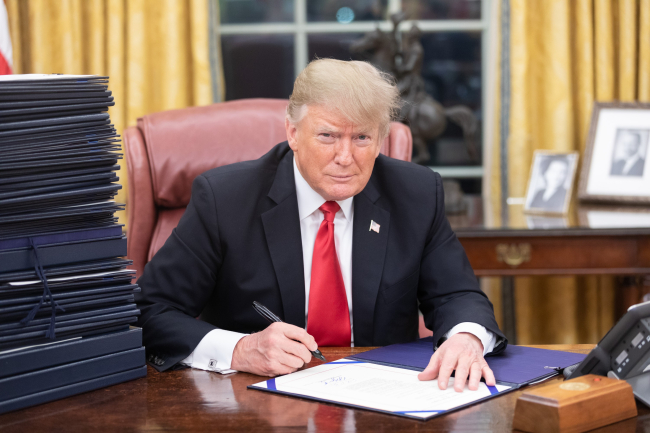
Trump II vs. Digital Governance: A Crusade in the United States and Europe
Since taking office, the Trump II administration has waged a systematic deregulation campaign targeting the tech sector in both the United States and Europe. How can Europe maintain dialogue while preserving its governance framework?
Replay - From Ambition to Action: Exploring Technological Partnerships with India
Replay of the conference at Ifri, March 18, 2026
Can EU-India technological cooperation reshape global strategic balances? This conference brought together European and Indian leaders to discuss opportunities and challenges in AI, semiconductors, and digital innovation. Watch the full debate.
Europe at the Crossroads of DefTech: Rethinking the European Defense Innovation Ecosystem
“The way I look at Iron Dome is as the ultimate manifestation of the future of the United States’ role in future conflicts, which is not to be the world police, but to be the world gun store,” said Palmer Luckey in November 2023. Luckey is the founder of Anduril, one of the most prominent DefTech companies. The ambition is clear: to participate in global rearmament by capitalizing on the quality of American innovations and to dominate the arms market—at least in the West—through technological mastery.
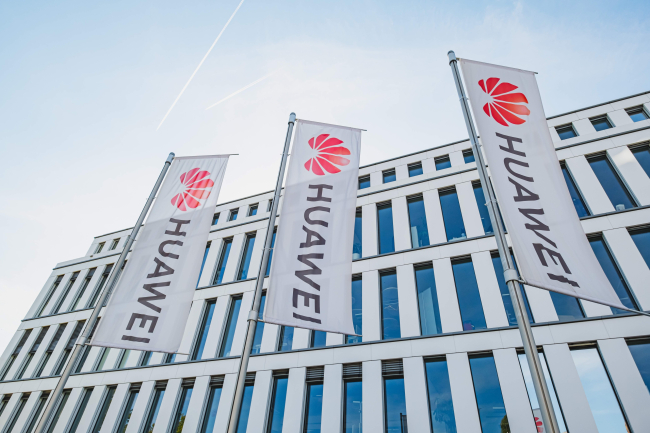
The “Huawei Saga” in Europe Revisited: German Lessons for the Rollout of 6G
While the European Union attempted to coordinate a collective response through its 5G Toolbox in Europe’s 5G infrastructure, member states diverged significantly in balancing political, economic, and technological considerations. Germany, despite its economic ties to China and status as Europe’s largest telecom market, only reached a tentative agreement in July 2024—one that appears largely symbolic.
A "DeepSeek Moment"?
DeepSeek, hailed as a champion of Chinese AI, represents less a revolution than a significant optimization of existing technologies. Doubts remain regarding the figures put forward by the start-up, inviting a more measured response to the media hype surrounding China’s technological catch-up. Nonetheless, DeepSeek signals the need to question an economic model based solely on the race for computational power. By betting on open innovation, Europe can carve out its own path in a competition that is far from being a zero-sum game.

AI showcase pays off for France, but US tech scepticism endures
France is staking its claim as an AI powerhouse. At the AI Action Summit in Paris this week, global leaders, tech innovators, and policymakers converged to chart the future of artificial intelligence - backed by major investments and bold ambitions for Europe’s leadership in the field. RFI breaks down the key takeaways.
Replay - Shaping Europe’s Technological Sovereignty
Watch Ifri's Center for Geopolitics of Technology's annual conference replay.
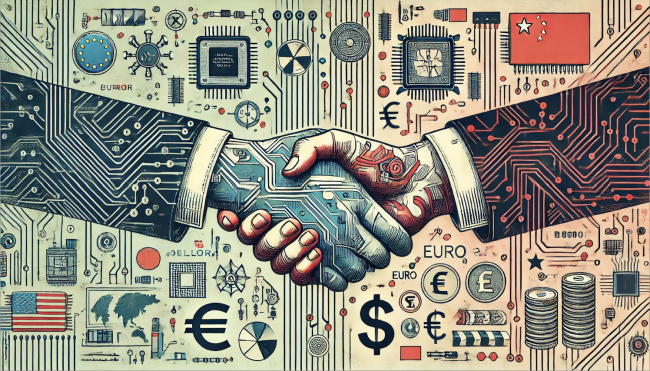
Funding A Rival: When the United States and Europe Invest in Chinese Tech
Outbound investments into rival powers are receiving increasing political attention on both sides of the Atlantic, as competition between the United States and China intensifies. The concern lies with American and European investments in certain Chinese technologies - such as artificial intelligence, biotechnology, semiconductors, or quantum computing - which could enable China to enhance its military capabilities and thus may pose risks to national and international security.
The Geopolitics of Artificial Intelligence: The Return of Empires?
Artificial intelligence (AI) is swiftly moving forward and becoming a real tool of power.
Fragmented Europe: Dealing with China as a technology and innovation power
How is Europe navigating China’s ascension as a technological power? The latest report by the European Think-tank Network on China (ETNC) provides a nuanced account of a converging, yet still fragmented approach across 22 countries.
Under construction: Europe’s economic repositioning in a fragmented international order
„Under Destruction“– this was this year’s motto at the Munich Security Conference. A motto that applies both to security and economy in an increasingly fragile international system. In 2024, Mario Draghi’s report on the EU’s competitiveness rang the alarm bell: Europe is slipping behind the US and China, European companies struggle with Brussels' bureaucracy, and the internal market is too fragmented. However, two years later only about 15 % of his recommendations were implemented: the wake-up call was not heard.
Europe Facing the Quantum Challenge: From Ambitions to Action
The nomination of researchers Alain Aspect and Michel Devoret for the 2022 and 2025 Nobel Prizes in Physics, for their work in quantum physics, attests to the enduring vitality of French and European research in this field. While the deployment of technologies stemming from the second quantum revolution is still in its infancy, one might think that strategic patience is called for, and that we must wait for the proliferation of basic research to give way to innovations ready for deployment. That would be a serious mistake, given that the potential for profound transformation inherent in the quantum sector is directly linked to states and organizations’ strategic autonomy.
Trump II vs. Digital Governance: A Crusade in the United States and Europe
Since taking office, the Trump II administration has waged a systematic deregulation campaign targeting the tech sector in both the United States and Europe. How can Europe maintain dialogue while preserving its governance framework?
Europe at the Crossroads of DefTech: Rethinking the European Defense Innovation Ecosystem
“The way I look at Iron Dome is as the ultimate manifestation of the future of the United States’ role in future conflicts, which is not to be the world police, but to be the world gun store,” said Palmer Luckey in November 2023. Luckey is the founder of Anduril, one of the most prominent DefTech companies. The ambition is clear: to participate in global rearmament by capitalizing on the quality of American innovations and to dominate the arms market—at least in the West—through technological mastery.
The “Huawei Saga” in Europe Revisited: German Lessons for the Rollout of 6G
While the European Union attempted to coordinate a collective response through its 5G Toolbox in Europe’s 5G infrastructure, member states diverged significantly in balancing political, economic, and technological considerations. Germany, despite its economic ties to China and status as Europe’s largest telecom market, only reached a tentative agreement in July 2024—one that appears largely symbolic.
A "DeepSeek Moment"?
DeepSeek, hailed as a champion of Chinese AI, represents less a revolution than a significant optimization of existing technologies. Doubts remain regarding the figures put forward by the start-up, inviting a more measured response to the media hype surrounding China’s technological catch-up. Nonetheless, DeepSeek signals the need to question an economic model based solely on the race for computational power. By betting on open innovation, Europe can carve out its own path in a competition that is far from being a zero-sum game.
"The US’s Trojan horse in Europe": Rheinmetall, the German defence giant with an insatiable appetite
Top secret. Land, sea, air and even space… Armin Papperger, the very powerful head of the German defence group, has grand ambitions—to the point of irritating France.
Replay - Geopolitical Stakes of the New Moon Race
As the United States, China, and India solidify their lunar ambitions, Europe is still seeking to define its stance: should it be a reliable partner or an autonomous strategic player? This conference examines the stakes of this new race to the Moon and Europe’s interest in asserting itself as a lunar power through partnerships, industrial ambitions, and whether its participation in the new lunar race serves as a lever for strategic autonomy and internal cohesion, or an illustration of its dependence.
AI showcase pays off for France, but US tech scepticism endures
France is staking its claim as an AI powerhouse. At the AI Action Summit in Paris this week, global leaders, tech innovators, and policymakers converged to chart the future of artificial intelligence - backed by major investments and bold ambitions for Europe’s leadership in the field. RFI breaks down the key takeaways.
Replay - Geopolitical Stakes of the New Moon Race
As the United States, China, and India solidify their lunar ambitions, Europe is still seeking to define its stance: should it be a reliable partner or an autonomous strategic player? This conference examines the stakes of this new race to the Moon and Europe’s interest in asserting itself as a lunar power through partnerships, industrial ambitions, and whether its participation in the new lunar race serves as a lever for strategic autonomy and internal cohesion, or an illustration of its dependence.
Replay - From Ambition to Action: Exploring Technological Partnerships with India
Replay of the conference at Ifri, March 18, 2026
Can EU-India technological cooperation reshape global strategic balances? This conference brought together European and Indian leaders to discuss opportunities and challenges in AI, semiconductors, and digital innovation. Watch the full debate.
AI showcase pays off for France, but US tech scepticism endures
France is staking its claim as an AI powerhouse. At the AI Action Summit in Paris this week, global leaders, tech innovators, and policymakers converged to chart the future of artificial intelligence - backed by major investments and bold ambitions for Europe’s leadership in the field. RFI breaks down the key takeaways.
Replay - Shaping Europe’s Technological Sovereignty
Watch Ifri's Center for Geopolitics of Technology's annual conference replay.
Ifri, a foundation recognized as being of public utility, relies largely on private donors – companies and individuals – to guarantee its sustainability and intellectual independence. Through their funding, donors help maintain the Institute's position among the world's leading think tanks. By benefiting from an internationally recognized network and expertise, donors refine their understanding of geopolitical risk and its consequences on global politics and the economy. In 2026, Ifri partners with over 90 French and international companies and organizations.


Trump's Anthropic Crackdown Sets Off AI Alarms for US Allies — The latest ban, which hits Anthropic’s Mythos and Fable models, affects software that banks, law firms and government offices are rushing to adopt. According to Mathilde Velliet, "that decision materializes a risk that had been on everyone’s mind outside of the US. [...] Mistral stands to gain from Anthropic’s restrictions in the long run, as Europe’s only large developer of AI models."
quoted by Mark Bergen and Ania Nussbaum for Bloomberg
France opens Space Command to Japanese officer as ties deepen under new road map — "A key aim [of France-Japan defense cooperation] is to reduce critical vulnerabilities as well as to strengthen sovereign capabilities and reduce reliance on U.S.-provided data. New opportunities are emerging in advanced technologies, including AI-enabled systems, autonomous platforms and space applications."
quoted by Gabriel Dominguez in the Japan Times