



Taking the Pulse: Has Political Deadlock in Member States Become a Strategic Problem for the EU?
At a pivotal moment for the EU, several of its member states are experiencing domestic political and economic crises. Is this hindering collective EU action in response to the challenges posed by Russia, China, and Trump’s administration?
Paul Maurice
Secretary general of the Study Committee on Franco-German Relations at the French Institute of International Relations (Ifri)
The possible change in the chancellorship from the Social Democratic Party’s Olaf Scholz to the Christian Democratic Union’s Friedrich Merz following the February 23 election in Germany could scale back the country’s defense commitments and military aid to Ukraine. Germany is also currently too preoccupied with its own internal problems to fully assume its traditional role as mediator between the United States and the EU. Meanwhile, France’s budgetary problems limit its ability to play a leading role in diplomatic negotiations or defense initiatives.
Add to this a few member states are being led by populist or far-right parties: Hungary, Italy, Slovakia, perhaps soon Austria... These situations create a leadership vacuum in key countries, complicating collective decisionmaking at EU level. European institutions such as the European Council, the commission, and the Polish presidency of the EU Council can play a stabilizing role, but they cannot fully compensate for the absence of national leadership.
The EU must also fix its economic competitiveness deficit, a crucial issue if it is to finance its ambitions in terms of defense and ecological transition. However, the internal divisions and divergent priorities of member states make it difficult to develop a coherent economic strategy in the face of China or the Trump’s United States, even if there is Franco-German convergence.
Aleksandra Kozioł
European security analyst at the Polish Institute of International Affairs (PISM)
Giovanni Grevi
Senior fellow at the Centre for Security, Diplomacy and Strategy of the Brussels School of Governance (VUB)
Nora Müller
Executive director for International Affairs at the Körber-Stiftung
Anna Wieslander
Director for Northern Europe at the Atlantic Council
Jaanika Merilo
Visiting lecturer at the Estonian Academy of Security Sciences
Daniel Gros
Director of the Institute for European Policymaking at Bocconi University
Oana Lungescu
Distinguished fellow at the Royal United Services Institute
Judy Dempsey
Nonresident senior fellow at Carnegie Europe
Ian Bond
Deputy director of the Centre for European Reform

Available in:
Themes and regions
Share
Paul MAURICE
Secretary General of the Study Committee on Franco-German Relations (Cerfa), Ifri

The Study Committee on Franco-German Relations (Cerfa)
The Study Committee on Franco-German Relations (Cerfa) was created in 1954 by an inter-governmental agreement between the Federal Republic of Germany and France, in order to raise awareness of Germany in France and analyze Franco-German relations, including in their European and international dimensions. In its conferences and seminars, which bring together experts, political leaders, senior decision-makers and representatives of civil society from both countries, Cerfa develops the Franco-German debate and stimulates political proposals. It regularly publishes studies through two collections: Cerfa notes and studies as well as Franco-German visions.
Cerfa maintains close relations with the network of German foundations and think tanks. In addition to its research and debate activities, Cerfa promotes the emergence of a new Franco-German generation through original cooperation programs. This is how in 2021-2022, Cerfa led a program on multilateralism with the Konrad Adenauer Foundation in Paris. This program is aimed at young professionals from both countries interested in the issues of multilateralism in the context of their activities. It covered a wide range of themes relating to multilateralism, such as international trade, health, human rights and migration, non-proliferation and disarmament. Previously, Cerfa had participated in the Franco-German future dialogue, co-led with the DGAP from 2007 to 2020, and supported by the Robert Bosch Foundation and the Daniel Vernet group (formerly the Franco-German Reflection Group) which was founded in 2014 upon the initiative of the Genshagen Foundation.
Franco-German Relations Through the Lens of Donald Trump’s Second Term: Between Strategic Realignments, European Sovereignty, and the Enduring Transatlantic Bond
Donald Trump’s return to the presidency of the United States in 2025 acts as a powerful catalyst for the Franco-German relationship. Faced with growing uncertainty over the reliability of US security guarantees, Germany, more directly affected by the questioning of the transatlantic relationship, is gradually moving closer to the French position in favor of strengthening European strategic sovereignty.
MAGA and AfD: Toward a Transatlantic Alliance of Nationalist Right-Wing Parties
The rapprochement between Donald Trump’s MAGA movement and Germany’s AfD has accelerated significantly since Trump’s return to the White House.
VW, Mercedes, and BMW in the Face of Donald Trump—A Tightrope Walk Between Investing in the U.S., Maintaining Operations in Europe, and Catching Up in Electric Mobility
The German automotive industry faces a threefold challenge: competition from China; a difficult transition to electric vehicles; and US tariffs.
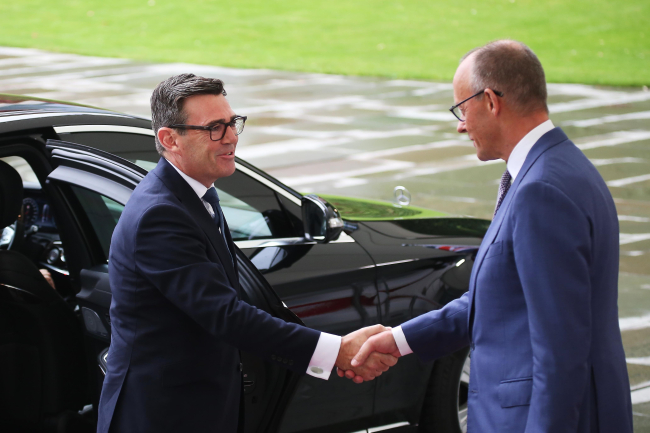
A Partnership Built on Security: Post-Brexit Rapprochement between Germany and the United Kingdom
Since the UK’s withdrawal from the EU, UK-German relations have undergone a remarkable transformation: from Berlin’s deliberate distancing from London during the Brexit negotiations, when Germany consistently prioritised EU-27 unity over bilateral arrangements, to a gradual rapprochement, culminating, for the time being, in the 2025 Kensington Treaty of Friendship.