



Japan-Russia: The end of delusions
The war in Ukraine has led to a major rift between Japan and Russia.
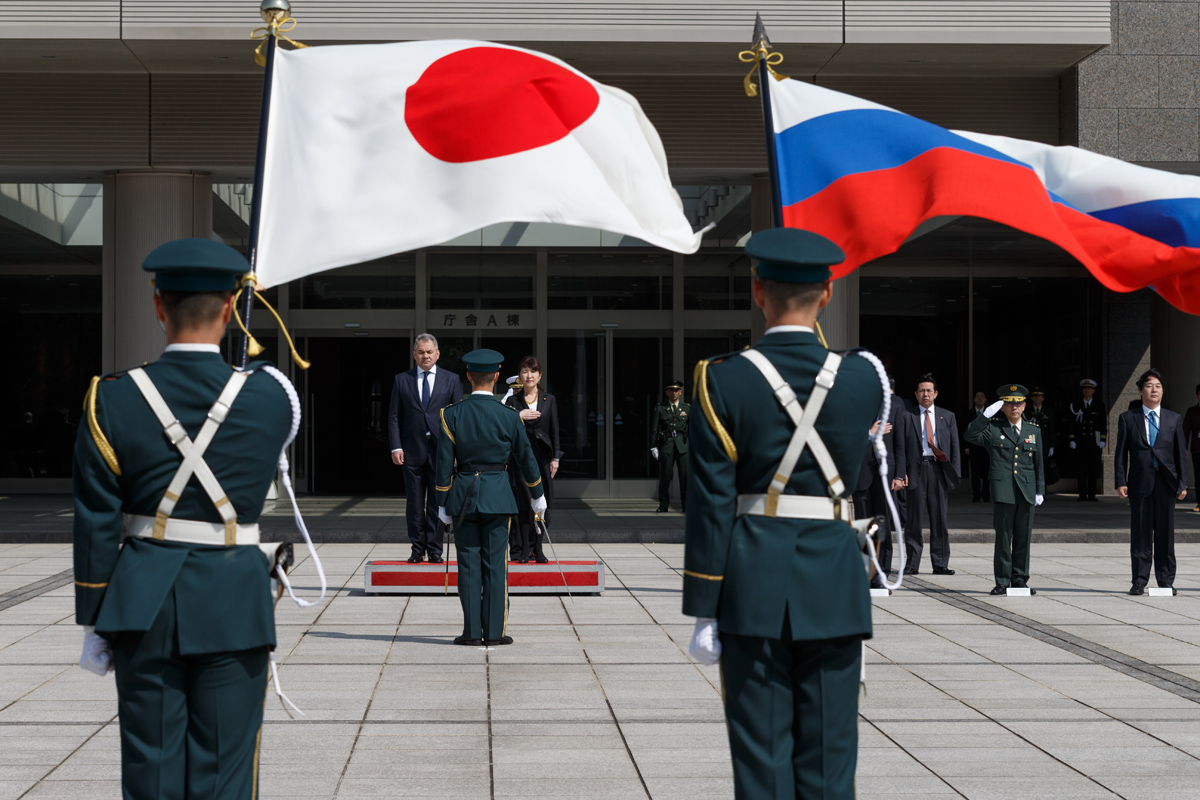
Reacting to political condemnation and economic sanctions from Tokyo, Moscow decided on 21 March to withdraw from the ongoing negotiations to solve their dispute over the Kuril Islands, ending 30 years of cordial relations between the two neighbours. Japan is now aware that Russia and China work hand-in-hand as revisionist powers, and that an engagement policy towards Moscow is no longer enough to secure its interests. Sanctioning Russia and materially supporting Ukraine also marks a historic break with Tokyo's traditional cautiousness on the international scene.
Taking stock of Abe’s engagement policy
Since the end of the Cold War, Moscow has no longer posed a threat to Tokyo. A weakened Russia even seemed open to returning at least two of the four South Kuril Islands to Japan. These islands have been under Russian sovereignty since 1945, but were previously under Japanese control and are strategically placed north of Hokkaido on the east flank of the Sea of Okhotsk. This territorial dispute has so far prevented the signing of a formal peace treaty between the neighbours. Former Prime Minister Shinzo Abe made resolving the dispute a personal affair — his father, a former foreign minister, passed away before completing a round of discussions that started in 1990.
During his tenure (2012-2020), Abe met with Putin almost 30 times in the hope of forging a relationship of trust. Adopting extremely modest sanctions after the annexation of Crimea in 2014, he actually proposed investing in Russia to facilitate the resolution of the territorial dispute. A joint development plan for the South Kuriles (“Northern Territories” for the Japanese) was announced in 2016, but this plan has not led to any concrete action. In fact, Abe's efforts were useless: Russia has not surrendered an inch of sovereignty. On the contrary, it has reinforced its existing military presence on the islands with, among other equipment, batteries of S-300 surface-to-air missiles at the end of 2020.
By trying to get closer to Putin, Shinzo Abe was also aiming for a more strategic objective: to prevent Russia from falling into the Chinese orbit, or at least, to prevent a Sino-Russian front against Japan on territorial and historical issues. This, again, has failed: Moscow's economic dependence on Beijing has been deepening and the two countries have been engaging in unprecedented military cooperation. In recent years, Chinese and Russian forces have conducted large-scale exercises in the Far East. Last October, Russian and Chinese vessels circled the Japanese archipelago, causing alarm in Tokyo. In 2022, the context is definitively different from 2014: the aggression against Ukraine by Russia is violating all the principles of the laws of war and humanitarian law. Hence, Japan has had no choice but to adopt a tougher stance and to make a clear break from Abe's magnanimous approach that only led to meagre results.
Japan firmly aligns with the West
Japanese rhetoric has hardened. Tokyo immediately condemned the Russian aggression, stating that it "unilaterally changes the status quo by force" — terminology usually used to describe Chinese manoeuvres in the South and East China Seas. In official documents, the Northern Territories are once again presented as an “inherent part” of the Japanese nation. The relationship with Russia will therefore undergo a profound reassessment: the revised National Security Strategy upcoming this year will certainly describe it as an unfriendly country. While over the last decades’ China has become the number one security concern for Tokyo — especially because it frequently intruded into Japanese territorial waters around the Senkaku Islands — the Japanese may now want to redeploy their Self-Defence Forces to cope with a more threatening Russia.
> The full article is available on 9DashLine

Available in:
Regions and themes
Share

Céline PAJON
Chercheuse, responsable de la recherche Japon et Indo-Pacifique, Centre Asie de l'Ifri

Center for Asian Studies
Asia is a nerve center for multiple global economic, political and security challenges. The Center for Asian Studies provides documented expertise and a platform for discussion on Asian issues to accompany decision makers and explain and contextualize developments in the region for the sake of a larger public dialogue.
The Center's research is organized along two major axes: relations between Asia's major powers and the rest of the world; and internal economic and social dynamics of Asian countries. The Center's research focuses primarily on China, Japan, India, Taiwan and the Indo-Pacific, but also covers Southeast Asia, the Korean peninsula and the Pacific Islands.
The Centre for Asian Studies maintains close institutional links with counterpart research institutes in Europe and Asia, and its researchers regularly carry out fieldwork in the region.
The Center organizes closed-door roundtables, expert-level seminars and a number of public events, including an Annual Conference, that welcome experts from Asia, Europe and the United States. The work of Center’s researchers, as well as that of their partners, is regularly published in the Center’s electronic journal Asie.Visions.

Pakistan and the Israel-Palestine Conflict: Transformation in Pakistan’s Approach After the War in Gaza
Pakistan has long combined vocal support for the Palestinian cause with covert engagement with Israel. Since the war in Gaza, this balance has become untenable: public opinion is united against Israel, joining Trump’s Board of Peace has drawn rare cross-party criticism, and new regional alignments put normalization out of reach.
The Oceania Factor in France’s Evolving Indo-Pacific Strategy
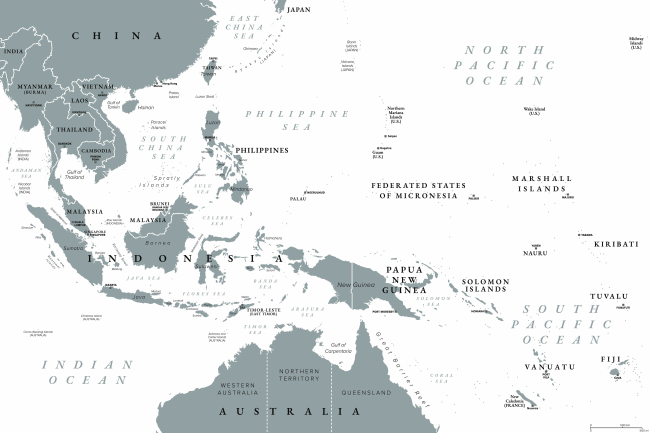
This paper examines the two-way relationship between France’s Indo-Pacific strategy and developments in Oceania. Oceania was not a priority in the initial years of France’s Indo-Pacific strategy, as the region was largely treated as secondary to major strategic hotspots and key partnerships, while overseas territories were primarily handled as domestic issues and recipients of a top-down strategy.

France’s View: From Diplomacy to Public-Private Action
France has emerged as the EU’s IMEC forerunner, combining port infrastructure, diplomatic alliances and public-private cooperation. With Marseille Fos at its core, the country brings a strategic hub for logistics, energy and digital connectivity to the corridor.
Trump II, the Crisis of the Rules-Based Order and Europe’s Indo-Pacific Strategy
This article examines the implications of Trump II for Europe’s engagement in the Indo-Pacific. The piece contends that Trump II is accelerating the erosion of the rules-based order and undermining the relevance of the Free and Open Indo-Pacific (FOIP) concept, while forcing Europe to refocus on its own continental security amid US retrenchment. Paradoxically, these very constraints create conditions for a more autonomous, pragmatic, and explicitly interest-driven European engagement in the Indo-Pacific, rather than outright withdrawal.