



Dependence in Europe's Relations with China: Weighing Perceptions and Reality

The idea that Europe has grown dependent on China is now a common refrain, but just how is this notion understood in capitals across the continent?
For the eighth report since its inception in 2014, the European Think-tank Network on China (ETNC) brings together analysis on 18 countries plus the European Union to examine how dependencies on China are presented in European public and policy-level debates, and how the notion shapes policymaking in each case.
Europe today is clearly in the midst of searching for a balance between openness and security—between yielding the benefits of interdependence and reducing the vulnerabilities of dependence. This is not a process that is solely about China, but it is nevertheless one that will fundamentally impact relations with it.
A robust body of work is being done by EU institutions to understand Europe’s dependencies and craft policies to address them at the macro level. While written independently, the report makes a qualitative complement to these ongoing efforts.
A striking observation from this analysis is that, beyond the EU institutions, surprisingly few states have made concerted efforts to assess their dependencies with any degree of depth. In only a quarter of countries observed has there been a significant level of public debate coupled with concerted policy-level action to both understand and address issues around dependence.
The ETNC brings together experts from 20 research institutes across Europe. Ifri is a co-founding, coordinating member of the network.
EU: China, a major driver in the push for greater resilience and autonomy
In her analysis of discussions at the EU level, Ifri's Marie Krpata explains that, against the backdrop of China’s emergence as a global economic powerhouse and its increasing assertiveness on the world stage, the impact of tense Sino-American relations and the Covid-19 crisis have spurred a debate about EU trade-, investment, and supply-chain-related dependencies. This debate has shed light on the vulnerability of the EU’s technological and industrial base and raised awareness of potential risks related to China’s geopolitical aspirations. In this context, the EU has developed strategies, policies, and instruments to reduce dependencies on third powers, including China, while also upholding market liberalism, human rights, and a rules-based world order. With the return of power politics, the EU needs to be clear-eyed about the tradeoffs it faces. If it wishes to embody a distinct position in the face of a growing US–China rivalry, it will have to boost its competitiveness, take measures to combat market and trade asymmetries, and proactively promote its values and interests abroad.
France: China one concern among many in the debate on resilience and strategic autonomy
In their analysis on France, John Seaman and Paul Louédin report that concerns about dependencies on China and the vulnerabilities they create are growing in France. While such dependencies are today seen as limited to a few specific (nevertheless critical) sectors, the potential for China’s dominance in the high-tech industries of the future raises concerns about a more strategic level of dependence in the years to come. Beijing’s observed willingness to leverage its asymmetric advantages through economic coercion, coupled with a broader misalignment of interests on core concepts shaping the international system (from economic governance to political values, the so-called systemic rivalry), are shaping policy views in Paris. And yet, the French discussion on dependence is one element of a broader discussion on France’s and Europe’s place in the world, going well beyond China. While holding to the concepts of openness and free trade, strategic autonomy and sovereignty are organizing principles in French policy discourse. It is now thought that the interdependencies created through open exchanges should be the result of more conscious, clear-eyed political choices rather than solely the consequence of an efficiency-seeking economic rationale.
Discover this and all ETNC reports on the network's website: https://etnc.info/
This page contains only a summary of our work. If you would like to have access to all the information from our research on the subject, you can download the full version in PDF format.
Dependence in Europe's Relations with China: Weighing Perceptions and Reality


John SEAMAN
Research Fellow, Center for Asian Studies, Ifri

Marie KRPATA
Research Fellow, Study Committee on Franco-German Relations (Cerfa), Ifri


Center for Asian Studies
Asia is a nerve center for multiple global economic, political and security challenges. The Center for Asian Studies provides documented expertise and a platform for discussion on Asian issues to accompany decision makers and explain and contextualize developments in the region for the sake of a larger public dialogue.
The Center's research is organized along two major axes: relations between Asia's major powers and the rest of the world; and internal economic and social dynamics of Asian countries. The Center's research focuses primarily on China, Japan, India, Taiwan and the Indo-Pacific, but also covers Southeast Asia, the Korean peninsula and the Pacific Islands.
The Centre for Asian Studies maintains close institutional links with counterpart research institutes in Europe and Asia, and its researchers regularly carry out fieldwork in the region.
The Center organizes closed-door roundtables, expert-level seminars and a number of public events, including an Annual Conference, that welcome experts from Asia, Europe and the United States. The work of Center’s researchers, as well as that of their partners, is regularly published in the Center’s electronic journal Asie.Visions.
European Think-tank Network on China (ETNC)
The European Think-tank Network on China (ETNC) is a gathering of China experts from a selection of European research institutes. It is devoted to the policy-oriented study of Chinese foreign policy and relations between China and European countries as well as China and the EU. It facilitates regular exchanges among participating researchers with a view to deepening the understanding within the European policy and research community and the broader public of how Europe, as a complex set of actors, relates with China and how China’s development and evolving global role is likely to impact the future of Europe. The network’s discussions and analyses take a decidedly ‘bottom-up’ approach, accounting for the various aspects of bilateral relations between European countries and China, and the points of convergence and divergence among EU member states in order to examine EU-China relations in a realistic and comprehensive way. The views presented in ETNC reports are the sole responsibility of the signed authors and do not in any way represent the views of all members of the ETNC, its participating institutions, nor the institutions with which the authors are affiliated.

Pakistan and the Israel-Palestine Conflict: Transformation in Pakistan’s Approach After the War in Gaza
Pakistan has long combined vocal support for the Palestinian cause with covert engagement with Israel. Since the war in Gaza, this balance has become untenable: public opinion is united against Israel, joining Trump’s Board of Peace has drawn rare cross-party criticism, and new regional alignments put normalization out of reach.
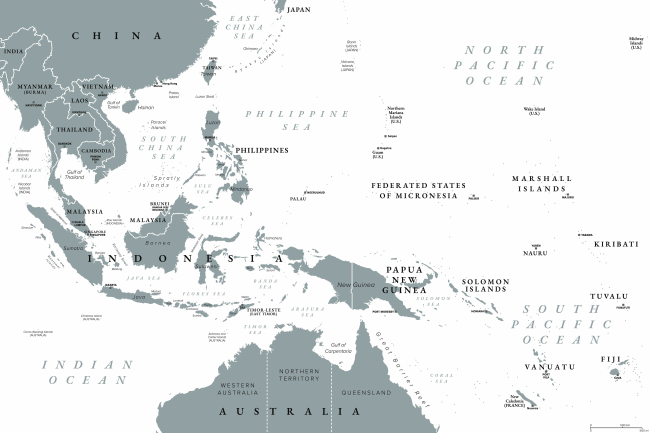
The Oceania Factor in France’s Evolving Indo-Pacific Strategy
This paper examines the two-way relationship between France’s Indo-Pacific strategy and developments in Oceania. Oceania was not a priority in the initial years of France’s Indo-Pacific strategy, as the region was largely treated as secondary to major strategic hotspots and key partnerships, while overseas territories were primarily handled as domestic issues and recipients of a top-down strategy.

France’s View: From Diplomacy to Public-Private Action
France has emerged as the EU’s IMEC forerunner, combining port infrastructure, diplomatic alliances and public-private cooperation. With Marseille Fos at its core, the country brings a strategic hub for logistics, energy and digital connectivity to the corridor.
Trump II, the Crisis of the Rules-Based Order and Europe’s Indo-Pacific Strategy
This article examines the implications of Trump II for Europe’s engagement in the Indo-Pacific. The piece contends that Trump II is accelerating the erosion of the rules-based order and undermining the relevance of the Free and Open Indo-Pacific (FOIP) concept, while forcing Europe to refocus on its own continental security amid US retrenchment. Paradoxically, these very constraints create conditions for a more autonomous, pragmatic, and explicitly interest-driven European engagement in the Indo-Pacific, rather than outright withdrawal.