



Pakistan and the Israel-Palestine Conflict: Transformation in Pakistan’s Approach After the War in Gaza
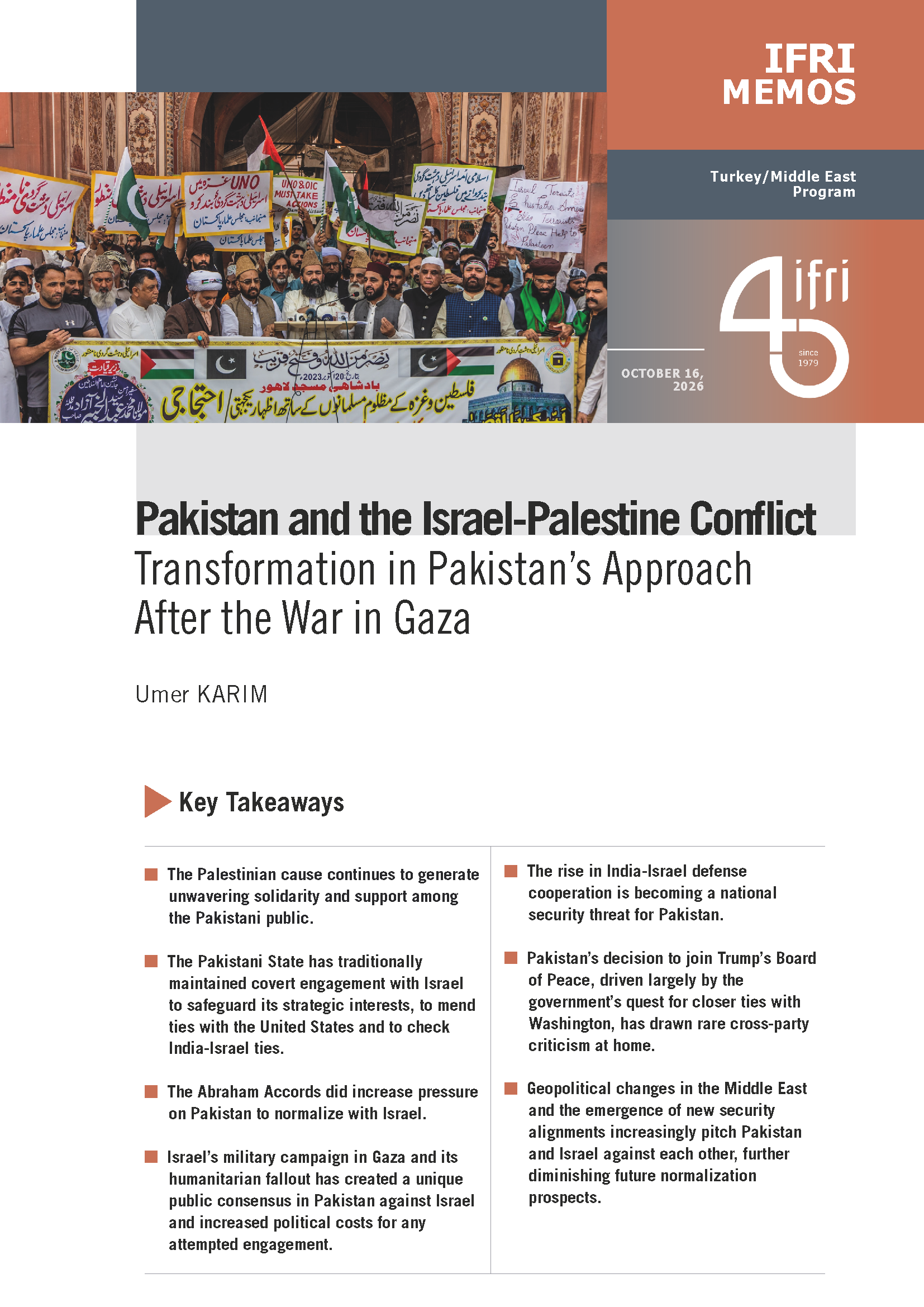
Pakistan has long combined vocal support for the Palestinian cause with covert engagement with Israel. Since the war in Gaza, this balance has become untenable: public opinion is united against Israel, joining Trump’s Board of Peace has drawn rare cross-party criticism, and new regional alignments put normalization out of reach.
Titre
Key Takeaways
The Palestinian cause continues to generate unwavering solidarity and support among the Pakistani public. Israel’s military campaign in Gaza and its humanitarian fallout has created a unique public consensus in Pakistan against Israel and increased political costs for any attempted engagement.
The Pakistani State has traditionally maintained covert engagement with Israel to safeguard its strategic interests, to mend ties with the United States and to check India-Israel ties. The rise in India-Israel defense cooperation is becoming a national security threat for Pakistan.
The Abraham Accords did increase pressure on Pakistan to normalize with Israel. Pakistan’s decision to join Trump’s Board of Peace, driven largely by the government’s quest for closer ties with Washington, has drawn rare cross-party criticism at home.
Geopolitical changes in the Middle East and the emergence of new security alignments increasingly pitch Pakistan and Israel against each other, further diminishing future normalization prospects.
Introduction
Few foreign policy positions are as deeply woven into Pakistan’s national identity as its support for the Palestinian cause. Since its founding in 1947, Pakistan has framed its opposition to Israel and its solidarity with Palestinians not merely as a diplomatic stance but as part and parcel of Pakistan’s ideological ethos and the vision of its founding fathers. This public support for Palestine has nevertheless not prevented covert engagement with Israel owing to strategic interests, mending ties with the United States (US) and also to impact Israel-India ties. The events since the Hamas-led attacks of October 7, 2023, culminating in Pakistan’s cautious engagement with Donald Trump’s Gaza ceasefire framework, the “Board of Peace” (BoP), and the debate over sending Pakistani troops to Gaza, have brought this tension into sharper public view than at almost any point in the country’s history.
The ideological foundations of Pakistan’s pro-Palestine stance
Pakistan’s refusal to recognize Israel dates to Israel’s creation in May 1948. Pakistan’s foundational and ideological ethos, the two-nation theory, which advocated for a separate homeland for Muslims of South Asia, also overlapped with the struggles of Muslim communities across the world, particularly those under colonial rule. This made Pan-Islamism a pillar of Pakistan’s foreign policy. Pakistan’s ruling elites and public were moved by the plight of the Palestinian people. Furthermore, Jerusalem’s status as home to Islam’s third holiest place, the Al-Aqsa Mosque, gave the issue a religious salience transcending geopolitics.
Pakistan’s founder, Muhammad Ali Jinnah, successive civil-military leadership of the country, broader public and different ideological sections of society have all consistently voiced support for the Palestinian cause and have demanded the creation of a separate Palestinian state in accordance with the United Nations (UN) Resolution 242 and along pre-1967 borders, with Al-Quds Al-Sharif (Jerusalem) as its capital. This position of Pakistan was further cemented after the 1948, 1967 and 1973 Arab-Israeli wars. The subsequent peace agreements between Israel and Egypt in 1978, Israel and the Palestine Liberation Organization (PLO) in 1993 and Israel and Jordan in 1994 did not change Pakistan’s position on the matter. The gradual Islamization of governance, politics and society starting from the 1970s made it even more politically challenging for any Pakistani government to compromise on the issue and accept Israel, as domestic public opinion remained highly anti-Israel.
Pakistan’s covert engagement with Israel
Despite maintaining a strong pro-Palestine stance and aiding Arab states militarily during the 1967 and 1973 wars, Pakistan’s covert engagement with Israel started when, in 1953, its Foreign Affairs minister Sir Zafarullah Khan met the Israeli ambassador to the US in New York, where a Pakistani official clarified that Pakistan did not harbor any hatred towards Israel.
In the 1990s, as India established ties with Israel and the Oslo Accords were signed, this covert engagement moved forward. Israel did not oppose Pakistan’s election as a non-permanent member of the UN Security Council, and diplomats on both sides developed a channel of communication. Under General Musharraf’s military government, this engagement progressed further, and in 2005, Pakistani and Israeli Foreign Affairs ministers met publicly in Istanbul. Afterward, General Musharraf also spoke to the World Jewish Congress and declared that Israel and Pakistan were not a threat to each other. This engagement with Israel helped further cement the credentials of Musharraf government within the US. There has been no verified official-level engagement between the two sides since the 2005 meeting.
The India factor
India remains one of the fulcrum points within Pakistan’s foreign policy and impacts its Israel policy as well. Interestingly, India’s recognition of Israel was only de jure in 1950, as Indian decision makers considered Israel an imperialist project and owing to ideological affinity with Arab nationalists. Israel did provide military assistance to India during its 1962 Sino-Indian War and 1965-1971 wars with Pakistan, but it did not change the relationship’s trajectory. This approach within India only started to change under the premiership of Rajiv Gandhi. India and Israel, however, did deliberate together to strike Pakistan’s nuclear facilities in 1983. The plan got canceled after the Central Intelligence Agency (CIA) tipped off Pakistan’s then President and military ruler General Zia-ul-Haq, a formidable ally in the struggle against the Soviet Union in Afghanistan.
After the two countries established diplomatic ties, their defense cooperation increased, and during the 1999 Kargil conflict between India and Pakistan, Israel provided a desperate India with thousands of 155 mm and 160 mm howitzer rounds alongside laser-guided bombs and unmanned aerial vehicles (UAVs). It was the first significant and game-changing military involvement of Israel between India and Pakistan. Under successive Indian governments, this defense cooperation has reached new heights, and Israel has become India’s third-largest defense partner, with India acquiring electronic warfare equipment, UAVs, smart bombs and a plethora of other defensive equipment from Israel. Over the years, this cooperation has reached a level where it has considerably improved Indian defense capabilities, thereby significantly enhancing the Indian threat to Pakistan.
This dynamic has led to a debate within Pakistan on the benefits of establishing a relationship with Israel and how it can help Pakistan restore diplomatic parity with India vis-à-vis Israel’s advantage over Pakistan. This further echoes the argument that Pakistan’s security circles have also favored such engagement, something publicly argued by former President General Musharraf.
The Abrahamic Accords, Oct-7th and the war in Gaza
Middle East’s geopolitical environment was considerably altered by the signing of the Abraham Accords and afterward by the October 7-attacks on Israel and the resultant Israeli military campaign in Gaza. With Pakistan increasingly dependent upon financial largesse of the Gulf states, notably Saudi Arabia and the United Arab Emirates, there was an apprehension that Pakistan might also be pressed to normalize with Israel. The first signs suggesting that Pakistan was being pushed on the matter came as Pakistan’s then Prime Minister Imran Khan in 2020 acknowledged that he had been under pressure to recognize Israel from the US but also from other friendly countries. Yet Khan reiterated Pakistan’s traditional stance on Palestine and did not initiate any engagement with Israel. After the attacks, Pakistan adopted a cautious approach. It did not outright condemn Hamas, but it also refrained from taking a strong anti-Israel position. Rather, the attempt was to frame these developments within the broader context of Israeli occupation. This suggested the country feared that a louder position in favor of Hamas might not go down well with its Western partners.
Over the following two years, as Israel’s Gaza campaign intensified and the humanitarian toll mounted, Pakistan repeatedly joined multilateral Muslim-world statements condemning Israeli conduct. There was also a rather interesting clash between the Pakistani and Israeli representatives at the UN Security Council, when the Israeli representative compared the Israeli strike in Qatar with the 2011 raid of American Navy SEALs in Pakistan that led to the killing of Osama Bin Laden. This episode highlighted that both sides were no longer even on engagement terms and shared a considerable degree of animosity.
The Israeli actions also resulted in stiffening of Saudi Arabia’s approach towards the Palestine question and reducing chances of any near-term normalization between the two sides. Israel’s air strike on Qatar made Israeli regional hegemonic ambitions further apparent and created a challenging security situation for Saudi Arabia. This new threat posed by Israel further led to the signing of the Pakistan-Saudi Arabia Strategic Mutual Defense Agreement (SMDA). Moreover, the humanitarian fallout from the Israeli military campaign in Gaza has virtually ended any regional pressure on Pakistan to recognize Israel.
On the domestic level, for the first time perhaps, there has been a convergence of views regarding opposition to Israel between different ideological and intellectual sections of Pakistan’s society. In a country increasingly in the throes of media and political censorship, the attempt to mobilize on the issue of Gaza also provided Pakistanis an outlet to criticize their own government while arguing that it was not doing enough to help people in Gaza. Members of the Pakistan Tehreek-e-Insaaf (PTI), the party of incarcerated former premier Imran Khan, had alleged that they were not allowed to hold processions in solidarity with the people of Gaza and also faced arrests by the administration. This showed that the Pakistani government ensured Gaza processions did not become an avenue for mobilization in support of the former premier.
Pakistan and Trump’s Gaza plan
Joining the Board of Peace
The trajectory of Pakistan’s Palestine policy entered a relatively new phase following the ceasefire brokered by US President Donald Trump in October 2025 and his announcement of the twenty-point “Comprehensive Plan to End the Gaza Conflict”. This plan led to the creation of a Trump-chaired Board of Peace, an oversight and advisory body, and an International Stabilization Force (ISF) to handle security in postwar Gaza. Eventually, under the UN Security Council mandate, the ISF was authorized to assist in transitional governance, security provision and also to monitor the demilitarization of Hamas. In January 2026, Pakistan announced its decision to join the BoP and framed it as part of the country’s efforts to bring lasting peace and stability in Gaza.
Both Pakistan’s intelligentsia and political opposition reacted strongly to this decision, labeling it as a rash and hurried decision geared to support Trump’s adventurism. Opposition leader in Pakistan’s Senate and a cleric bearing close ties with Iran, Allama Raja Nasir Abbas, also labeled it as morally incorrect and indefensible. He argued that, by joining the BoP, Pakistan has become an accomplice to efforts to impose external governance on Gaza and to undermine Palestinian self-determination. Chairman of the PTI, Gohar Ali Khan, party of the incarcerated former premier Imran Khan, strongly criticized the government in the parliament and accused it of signing an American pact without due consideration and without taking the country’s parliament into confidence.
Leading Islamist politicians were also fiercely critical of the development. Jamaat-e-Islami Pakistan’s (JIP) chief, Hafiz Naeem Ur Rehman, denounced the BoP as “a new form of colonialism”, meant to seize Palestinian land and resources under the guise of reconstruction. His party warned that if the board’s operations caused further hardship for Gazans, it would spark protests and resistance both within Pakistan and around the world. JIP has remained a unique political force inside Pakistan, which has held nationwide demonstrations in support of Gazans, and its welfare wing has also delivered significant humanitarian aid to Gaza. Maulana Fazlur Rehman, leader of a prominent religio-political outfit, Jamiat Ulema-e-Islam Pakistan, also reacted in a strong manner and rejected Pakistan’s decision to join a group that included Israeli Prime Minister Benyamin Netanyahu while excluding Palestinians. More broadly, the criticism framed this decision as capitulation to Western interests, raising questions about Islamabad’s credibility as a defender of broader Islamic causes.
Interestingly, again, elements from both the country’s right wing and left and progressive domain were on the same page on this issue, a particularly rare feat in Pakistani politics. Government circles firmly defended the decision to join the BoP and declared it a diplomatic success for Pakistan. It was also argued that Pakistan, through its membership of the forum, was able to raise its voice for peace in Palestine and Gaza, and the decision was only taken after consulting other Muslim countries.
Here it is noteworthy that Pakistan’s current government has been formed as a result of the controversial election in February 2024 and has been generally described as a hybrid regime with the military essentially calling the shots. In this backdrop, the ruling quarters are always pushing to gain additional legitimacy and political capital, in particular from external patrons. This is probably one of the key reasons behind Pakistani decision-makers’ attempts to cultivate stronger ties with the Trump administration and become part of its key initiatives. As these attempts paid off during and after the four-day conflict with India, Pakistan’s decision-makers would not have taken a step to antagonize President Trump and therefore joined this initiative.
The debate over sending troops
The most controversial element of Pakistan’s decision to join the BoP has been the question of contributing troops to the ISF. Even before this decision, the American Secretary of State, Marco Rubio, had disclosed that Pakistan had agreed to consider deploying troops in Gaza. This also showed that Washington was putting significant pressure on Pakistan to become part of this body.
Survey results suggested that Pakistanis did favor such a deployment of Pakistani troops, particularly if they would help in rebuilding and reconstruction of Gaza, but not if they had been assigned to disarm Hamas. It is interesting that Pakistan was one of the 13 UNSC members that voted in favor of Resolution 2803 authorizing the establishment of the ISF, a resolution rejected by Hamas. The Pakistani Foreign Affairs minister did acknowledge the concerns about the force’s role and insisted that the role of the force would only be peacekeeping and not peace-enforcing. However, the government did not have any clear answers regarding the actual mandate of the force and the nature of its interaction with Israel. This dynamic and the critical media debate eventually compelled the government to seek clarity with the US regarding the mandate of the ISF.
The domestic security establishment was also worried about the memory of past controversies over troop deployments abroad, most notably the furious backlash in 2003 when President Pervez Musharraf considered sending Pakistani troops to Iraq. Pakistan did not send troops eventually, but it did result in significant Islamist mobilization at that time. Since February 2026, the Pakistani government has gone silent on this question. Considering Israeli insistence on maintaining its freedom of military action in Gaza, it is apparent that the involved stakeholders are reluctant to commit troops to the ISF.
Regional realignments: normalization out of reach
The emergence of new blocs pitting Saudi Arabia, Turkey and Pakistan against Israel, India and potentially the UAE, makes Pakistan-Israel normalization even more distant. Israel-India defense cooperation has already reached a stage where it is unlikely to be scaled back. Similarly, inside Israel, politics seems to be shifting decisively away from any concessions on the Palestinian question. All of this reduces the incentive for Pakistan to engage with Israel.
Pakistan’s decisionmakers still understand that the Israel factor can be instrumentalized to win favor in Washington, yet the domestic political cost of any such venture has become too high to bear. The recurring cycles of covert engagement between the two countries may therefore no longer be feasible, especially given the hardening of Israel’s position on the Palestinian question. Pakistan’s silence on sending troops to the ISF, suggests that its decisionmakers have reached the same conclusion.

Available in:
Themes and regions
ISBN / ISSN
Share
This page contains only a summary of our work. If you would like to have access to all the information from our research on the subject, you can download the full version in PDF format.
Pakistan and the Israel-Palestine Conflict: Transformation in Pakistan’s Approach After the War in Gaza

Turkey/Middle East Program
Ifri's Turkey/Middle East Program aims to provide expertise on the trends and developments in politics, societies and economies across the region.
The programme has the following objectives:
- Proposing a new approach towards the MENA region through an analysis of local, regional, and international dynamics with the potential to guide and influence new policies.
- Highlighting the role of foreign powers which have traditionally been present in the region and analyzing the new role taken on by emerging countries ;
- Anticipating new directions and outlooks in each country.
- Interpreting risks and potentials and putting forward new templates for analysis.
The programme has built a dense network of researchers and experts who provide expertise on the MENA region and working together on a range of crosscutting themes.
Center for Asian Studies
Asia is a nerve center for multiple global economic, political and security challenges. The Center for Asian Studies provides documented expertise and a platform for discussion on Asian issues to accompany decision makers and explain and contextualize developments in the region for the sake of a larger public dialogue.
The Center's research is organized along two major axes: relations between Asia's major powers and the rest of the world; and internal economic and social dynamics of Asian countries. The Center's research focuses primarily on China, Japan, India, Taiwan and the Indo-Pacific, but also covers Southeast Asia, the Korean peninsula and the Pacific Islands.
The Centre for Asian Studies maintains close institutional links with counterpart research institutes in Europe and Asia, and its researchers regularly carry out fieldwork in the region.
The Center organizes closed-door roundtables, expert-level seminars and a number of public events, including an Annual Conference, that welcome experts from Asia, Europe and the United States. The work of Center’s researchers, as well as that of their partners, is regularly published in the Center’s electronic journal Asie.Visions.
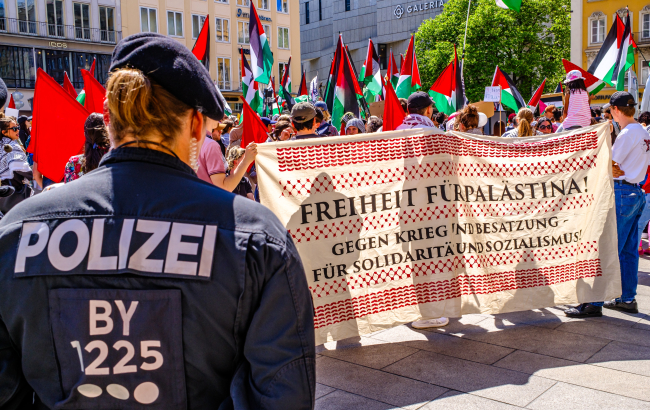
Overwhelmed: Germany’s Israel Policy after October 7th
Few countries have been as profoundly affected by the attacks of October 7th and the subsequent Gaza war as Germany. This is not merely a political controversy. It reflects a deeper structural problem: German-Israel policy has long rested on two guiding principles—a particular historical responsibility toward Israel derived from the Holocaust, and a firm commitment to universalist norms, above all international law and human rights.
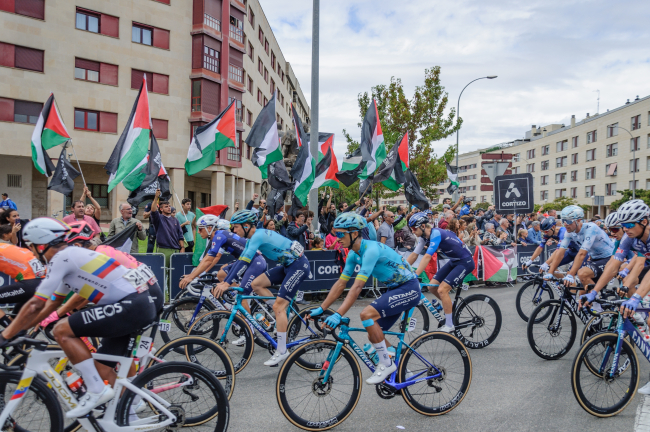
Escalation within Continuity: Spain’s Foreign Policy towards Israel and Palestine after October 7th
Over the past two years, Spain has emerged as one of the most vocal countries in supporting the Palestinian cause. While Madrid initially aligned with the prevailing European position, recognizing Israel’s right to self-defense after the 7 October attacks, it soon distinguished itself from most European Union (EU) Member States by questioning and later condemning Israel’s conduct of war in Gaza.

Australia’s Recognition of Palestine: A Case of Supporting the Status Quo over Accountability
Hamas’s terrorist attacks against Israel on October 7, 2023, killed over a thousand Israelis, altering irrevocably the way the Palestinian/Israeli conflict is viewed internationally. Australia’s government professed profound shock and disgust at Hamas’s attacks, together with its unwavering diplomatic and political support for Israel. But as Israel’s response became more concerned with exacting revenge and as the pretext to fulfill long-held ideological dreams of a Greater Israel, support from Australia became more muted and conditional. This culminated in Australia joining Britain, France, and Canada in formally recognizing a Palestinian state at the United Nations General Assembly meeting in September 2025.
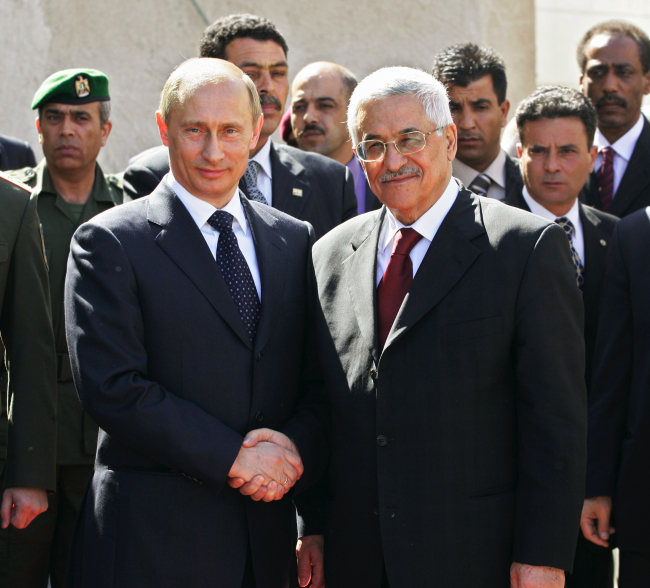
Russia, the Palestinians and Gaza: Adjustments after October 7th
The Soviet Union (USSR), and subsequently the Russian Federation as its internationally recognized legal successor, has consistently sought to play a visible role in efforts to resolve the Israeli-Palestinian conflict.