




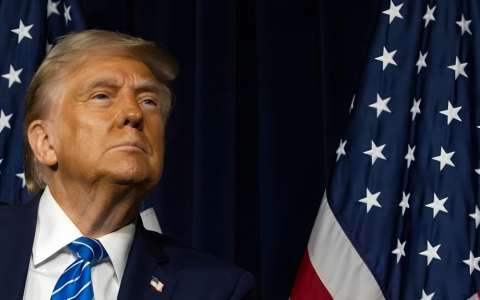
Jeffrey GOLDBERG - Trump: One Year After The Election
3 questions to Jeffrey GOLDBERG, Editor in Chief, The Atlantic
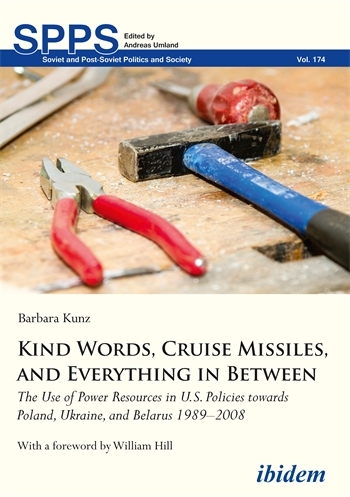
Kind Words, Cruise Missiles, and Everything in Between. The Use of Power Resources in U.S. Policies towards Poland, Ukraine, and Belarus 1989–2008
According to realist premises, the United States has an interest in remaining the world's only superpower, thus creating the need to manage and maintain unipolarity. The pursuit of this grand strategy, however, required the U.S. to adapt its various strategies to individual states. Poland, Ukraine, and Belarus have played very different roles.
The German landscape of foundations and think tanks.
The number of crises we face is rising, due to failing states, wars and armed conflicts, poverty and lack of good governance in many countries. State and society are constantly confronted with new challenges. These crises occur simultaneously and at an ever faster pace.
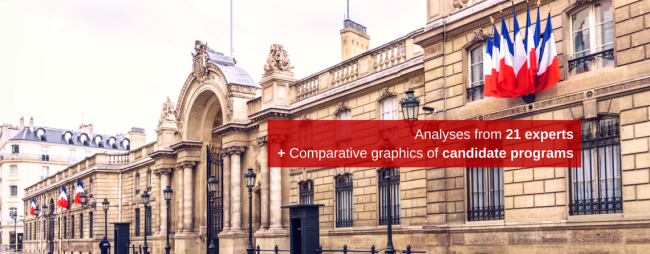
Foreign Policy Challenges for the Next French President
France’s current presidential campaign has created an unprecedented situation fuelled by revelations and a total absence of restraint, but it has not truly taken account of the disruptions of the last year: Brexit, the attempted coup in Turkey, the election of Donald Trump, the recapturing of Aleppo by Bashar al-Assad, Xi Jinping’s declarations about “economic globalization”, or the behavior of North Korea. The debate, or rather its absence, can be looked at in two ways.

Tough Balancing Act for Japan’s Abe in Second Meeting With Trump
Japanese Prime Minister Shinzo Abe was the first foreign leader to meet with U.S. President-elect Donald Trump after his election. On Friday, Feb. 10, he will meet with President Trump, before spending the weekend at Mar-a-Lago in Florida.
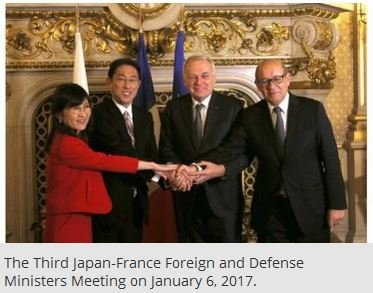
Japan and France: Slowly but Surely Moving Forward on Security Cooperation
Despite being geographically distant, France and Japan share a number of converging interests.
India’s Act East policy: strategic implications for the Indian Ocean
Since the Modi government came to power in June 2014, it has invested diplomatic capital in announcing the transformation of India’s ‘Look East’ policy into a new ‘Act East’ policy.
Middle East, the new "Great Game"
Will a divided Middle East become the center of a new “Great Game”? The world’s global powers are aligned in it: the United States, falsely tempted by retraction; Russia, establishing its position in an unexpected state of play, France, destabilized by the contradictions of its own policy… In addition are tussles for regional hegemony between Iran, Turkey, and Saudi Arabia.
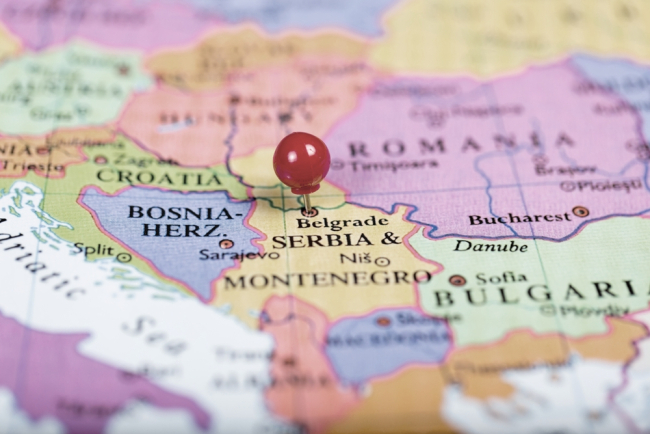
The Western Balkans : a touchstone for German and European foreign policy
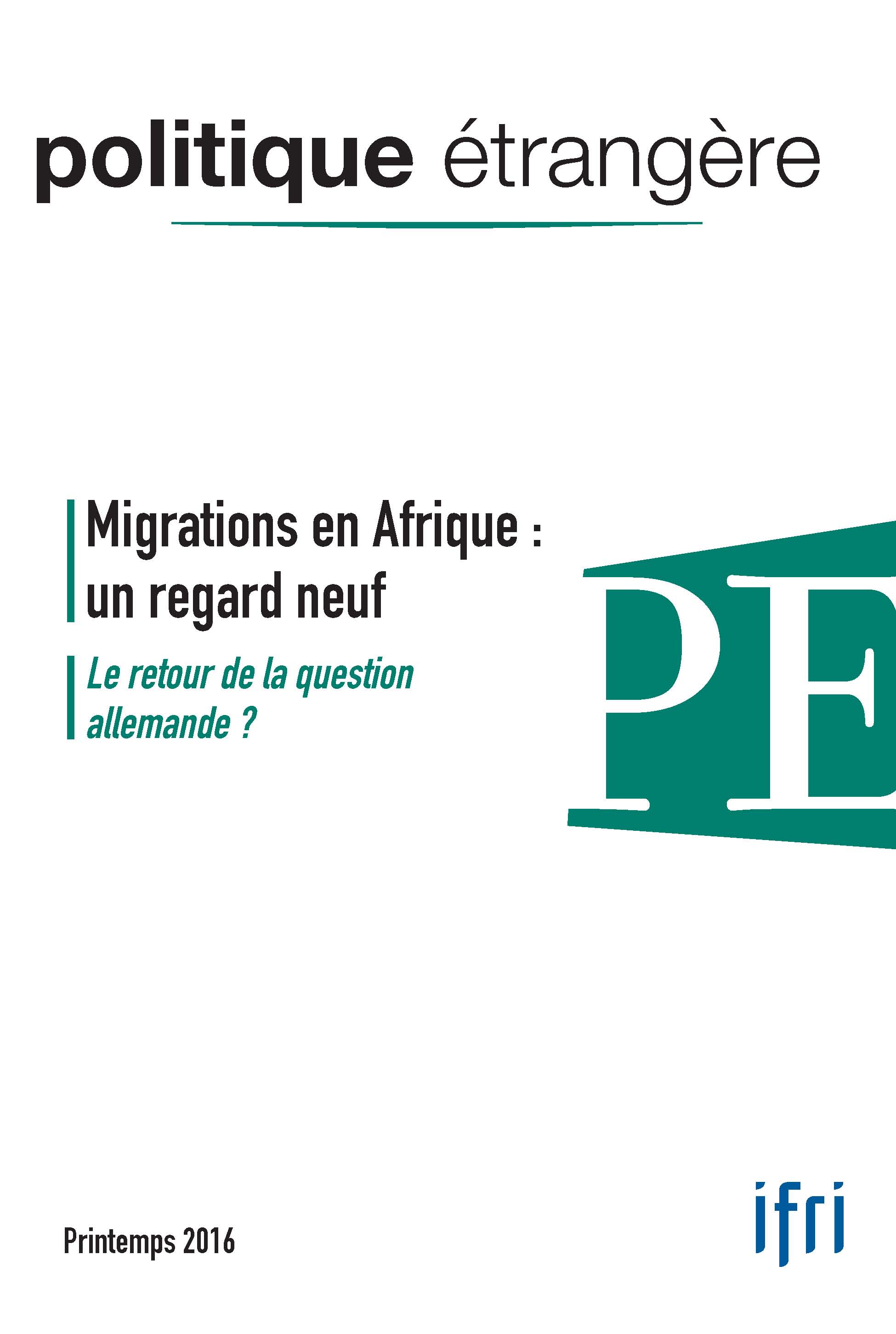
Migrations in Africa: Another Look
Migration in Africa is a major concern, but largely for Africans alone. To adequately study the question of international migration, one must look beyond Europe’s current predicament. Through its dossier on “Migrations in Africa: Another Look”, this issue of Politique étrangère examines a number of factors that determine migration movements, how states in Africa attempt to manage the significant problem of internal migration, the difficulties of integrating migrant workers into their host societies, and the false pretenses of Euro-African agreements on readmission.
A Time of Change for Algeria’s Foreign Policy
Having been formed in large part by the legacy of the post-independence diplomatic process, by forced withdrawal during the civil war and fixation on a few regional issues, Algerian diplomacy has to redefine itself in a rapidly changing world.
Challenges ahead for Global Europe
The year ahead will be critical in determining the European Union’s standing on the global stage.
China's Two-Track Foreign Policy: From Ambiguous to Clear-Cut Positions
This analysis examines the current ambiguities, priorities and approaches of Chinese foreign policy from a practitioner’s perspective, taking into account experiences of Beijing-based diplomats (interviews conducted in 2011 and 2012), in addition to recent Chinese foreign policy positions and official communications.
It leads to the following conclusions:
Defence and Foreign Policy Under President-elect François Hollande
We know little about François Hollande's stance on wider foreign and defence policy issues. Though we are unlikely to see major changes from his predecessor, some clues from his successful campaign suggest that President-elect Hollande will adopt a more European and Gaullist approach.
South Africa and the Arab Spring: opportunities to match diplomacy goals and strategies
This paper highlights how the Arab Spring magnified a two-dimensional gap in South Africa’s foreign policy. First that South Africa does not have a vision which reconciles demands for achieving the goals of protecting human rights, sovereignty, and multilateralism; second, that its strategies do not meet set goals. The paper then provides tentative explanations to this gap. It ends by elaborating what in the “African Awakening” and in the midst of the Arab Spring are opportunities for South Africa to overcome this gap.
Turkey's re-imagined neighborhood policy after the Arab Spring
Joshua W. Walker was a speaker at the international conference on “The international consequences of the Arab Spring” held at Ifri on March 13th, 2012. This paper is a follow up on his oral intervention.
Dreams and Nightmares: Australia's Past, Present and Future in Asia
This paper argues that Australian governments of both political stripes have responded pragmatically and effectively to the rise of China, the relative decline of the United States and the increased assertiveness of the Association of Southeast Asian Nations (ASEAN). When they have made mistakes, the Howard, Rudd and Gillard governments have worked hard to improve relations.
Ampo at 50: The Faltering US-Japan Relationship
For the last 50 years the governance of the US-Japan alliance has often been characterized by secret diplomacy and discretionary choices. In the post-war period Japan's strategic choices have given overall priority to sustaining a strong security alliance with the United States.
The Appointment of Vale de Almeida: A symbol of the Commission's predominance of the EEAS?
The recent appointment of João Vale de Almeida to be the head of the EU’s delegation in Washington D.C. sparked waves of controversy among the Member States. Why has this manoeuvre of Catherine Ashton become so polemical? What does it tell us about the institutional posturing of the new European External Action Service (EEAS)?
Japan's Foreign Policy Since The Meiji's Era: an Attempt of Interpretation
Ifri, a foundation recognized as being of public utility, relies largely on private donors – companies and individuals – to guarantee its sustainability and intellectual independence. Through their funding, donors help maintain the Institute's position among the world's leading think tanks. By benefiting from an internationally recognized network and expertise, donors refine their understanding of geopolitical risk and its consequences on global politics and the economy. In 2026, Ifri partners with over 90 French and international companies and organizations.
