Replay - Conference with Chris Wright, Secretary, U.S. Department of Energy
Welcomed at the French Institute of International Relations (Ifri), Chris Wright outlined his vision of American energy policy built around two core axes: the human reality of energy access, and a data-driven approach. For the Secretary, energy is the foundation of prosperity, health, and longer life expectancy on a global scale. His doctrine rests on an ambition of American "energy dominance" — not merely independence, but the capacity to produce at scale in order to lower domestic costs, reindustrialize the country, and support U.S. allies.
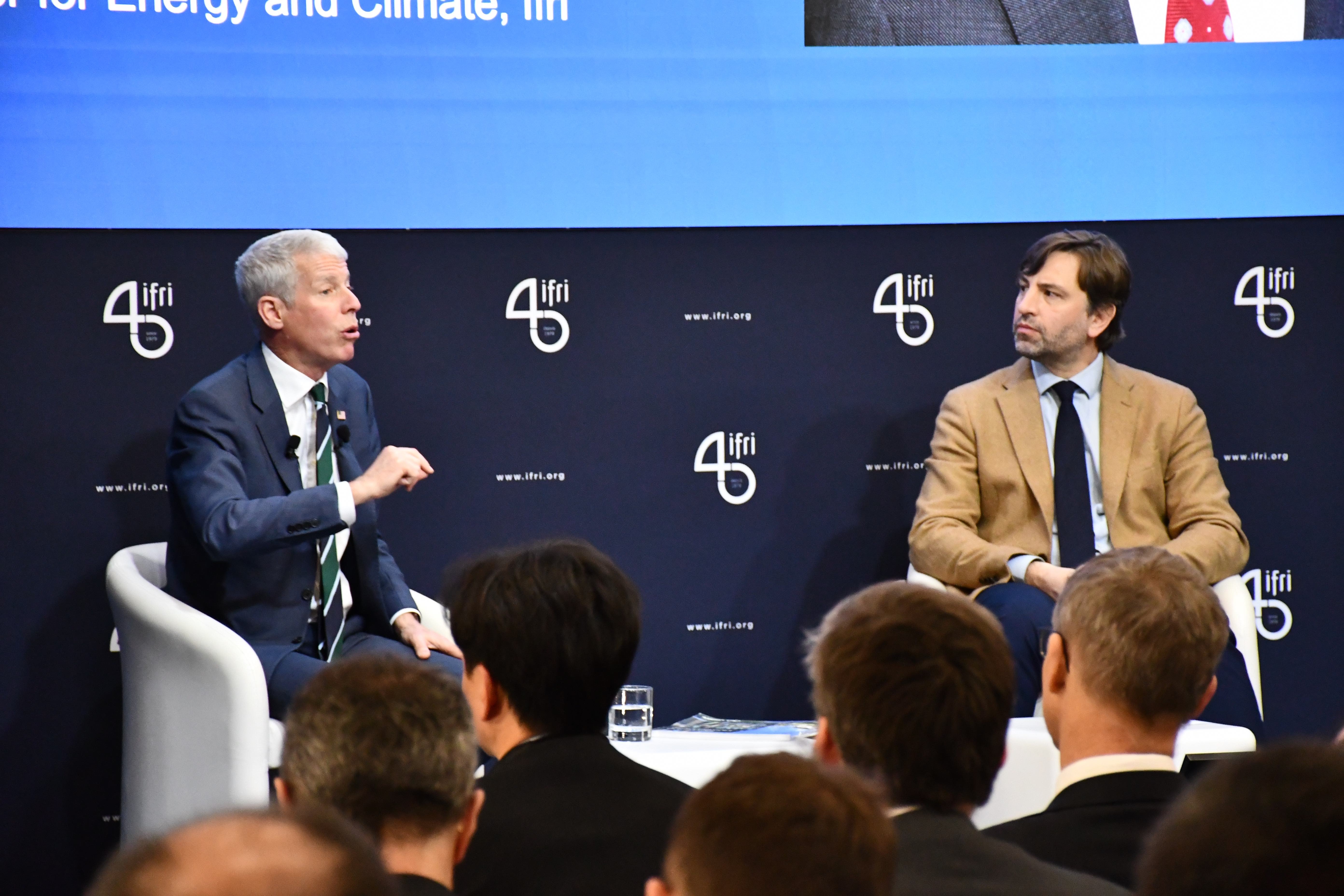
EU-US Energy Relations in Times of Global Reshuffling
A Franco-American Partnership Centered on Nuclear Energy
Nuclear power occupies a central place in Wright's address, as he describes a genuine "renaissance" of the sector in the United States. He announces a strengthened industrial partnership with French group Orano to restore American uranium enrichment and spent fuel reprocessing capabilities. He also expresses strong interest in small modular reactors (SMRs), capable of delivering not only electricity but also industrial heat, and views nuclear energy as the technology offering the greatest growth potential among stable, dispatchable energy sources.
American LNG as a Pillar of European Energy Security
Wright highlights that the United States has become Europe's leading supplier of liquefied natural gas, with the capacity to cover up to 70% of its needs. Driven by the shale revolution, he argues that this abundant and competitive supply can be guaranteed over the long term. Natural gas is presented as an indispensable transition resource — cleaner than coal and more flexible than other sources. This energy lever is part of a broader geopolitical strategy: securing supply for countries such as Bulgaria, Romania, and Ukraine through LNG corridors, in order to reduce their dependence on Russia.
Innovation, Regulation, and the Energy Mix
On energy policy, Wright advocates an approach centered on innovation rather than regulation. He questions the returns on investments in wind and solar relative to their share of the global energy mix, and raises concerns about the potential impact of certain regulatory frameworks — such as the European Union's Carbon Border Adjustment Mechanism (CBAM) — on smaller producers. He is, however, notably optimistic about the prospects of nuclear fusion and geothermal energy, the latter offering the advantage of continuous, stable output.
Global Energy Governance and Power Grids
Wright challenges the current positioning of the International Energy Agency, arguing that it has drifted from its original mission of energy security. He raises the possibility of an American withdrawal should the organization fail to refocus its priorities. He also acknowledges a structural underinvestment in electricity grids, both in the United States and in Europe, and calls for regulatory simplification to accelerate the deployment of transmission infrastructure and better meet peak demand.
> Learn more about the conference.

Media:
Share
Authors

Marc-Antoine EYL-MAZZEGA
Director, Center for Energy & Climate, Ifri