




Politique étrangère
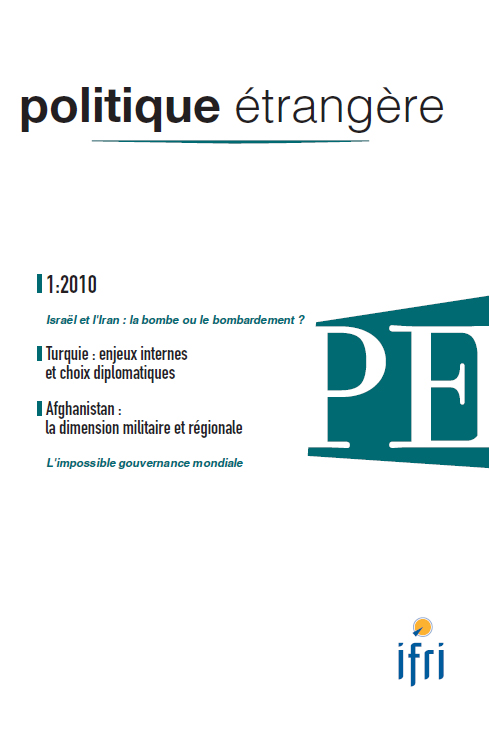
Turkey: Internal Issues and Diplomatic Challenges
The Lisbon Treaty was meant to mark the dawning of a new era for the EU. But as this issue of Politique étrangère demonstrates, the present outcome, which is only in part the result of the Treaty, is far from satisfactory.
NATO 1949-2009
A little more than 60 years after its creation, questions about the future of the Alliance emerge at the intersection of three observations. First, the complexity of the world, which makes the Alliance ‘inevitable,' since it is a rare source of stability and solidarity in a world marked by uncertainty. Second, American doubt. If the United States was the global policeman for some simple minds at the start of the 1990s, others see the US as having used up its power in the adventurism of the Bush Administration. The future will wipe out these two caricatures. For members of the Alliance, the US will long continue to be a necessary friend, whose power and possible abandonment are feared. The third observation is, obviously, Europe's incurable ethnocentricity: if Europeans knew how to look at the world and their place in it, they would rapidly give up their mediocre powerlessness. History is moving on elsewhere and raises questions on its chaotic path to which others are replying more quickly. In the years ahead, therefore, the Alliance may lorge ahead without Europe or nearly without it, despite the fact that Europeans' specific know-how could be useful.

The Reform of NATO and the Free World’s Security Pact
Reforming the structure does not go to the heart of the problem. A new understanding has to be reached among the allies that takes into consideration the political, economic and technical changes of the last decade.
Reforming NATO’s Institutions: Pressing Need, Enduring Obstacles, New Opportunities
The lessons learned from its engagement in Afghanistan, a desire to transform itself, and its current financial problems are all factors pointing to the need to reform the Alliance. Formulating a new Strategic Concept will allow institutional reform to be associated with a new sense of purpose.
NATO and Nuclear Weapons
The changes in the way that NATO operates raise the question of whether the nuclear weapons stationed in Europe would, in a time of crisis, be an instrument of solidarity, or lead instead to divisiveness.
France’s “Return” to NATO: An Inopportune Decision
The French decision to re-enter NATO’s integrated military structure is merely the confirmation of a series of shifts that started a long time ago. But it is no less questionable a decision. It is a symbolic decision that affects France’s image internationally. It by no means guarantees that the Alliance will evolve in a way that corresponds to France’s national interests; nor does it shed light on France’s ambiguous future. It does, however, in a very real way, risk diminishing France’s will to defend itself.
NATO-Russia: Is the ‘Russian Question’ European?
The proliferation of theaters (in Europe, the Caucasus, Central Asia, the Far East, the Middle East and the Arctic) and cross-cutting issues (proliferation, disarmament, energy, arms sales) demonstrate the overall importance of the NATO/Russia relationship.
Support independent French research
Ifri, a foundation recognized as being of public utility, relies largely on private donors – companies and individuals – to guarantee its sustainability and intellectual independence. Through their funding, donors help maintain the Institute's position among the world's leading think tanks. By benefiting from an internationally recognized network and expertise, donors refine their understanding of geopolitical risk and its consequences on global politics and the economy. In 2026, Ifri partners with over 90 French and international companies and organizations.
