
Politique étrangère
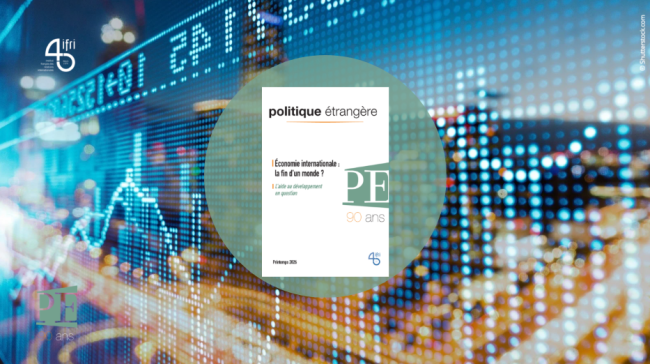
Digital Revolution, Economic Upheaval
The digital revolution is profoundly shaking up the economy, with the impact felt well beyond the digital sector itself. Indeed, it is transforming the very concept of value creation. Artificial intelligence represents a new phase that requires a colossal investment in physical infrastructure like data centers. Europe failed to grasp the scale of these changes in time, but it does have certain advantages.
Official Development Assistance in the Age of Deglobalization
Official development assistance has collapsed since 2023, both in Europe and in the United States. This decline has affected both developing and industrialized countries. Under fire in the Global North and South, the goals and methods of development assistance must be redefined if it is to adapt to an international landscape in which the principal actors—the United States, the European Union, China, the Arab countries—are adopting new stances.
Germany: The Return of Military Service?
Abolished in 2011, conscription returned to Germany in 2025, albeit in a new, voluntary form. The decision in 2011 was broadly supported. Public opinion, like the political sphere, is more divided now. The reintroduction of voluntary service for men reflects the demands of the geopolitical landscape and the Bundeswehr’s need for troops. It remains to be seen whether the model chosen will fulfill the requirements of defense chiefs.

The Gulf Search for Power(s) / Politique étrangère, Vol. 90, No. 4, 2025
Persian Gulf countries have become heavyweights in the international arena, wielding influence both regionally and far beyond. Acting as diplomatic mediators, investors, and hosts of global events, they are attempting to move beyond their long-standing role as suppliers of energy resources and reshape their economic, social, and political foundations through ambitious national “Visions”. Their international alliances are proving increasingly flexible, broadening their diplomatic reach (even if Washington’s influence remains decisive)—with Saudi Arabia, Qatar, and the United Arab Emirates all part of a dynamic pushing many global actors toward multi-alignment.
Gulf Sovereign Wealth Funds: Major Actors in World Finance
The sovereign wealth funds of Gulf countries have become key players in world finance. By investing colossal sums in strategic sectors, they contribute both to local development and the growing influence of the Gulf monarchies in the global economy and international politics. In the near future, they will have to grapple with two challenges: that of human capital, and that of their geopolitical position between the Global North and Global South.
Caught between China and the US: Southeast Asia’s Strategic Fence-Sitting
The secret of success for many Southeast Asian countries has been their choice of economic and diplomatic multilateralism. Fence-sitting between rival powers is becoming fraught. China inspires a degree of fear in the region, due to its clout and geographical proximity. And under Trump, the United States is on the offensive against the multilateral trade system, with major diplomatic consequences. Can Southeast Asian countries maintain their balance by embracing new partnerships?
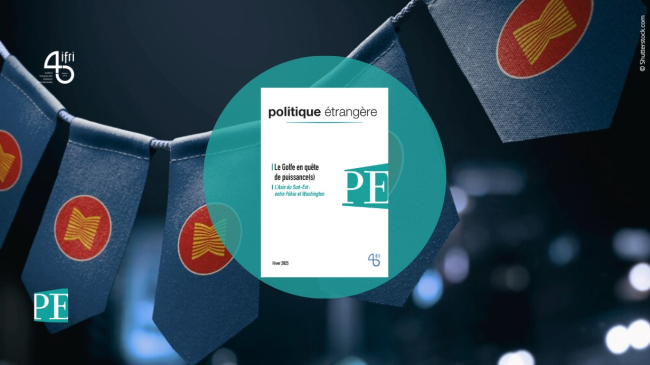
Has ASEAN become Marginalized within Regional Security Architecture?
South Asian leaders continue to reiterate how “central” ASEAN is to the region’s security architecture. However, in practice, the tendency is to prioritize bilateral agreements, gradually marginalizing the organization. This fragmentation is weakening regional cooperation, accentuating divisions, and compromising stability in the context of growing tensions in the Indo-Pacific. These trends are worrying at a time when Sino-American rivalries are becoming more acute.
Support independent French research
Ifri, a foundation recognized as being of public utility, relies largely on private donors – companies and individuals – to guarantee its sustainability and intellectual independence. Through their funding, donors help maintain the Institute's position among the world's leading think tanks. By benefiting from an internationally recognized network and expertise, donors refine their understanding of geopolitical risk and its consequences on global politics and the economy. In 2026, Ifri partners with over 90 French and international companies and organizations.