


Politique étrangère
Law and the International Order
It is tempting to conclude that international law’s influence is receding in a context where power struggles are in the ascendant, especially between dominant nations. But the law still carries weight: as the ultimate constraint on the use of violence, as a shared language for all human communities, and as a framework for action for those who seek to invoke it. It doubtless needs to be rethought and adapted to changes in international relationships, but without losing sight of its day-to-day importance.
The Crises Testing Arms Control
The arms control system built during and after the Cold War is under enormous stress and is fraying at the edges. It once enabled significant improvements in international security but is in danger of not withstanding the resurgence of tensions in recent years. Urgent action is now needed to prevent the proliferation of nuclear, chemical, and biological weapons, as well as cluster bombs and anti-personnel mines.

War and Technology: An Approaching Military Revolution?
Historically, technological change has altered how battles are fought but has not overturned the fundamental principles of war. However, three considerations may now represent an actual revolution: the recourse to tactical nuclear weapons, the development of software for “multi-domain operations,” and the prospect of general artificial intelligence. The organization of militaries and the use of force need to be rethought in this light.
War and Technology: An Approaching Military Revolution?
Historically, technological change has altered how battles are fought but has not overturned the fundamental principles of war. However, three considerations may now represent an actual revolution: the recourse to tactical nuclear weapons, the development of software for “multi-domain operations,” and the prospect of general artificial intelligence. The organization of militaries and the use of force need to be rethought in this light.
The Year He Woke
Vikas Swarup, an Indian writer and former diplomat, is the author of four novels, including Q & A (New York: Doubleday, 2005), which has been translated into 47 languages and adapted for the screen under the title Slumdog Millionaire.
Text published in Politique étrangère, Vol. 91, No. 2, 2026.
The Global Economy: Caught in the Storm / Politique étrangère, Vol. 91, No. 1, 2026
The global economy has become the primary arena for the clash of power ambitions in a world where understanding, coordination, and concerted multilateralism seem to have been permanently marginalized. In this fragmented landscape, how will American and Chinese strategies interact? Will the European Union manage to break out of its decades-old framework in order to face new competition? And will it be able, like others, to integrate the announced shift from a production economy to a digital, information economy? And what role will financial institutions, and central banks in particular, play in this transitioning international economy?
From Trump to Xi Jinping: Globalization's Great Rupture
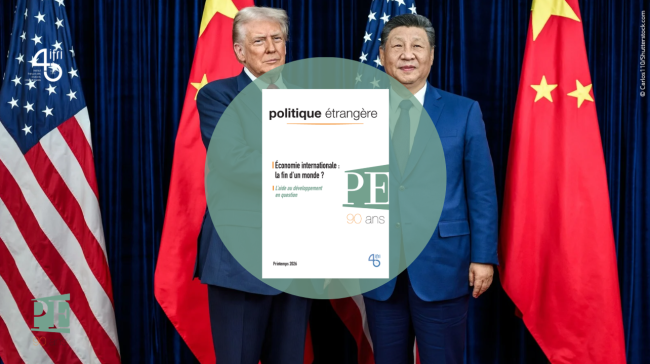
The second Trump administration’s trade policy represents a rupture with the United States’ international commitments and a seismic shock for the multilateral trade system. Its destabilizing impact has been exacerbated by China’s disproportionate trade surplus, which has doubled since the 2020 pandemic. We are entering a new era marked by the erosion of norms and their replacement by a more transactional logic. For Europe, the challenge is enormous.
Support independent French research
Ifri, a foundation recognized as being of public utility, relies largely on private donors – companies and individuals – to guarantee its sustainability and intellectual independence. Through their funding, donors help maintain the Institute's position among the world's leading think tanks. By benefiting from an internationally recognized network and expertise, donors refine their understanding of geopolitical risk and its consequences on global politics and the economy. In 2026, Ifri partners with over 90 French and international companies and organizations.
