


The European Union : When the Commission and Governments put the Future of Electricity Producers at Stake
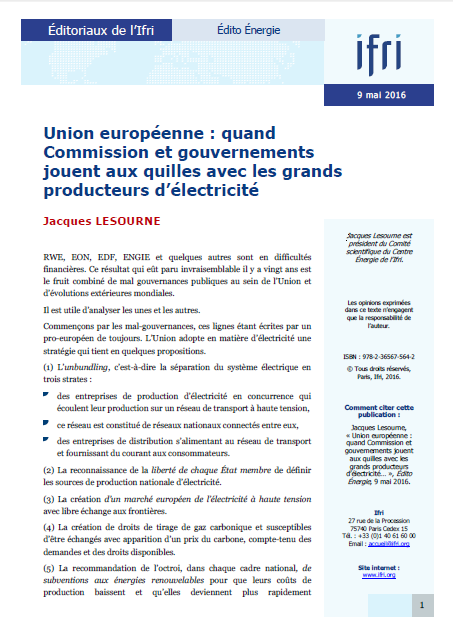
RWE, EON, EDF, ENGIE and other large utilities are in financial turmoil. This situation, which would have been unlikely twenty years ago, is related to several failures in governance within the EU as well as to global evolutions. This Edito Energie analyses the situation of large European electricity producers in light of the European energy policy.
This content is available in French: "Union européenne : quand Commission et gouvernements jouent aux quilles avec les grands producteurs d’électricité"


Jacques LESOURNE
Jacques Lesourne was President of the Scientific Committee of the Center for Energy

Center for Energy & Climate
Ifri's Energy and Climate Center carries out activities and research on the geopolitical and geoeconomic issues of energy transitions such as energy security, competitiveness, control of value chains, and acceptability. Specialized in the study of European energy/climate policies as well as energy markets in Europe and around the world, its work also focuses on the energy and climate strategies of major powers such as the United States, China or India. It offers recognized expertise, enriched by international collaborations and events, particularly in Paris and Brussels.
EU-UK Summit: The Need for a Reset
Since Brexit officially entered into force in 2020, the United Kingdom (UK) has worked to forge a new partnership with the European Union (EU). Serving its interests has meant getting closer to the EU in several economic sectors, without ever officially working towards EU reaccession.

Strategic Redundancy beyond Hormuz: Alternative Oil and Gas Corridors and Türkiye’s Emerging Role
The central question raised by the present crisis in the Gulf and the disruption of navigation through the Strait of Hormuz is not simply how quickly and lastingly normal flows can be restored, but whether the regional energy architecture can continue to rely so heavily upon a single maritime corridor.
Mining Nationalism and Export Restrictions: The Challenges of Economic Development
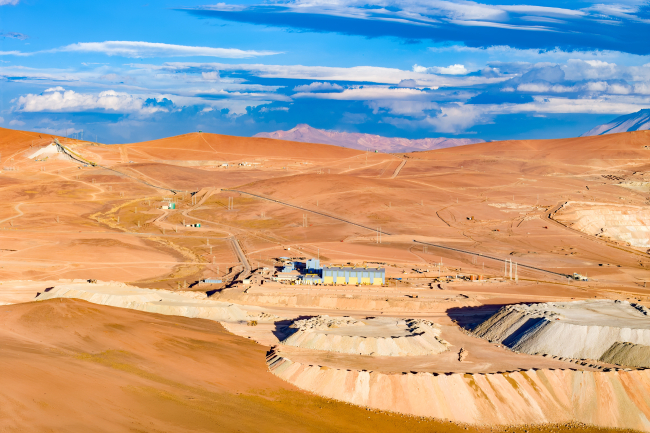
Since the end of the 2000s and especially the 2010s, resource nationalism has been on the rise.

Solar Radiation Management: A Climate Tool with Geopolitical Implications
The Paris Agreement (2015) aims to keep global warming below 2 °C, preferably 1.5 °C, above pre-industrial levels. Mitigation (reducing greenhouse gas emissions) remains the core tool for reaching net carbon neutrality by mid-century. However, a temperature overshoot is anticipated. The United Nations Environment Programme (UNEP) forecasts that the 1.5 °C threshold will be exceeded in the coming years, with warming potentially peaking between 2.2 °C and 3.6 °C this century. Against this backdrop, three trends characterize the climate policy debate.