


Strategic Redundancy beyond Hormuz: Alternative Oil and Gas Corridors and Türkiye’s Emerging Role
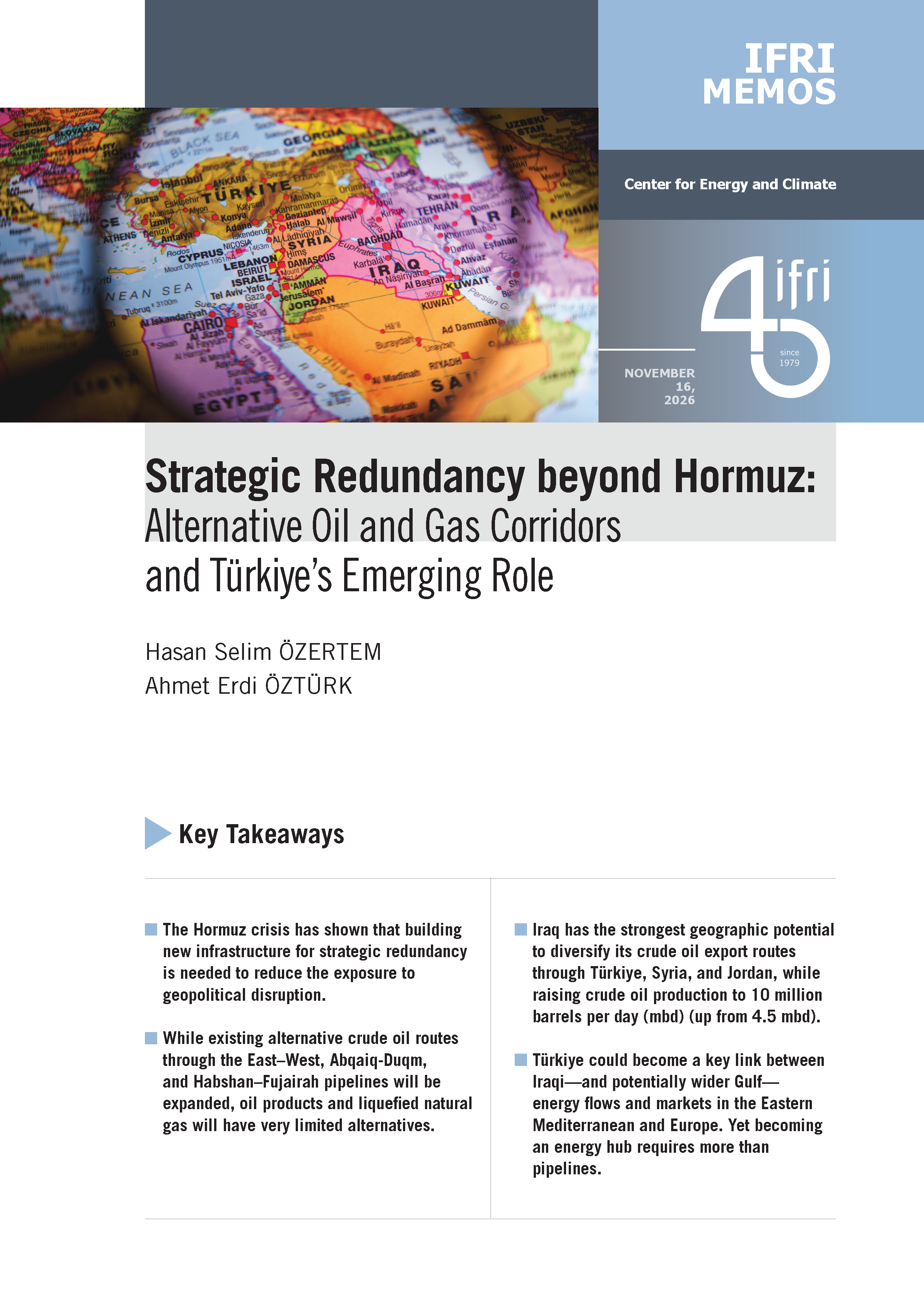
The central question raised by the present crisis in the Gulf and the disruption of navigation through the Strait of Hormuz is not simply how quickly and lastingly normal flows can be restored, but whether the regional energy architecture can continue to rely so heavily upon a single maritime corridor.

Recent developments suggest that vessels may face another challenge in passing Bab al-Mandeb, another chokepoint before the Suez Canal for cargoes destined for European markets or for tankers loaded at Yanbu headed for Asian markets.
A complete bypass of Hormuz is unrealistic, given that one-fifth of global energy flows pass through it. Thus, efforts towards diversification rather than substitution are being engaged in the medium term.
This involves projects that can be understood through the concept of strategic redundancy in parallel infrastructure, whose importance derives not simply from commercial efficiency under normal conditions but from its capacity to provide alternatives during periods of geopolitical disruption.
In this changing configuration, Türkiye, Syria and Jordan may acquire greater strategic transit significance as alternative and possibly competing routes develop.
This briefing evaluates ongoing projects and Türkiye’s potential new role as a hub for hydrocarbon supplies from the region.
Titre
Key Takeaways
The Hormuz crisis has shown that building new infrastructure for strategic redundancy is needed to reduce the exposure to geopolitical disruption.
While existing alternative crude oil routes through the East–West, Abqaiq-Duqm, and Habshan–Fujairah pipelines will be expanded, oil products and liquefied natural gas will have very limited alternatives.
Iraq has the strongest geographic potential to diversify its crude oil export routes through Türkiye, Syria, and Jordan, while raising crude oil production to 10 million barrels per day (mbd) (up from 4.5 mbd).
Türkiye could become a key link between Iraqi—and potentially wider Gulf—energy flows and markets in the Eastern Mediterranean and Europe. Yet becoming an energy hub requires more than pipelines.

Available in:
Themes and regions
ISBN / ISSN
Share
This page contains only a summary of our work. If you would like to have access to all the information from our research on the subject, you can download the full version in PDF format.
Strategic Redundancy beyond Hormuz: Alternative Oil and Gas Corridors and Türkiye’s Emerging Role

Center for Energy & Climate
Ifri's Energy and Climate Center carries out activities and research on the geopolitical and geoeconomic issues of energy transitions such as energy security, competitiveness, control of value chains, and acceptability. Specialized in the study of European energy/climate policies as well as energy markets in Europe and around the world, its work also focuses on the energy and climate strategies of major powers such as the United States, China or India. It offers recognized expertise, enriched by international collaborations and events, particularly in Paris and Brussels.

Mining Nationalism and Export Restrictions: The Challenges of Economic Development
Since the end of the 2000s and especially the 2010s, resource nationalism has been on the rise.

Solar Radiation Management: A Climate Tool with Geopolitical Implications
The Paris Agreement (2015) aims to keep global warming below 2 °C, preferably 1.5 °C, above pre-industrial levels. Mitigation (reducing greenhouse gas emissions) remains the core tool for reaching net carbon neutrality by mid-century. However, a temperature overshoot is anticipated. The United Nations Environment Programme (UNEP) forecasts that the 1.5 °C threshold will be exceeded in the coming years, with warming potentially peaking between 2.2 °C and 3.6 °C this century. Against this backdrop, three trends characterize the climate policy debate.
China’s Hydrogen Economy Five Years On
China’s hydrogen sector is not new. It is the world’s largest industrial hydrogen system, rooted in ammonia, methanol, refining, coal chemicals and by-product gas streams.
27 Plans for 2027: Turning the Electrification Action Plan into National Action
With the aim of structurally reducing the European economy’s dependence on fossil fuel imports and accelerating the energy transition, the European Commission has opted for electrification.