





South Asia
South Asia, a field of rivalry for influence between China and India, continues to experience high levels of intra-state violence in certain areas (Afghanistan, Baluchistan, Jammu and Kashmir).
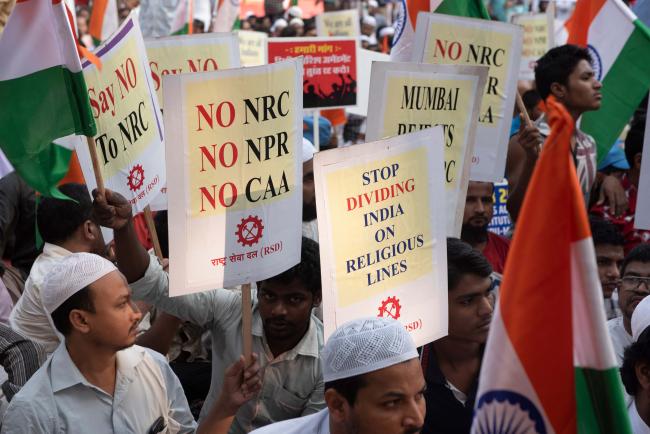
Making Sense of India’s Citizenship Amendment Act 2019: Process, Politics, Protests
India's new citizenship law is an outcome of Hindutva Constitutionalism that legitimizes the notion of Hindu victimhood. While the opposition to the law has been vocal, it has remained fragmented.
India’s Space Program - International Competition and Evolution
India’s space program has grown and evolved significantly in the last five decades. The program originally focused on developing space assets that provided direct developmental benefits, for example telecommunications and remote sensing satellites that helped both in improving communication facilities and giving direct assistance to India’s farmers. But over time, India has shifted a part of its focus towards space exploration and other high-profile missions that do not have as clear a developmental purpose as earlier. This includes, for example, India’s Mars and Moon exploratory missions. Overall, India has been fairly successful in these efforts and its space program has become a comprehensive one that includes not only a robust launch capacity and very large remote sensing satellite systems, but also a very well rounded scientific and deep space exploratory program.

The Indo-Pacific: A Viable Concept? / Can we Stabilize the Sahel?
Only devised a few years ago, the concept of the Indo-Pacific seeks to express a new configuration of the world’s globalization. In terms of economic exchange and power distribution, the Indo-Pacific is a unitary region spanning from the Persian Gulf to the Pacific, where all the major powers meet, size up and confront one another.
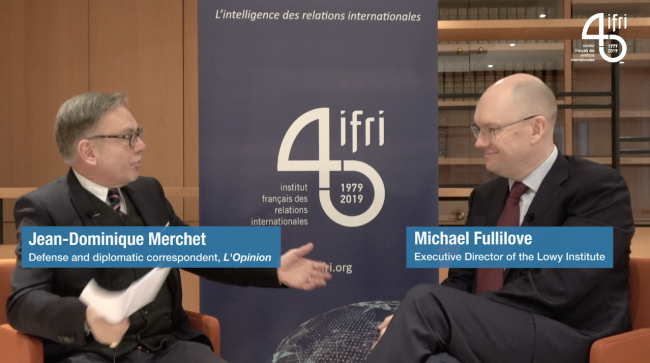
The Indo-Pacific: a View from France and Australia
An interview with Michael Fullilove, Executive Director of the Lowy Institute, by Jean-Dominique Merchet, Defense and Diplomatic Correspondent, L'Opinion.
Natural Allies? The India-US Relations from the Clinton Administration to the Trump Era
In recent years, experts and onlookers have noted a convergence of geopolitical interests between the United States and India.
Between Giants: The Sino-Indian Cold War in the Indian Ocean
Strategic competition between India and China in the Indian Ocean is growing and has the potential to profoundly impact the stability and security of the region. The Indian Ocean is becoming the scene of a sustained contest that in some ways resembles strategic competition during the Cold War.
The Indo-Pacific Vision in Strategic Limbo: A Foreign Policy Case Study for the Trump Era
The Trump Administration’s Indo-Pacific security strategy is a case study in foreign policymaking under a non-unitary executive.
Asia–Africa Growth Corridor at the crossroads of business and geopolitics
The Asia–Africa Growth Corridor (AAGC) — a Japan–India initiative to promote connectivity between Asia and East Africa and encourage joint projects in Africa — is often misrepresented. All too often, the AAGC is depicted as a political move aimed exclusively at countering China’s Belt and Road Initiative (BRI).
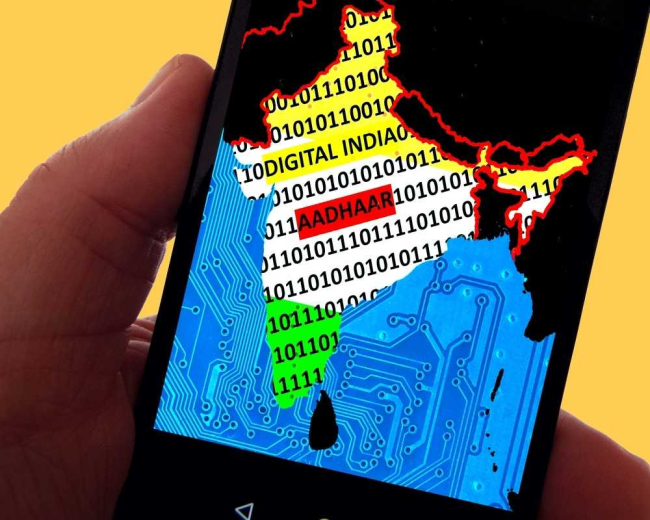
Questions of Fact: India’s Aadhaar Matter and the Limits of the Supreme Court
In September 2018, the Supreme Court of India rendered its verdict in a landmark case with major implications for the Aadhaar biometric identification project as well as the application of right to privacy in India, but the Aadhaar Matter raises important questions about the shortcomings of the Supreme Court’s practice of judicial review.
The Japan-India Economic Partnership: A Politically Driven Process
In the last decade, the strengthening of the India-Japan strategic partnership has been primarily driven by geopolitical considerations, in an era of competing regional visions and influence.
“Development for All”: The Tarnished Slogan of Modi’s India
Narendra Modi’s BJP (Bharatiya Janata Party) has held an unprecedented majority since the 2014 elections.

Renewable Energy in India: Solutions to the Financing Challenge
India has committed to ambitious action on climate change, but financing its renewable energy goals remains a significant challenge.
Democracy in Asia: Models, Trends and Geopolitical Implications
Assessing the state of democracy in Asia is a challenge. While some countries, such as Japan and India, have been showing the way from early days, some others, such as in Southeast Asia are still struggling to ensure stable and sustainable democratic institutions and practices.
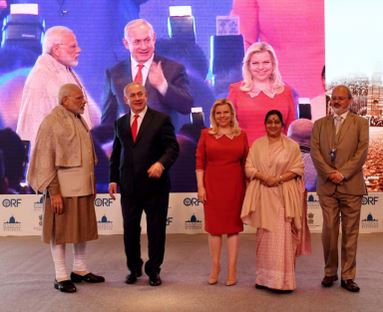
The Raisina Dialogue: India's Answer to World Disruptions
If India has long been perceived, and rightly so, as a reluctant player in international affairs, but that perception is quickly coming to an end. Indeed, by organizing a major international forum, the Raisina Dialogue, for the third year in a row, Delhi is signaling that it is now seeking to play a much more active role in dealing with the colossal economic, environmental, and political changes and disruptions affecting the world.
Working with “Last Mile” Data Protection in India
India’s digital economy is characterized by “last mile” data protection, with privacy norms, data collection and sharing standards being set at the level of the application (“app”), operating system (OS) and the device. This practice lends itself to multiple, often crisscrossing rules maintained by smartphone manufacturers, mobile operating system vendors and application developers. The user is caught in a maze of privacy policies that bear on important questions: what data is collected, where it is stored, who it is shared with, and legal recourse in the face of policy violations or unauthorized use of data by third parties.
Diplomacy as Diaspora Management: The Case of India and the Gulf States
In today’s world, diaspora management and diplomacy have become increasingly enmeshed, reflecting the growing interconnections between domestic and international issues.
The China-Pakistan Economic Corridor and the New Regional Geopolitics
The China-Pakistan Economic Corridor (CPEC) brings a dimensional shift in the two countries' relations at a time of significant geopolitical change. But while it promises wide-ranging benefits for infrastructure development and economic growth in Pakistan, a number of important challenges remain to be overcome if the project is to be sustainable and produce long-term benefits for Pakistanis.
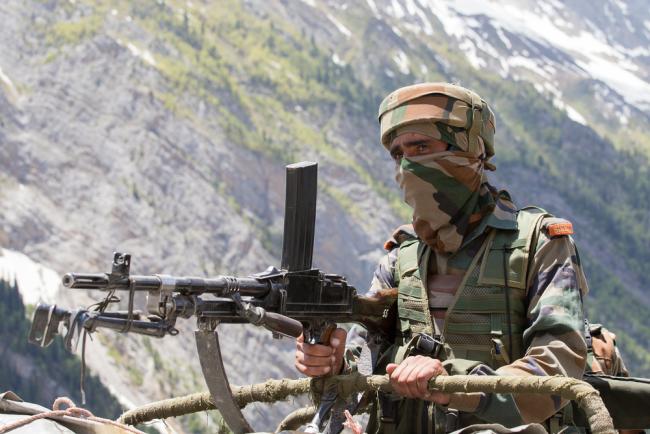
The Kashmir Uprising and India-Pakistan Relations: A need for conflict resolution, not management
This paper analyses the causes and consequences of the 2016 uprising in Kashmir, making six interrelated arguments.
Asia: What impact of international politics and grand strategies on regional stability?
As the regional balance of power in East Asia continues to evolve and tensions in a number of hot spots - from the East and South China Seas to the Korean Peninsula and the Taiwan Strait - either simmer or intensify, the future of regional stability is increasingly uncertain.
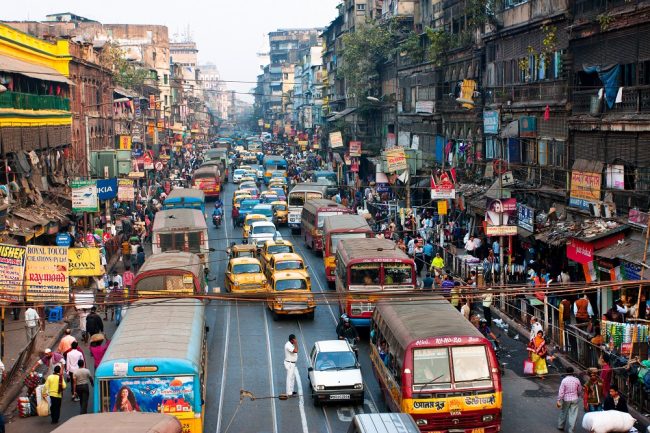
Challenge of Making Smart Cities in India
The Indian government has launched the Smart Cities Mission in June 2015 with the aim of providing a better quality of life to the citizens in 100 cities of the country. This paper describes the main features of the Mission and attempts to explain the challenges in the way forward.
Hospital Chains in India: The Coming of Age?
In many countries, the provision of hospital care is turning into an industry with the increasing presence of large corporate hospital chains. Along with public agencies and small private operators, corporations are now investing in the Indian hospital sector.
Since the 1980s, health sector reforms and the liberalization policy in India have created new profit-making opportunities in the health care market for local and international corporations. A new pro-market regulatory environment has helped private corporations to invest in the hospital sector.

The India-Pakistan-China Strategic Triangle in the New International Environment
Ifri, a foundation recognized as being of public utility, relies largely on private donors – companies and individuals – to guarantee its sustainability and intellectual independence. Through their funding, donors help maintain the Institute's position among the world's leading think tanks. By benefiting from an internationally recognized network and expertise, donors refine their understanding of geopolitical risk and its consequences on global politics and the economy. In 2026, Ifri partners with over 90 French and international companies and organizations.

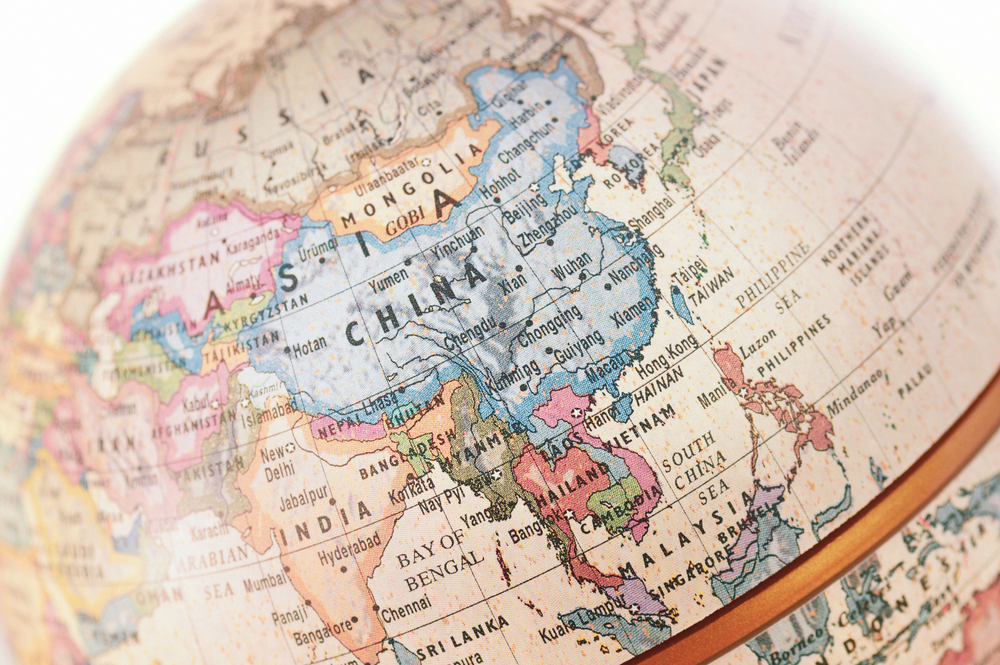
Asia is a nerve center for multiple global economic, political and security challenges. The Center for Asian Studies provides documented expertise and a platform for discussion on Asian issues to accompany decision makers and explain and contextualize developments in the region for the sake of a larger public dialogue.
The Center's research is organized along two major axes: relations between Asia's major powers and the rest of the world; and internal economic and social dynamics of Asian countries. The Center's research focuses primarily on China, Japan, India, Taiwan and the Indo-Pacific, but also covers Southeast Asia, the Korean peninsula and the Pacific Islands.
The Centre for Asian Studies maintains close institutional links with counterpart research institutes in Europe and Asia, and its researchers regularly carry out fieldwork in the region.
The Center organizes closed-door roundtables, expert-level seminars and a number of public events, including an Annual Conference, that welcome experts from Asia, Europe and the United States. The work of Center’s researchers, as well as that of their partners, is regularly published in the Center’s electronic journal Asie.Visions.