



Framework Nation: A European Challenge and French Ambition
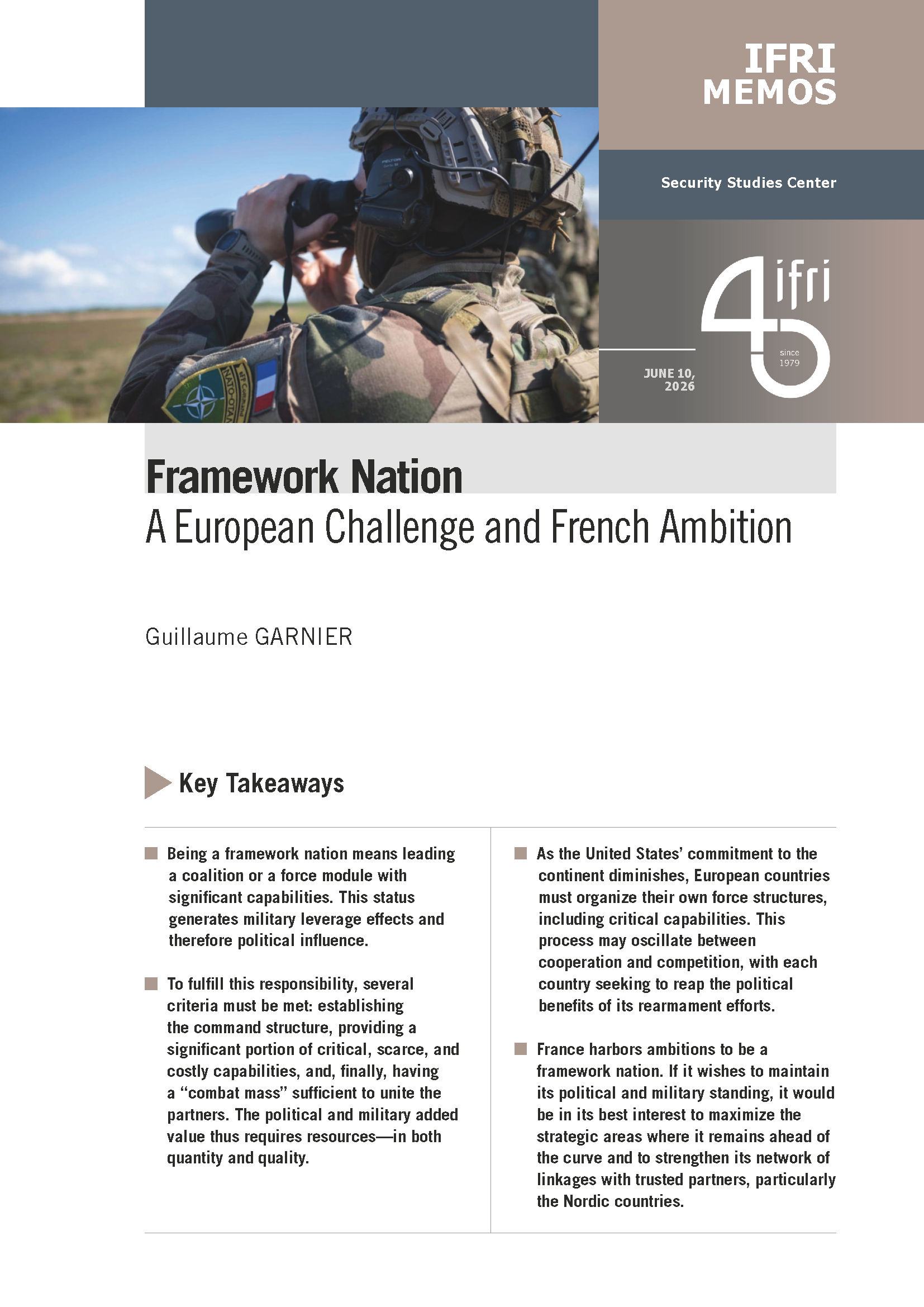
First appearing in the early 2000s, the framework nation concept follows several distinct rationales, whether it refers to a country assuming the leadership of a military operation, directing a multinational capability project, or commanding a permanent force structure. In every case, the country that takes on this role fully intends to derive from it additional politico-military influence.
Titre
Key Takeaways
Being a framework nation means leading a coalition or a force module with significant capabilities. This status generates military leverage effects and therefore political influence.
To fulfill this responsibility, several criteria must be met: establishing the command structure, providing a significant portion of critical, scarce, and costly capabilities, and, finally, having a “combat mass” sufficient to unite the partners. The political and military added value thus requires resources—in both quantity and quality.
As the United States’ commitment to the continent diminishes, European countries must organize their own force structures, including critical capabilities. This process may oscillate between cooperation and competition, with each country seeking to reap the political benefits of its rearmament efforts.
France harbors ambitions to be a framework nation. If it wishes to maintain its political and military standing, it would be in its best interest to maximize the strategic areas where it remains ahead of the curve and to strengthen its network of linkages with trusted partners, particularly the Nordic countries.
Originally conceived for crisis-management scenarios, the concept must now be analyzed through the lens of a “major engagement”, a hypothesis clearly reaffirmed in the Revue nationale stratégique 2025 (National Strategic Review) and underscoring the imperative to field forces capable of waging a sustained interstate conflict. The challenge is therefore of an altogether different nature and must be placed in a context where the defense of the European continent could rest, essentially, on the forces of its own countries alone, owing to the tangible weakening of the transatlantic link.
Being a framework nation presupposes, first of all, possessing a number of critical command and support capabilities that ensure coherence among the deployed force modules. Yet these “critical enablers” are precisely what Europe lacks, since the North Atlantic Treaty Organization (NATO) collective force system was conceived and organized around a decisive American contribution. Beyond its role as a capability architect, the framework nation must also be able to provide a sufficient “combat mass” to give consistency and impetus to the whole. Meeting this challenge in the short term is extremely ambitious, and all the more so as it could fall within a logic of competition among European states seeking to translate their rearmament effort into political influence or industrial returns. It is therefore necessary to gauge the scale of these efforts in order to consider the possible shifts within the continent’s politico-military hierarchy.
At the European level, no country today meets all the criteria; while the weight of Germany and Poland is set to grow, France retains comparative advantages that give it, for some time yet, a certain head start in proposing common projects that would allow it to act as a framework nation, particularly on matters with a strategic dimension. France should also better organize “clubs of affiliates” in order to bring together the conditions for structuring sizeable force clusters, ahead of a major engagement.

Available in:
Themes and regions
ISBN / ISSN
Share
This page contains only a summary of our work. If you would like to have access to all the information from our research on the subject, you can download the full version in PDF format.
Framework Nation: A European Challenge and French Ambition


Guillaume GARNIER
Associate Research Fellow, Security Studies Center, Ifri

Security Studies Center
Heir to a tradition dating back to the founding of Ifri, the Security Studies Center provides public and private decision-makers as well as the general public with the keys to understanding power relations and contemporary modes of conflict as well as those to come. Through its positioning at the juncture of politics and operations, the credibility of its civil-military team and the wide distribution of its publications in French and English, the Center for Security Studies constitutes in the French landscape of think tanks a unique center of research and influence on the national and international defense debate.
Defense Research Unit
The Defense Research Unit is a program that aims at stimulating the strategic debate by dealing with subjects at the junction of the “technico-operational” and the “political-strategic”. A unique structure in France, it brings together civilian researchers and “military fellows” from each of the three armies to produce work on defense policies, the capability and strategic adaptation of armies, and foresight on tomorrow's conflicts.

Confronting Russia’s High-Velocity Arsenal: European Challenges and Solutions
Since February 2022, Russian missile and long-range drone strikes against Ukraine have served as near-daily reminders of what European states could face in a war with Russia. The same weapon systems battering Ukrainian infrastructure and population centers would be directed against European military and civilian targets in any confrontation between Russia and NATO. As Russian missile production expands and its arsenal diversifies, Europe must confront an uncomfortable question: how to deter, and if push comes to shove, fight Russia's long-range strike arsenal?

The War on Terrorism: Global Experts Reflect on Lessons Learned Twenty-Five Years After 9/11
Twenty-five years ago, the September 11 attacks prompted the invention of new security architectures that shaped the war on terrorism. Sixteen think tank experts from fifteen countries reflect on the successes, failures, and missed opportunities in the fight against terrorism—a fight that is still ongoing.
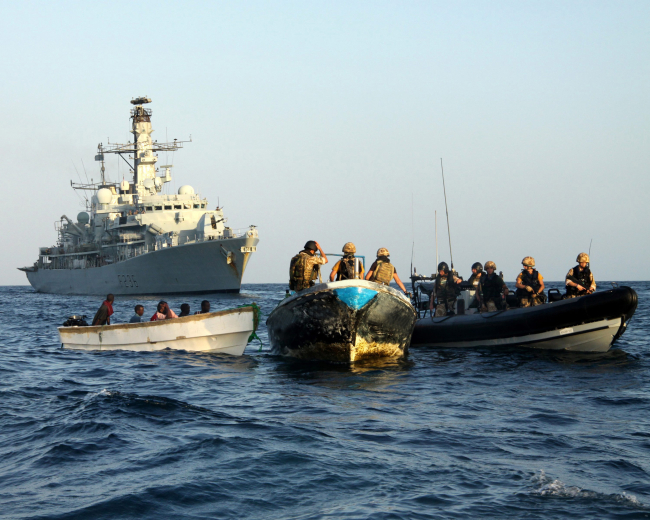
From Corsairs to Private Military Contractors. Nonmilitary Maritime Actors and the Historical Continuities of Naval Warfare
Since late 2023, several Houthi attacks on commercial shipping have involved privately contracted armed teams conducting defensive engagements and coordinating immediate response efforts, often in the relative absence of regular naval forces during the immediate hostilities at sea. These cases highlight a strategic tension that increasingly confronts modern navies. On the one hand, they are expected to conduct persistent, low-intensity maritime security tasks such as counterpiracy, maritime policing, and the protection of commercial shipping. On the other hand, they face renewed pressure to prepare for high-intensity conflict against peer and near-peer adversaries amid the return of great power competition.
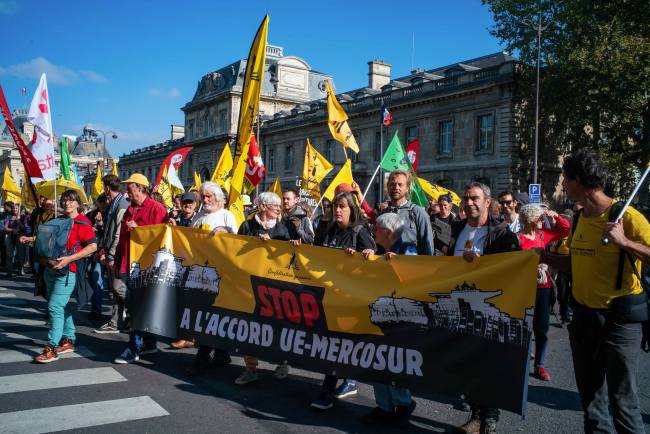
The Nuanced Relationship Between Public Opinion and Foreign Policy
Public sentiment is something decision-makers must contend with, especially in democratic states. However, the extent to which public opinion shapes foreign policy varies. Three Council of Councils experts in France, India, and Nigeria reflect on how public opinion does—and sometimes does not—affect foreign policy decisions.