






Fury from the Skies. A Strategic Analysis of Air Campaign against Iran
What is the outcome of Operations Roaring Lion (RL) and Epic Fury (EF), launched by Israel and the United States against the Islamic Republic of Iran on February 28, 2026?
Over 40 days, nearly 19,000 sorties struck some 24,000 targets without major ground engagement and without any credible domestic armed opposition. For the first time since 1945, this amounted to a real-scale test of the maximalist airpower thesis—the claim that aerial force alone can topple a major regional regime. The attempt failed in its central political objective. The April 8 ceasefire registered an implicit downward revision of US–Israeli ambitions.
Yet the campaign cannot be dismissed as a total failure: its execution demonstrated an unprecedented mastery of airpower across several lines of operation. It demands instead a careful interrogation of contemporary airpower’s capabilities and structural limits.
Titre Edito
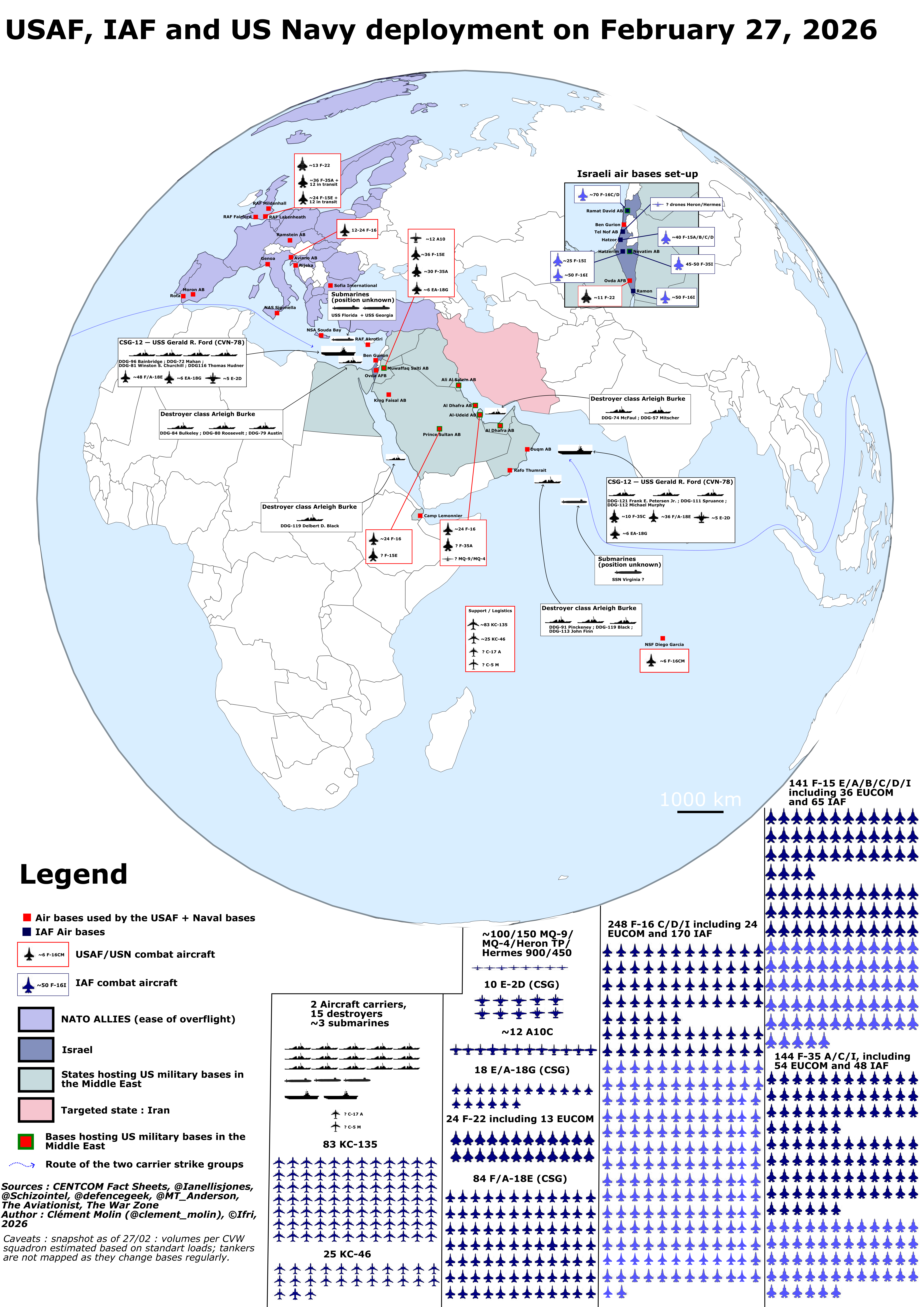
Air and Naval Order of Battle as of February 27, 2026
Air and Naval Order of Battle as of February 27, 2026
The coalition’s theory of victory rested on regime change by decapitation, sustained by an alignment between Israel and the US, by Iran’s relative weakening, and by an emerging hubris fed by the perceived successes of Operations Midnight Hammer (June 2025) and Absolute Resolve (January 2026). It drew on a distinctively Israeli strategic culture characterized by a preference for elimination over neutralization and the primacy of intelligence-driven targeting—rather than on the classical canons of airpower theory—and on the twenty-year maturation of the Israeli Air Force (Heyl Ha’Avir) since the 2006 Lebanon shock: industrialized dynamic targeting, Artificial Intelligence (AI)-assisted kill chains, fourfold sortie generation, and longer reach through Sparrow aero-ballistic missiles and the F-35I Adir.
Titre Edito
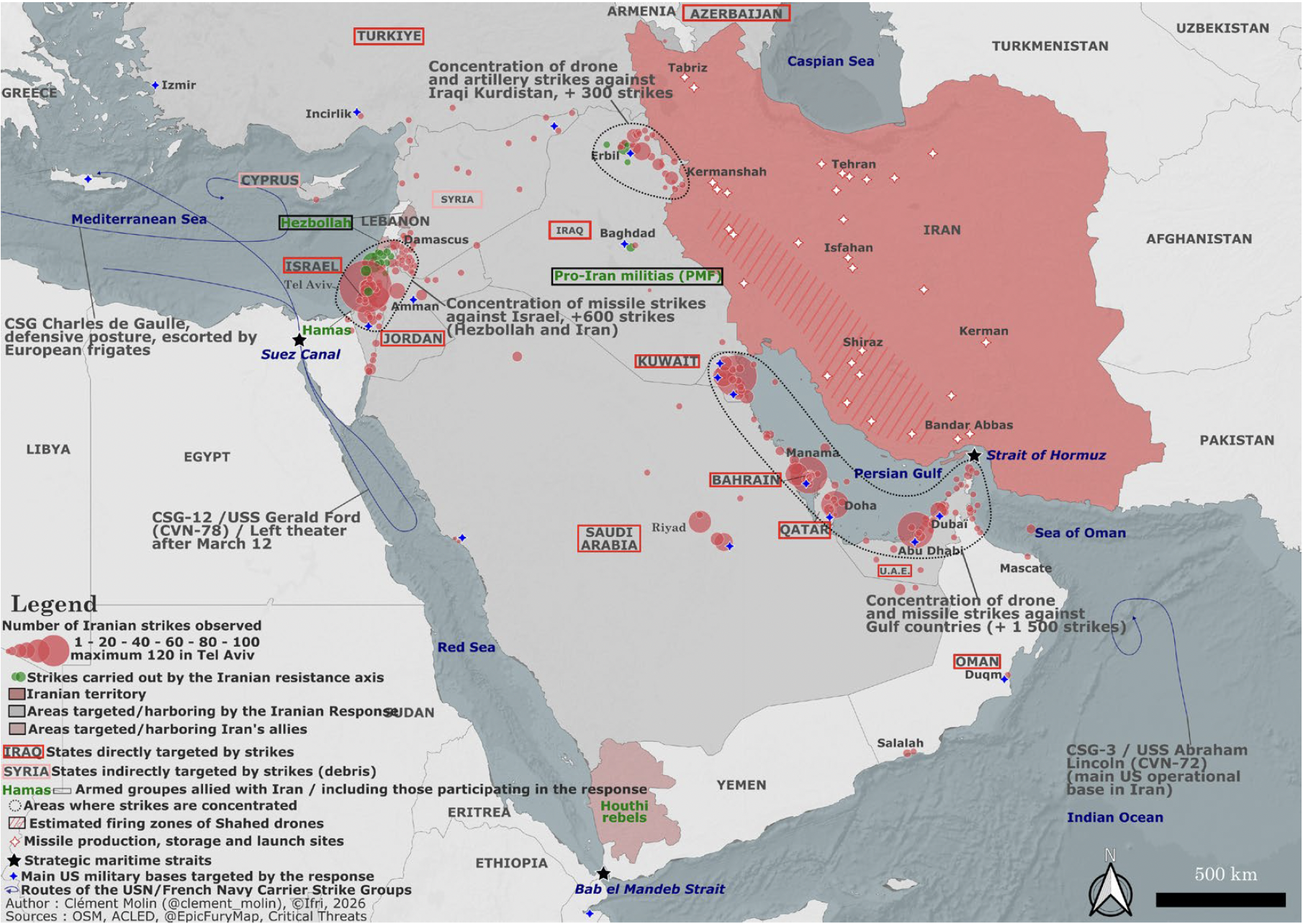
Iran's Response in the Region
Iran's Response in the Region
The campaign’s dynamics were shaped as much by Iranian counterstrategy as by allied planning. The opening triptych (decapitation, air superiority, preemptive disarmament) was executed with rare precision. But Iran’s “mosaic defense” construct, patiently built since 2005, absorbed the initial shock, allowed rapid reconstitution of a hardened command structure, and imposed costs through horizontal escalation against Gulf bases and via proxies. The coalition was forced to inflect its effort, sliding from the original logic of political paralysis toward attrition, and then toward a coercive logic initially excluded from its theory of victory.
Three cross-cutting lessons emerge.
- EF/RL should be read as one episode in a meta-campaign open since April 2024, if not the October 7 attacks, with multiple phases of “shaping by striking”.
- Full air supremacy proved out of reach even against a moderately equipped adversary whose integrated air defense system (IADS) had already been degraded by two prior offensive sequences. What remains attainable is conditional superiority, dependent on continuous suppression of enemy air defenses (SEAD) effort and confined to certain altitude bands; the lower layer is contested by short-range and infrared systems, and projected bases remain vulnerable to one-way attack (OWA) drones and ballistic missiles.
- Modern high-intensity air campaigns are now governed by the industrial sustainability of the salvo competition: production capacity, magazine depth, and the hi-low effector mix matter as much as platform performance—a calculus that current Western budgets and industrial architectures cannot solve in the short term.
Titre Edito
The Roaring Lion/Epic Fury Air Campaign
The Roaring Lion/Epic Fury Air Campaign
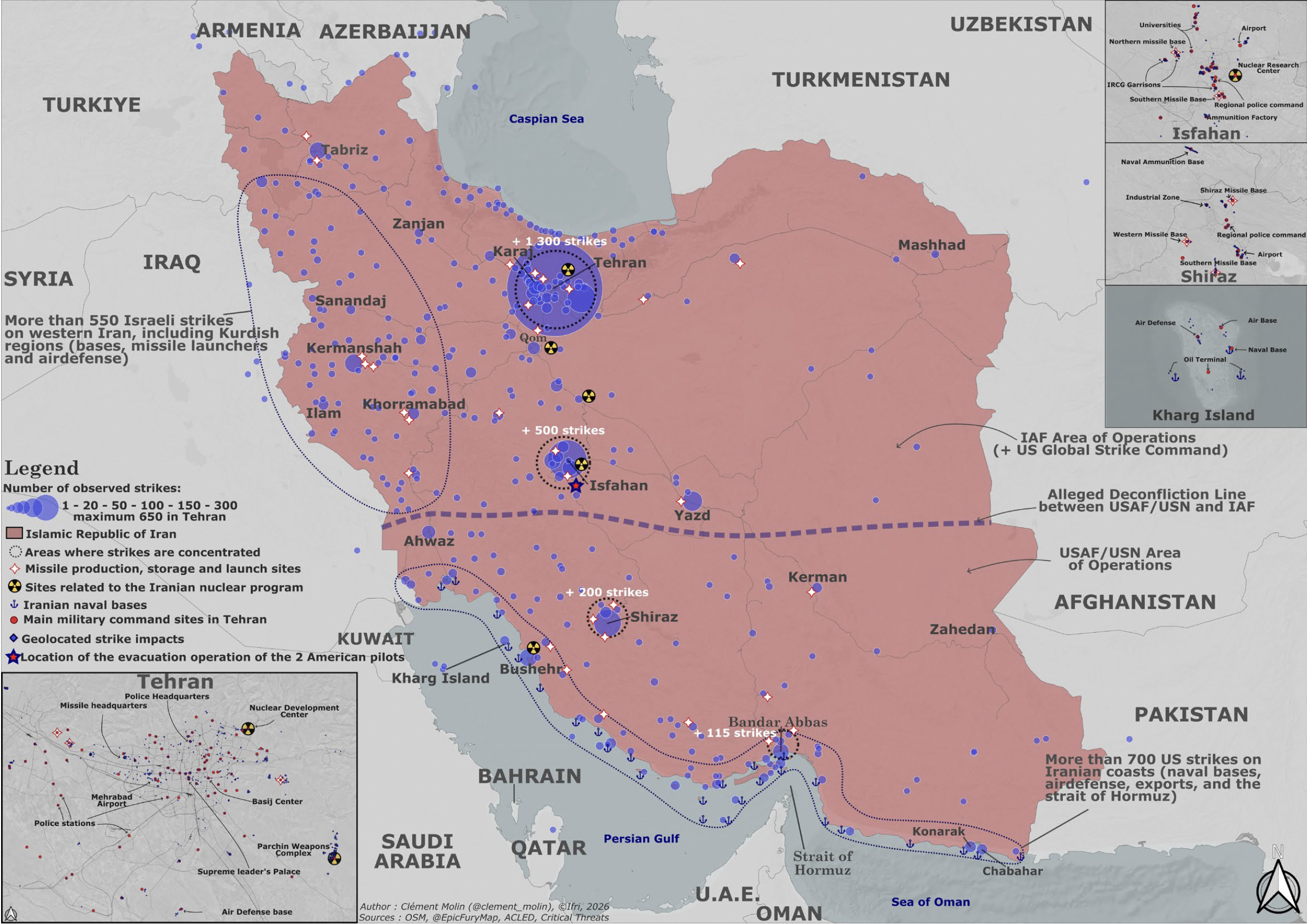
The verdict on EF/RL is therefore suspended. Of the five declared objectives, regime change failed; the dismantling of the nuclear program and of ballistic capabilities were partial successes, the question of 440 kg of highly enriched uranium still dissimulated in several facilities remaining unresolved; the destruction of the Islamic Republic of Iran Navy was substantially achieved; the disruption of Iran’s regional proxy network failed, with Hezbollah, the Houthis and Iraqi militias still active at the ceasefire. The reopening of the Strait of Hormuz, an objective added by economic necessity, remained unrealized, with crude trading above $100 one month after the ceasefire, compared with $70 before the war.
The implications for European air forces are direct, and they do not rest on the relevance of the Iranian theater to European interests. They follow from the transposition of EF/RL’s parameters to the high-intensity hypothesis against Russia, in a context where US strategic rear-support and backfilling can no longer be presupposed.
Three hard points stand out:
- The inadequacy of European SEAD capabilities and anti-radiation munition stocks against a Russian IADS of an entirely different order of magnitude.
- The gap of one to two orders of magnitude between European inventories and the volumes consumed in 40 days of EF/RL; and the obsolescence of a model centered on a narrow core of advanced platforms, which must give way to a complete capability ensemble—stand-off and stand-in effectors, multilayer air defense, persistent intelligence, surveillance, and reconnaissance (ISR).
- An industrial base sized to reconstitute stocks at the cadence of their consumption.
No European air force possesses this today; no European coalition possesses its cumulative sum. The cost of building it will be considerable. The cost of facing the coming decade with an air model calibrated for 1990s expeditionary operations would, in light of EF/RL, be greater still.
This study is also available in French.

Available in:
Themes and regions
ISBN / ISSN
Share
This page contains only a summary of our work. If you would like to have access to all the information from our research on the subject, you can download the full version in PDF format.
Fury from the Skies. A Strategic Analysis of Air Campaign against Iran

Élie TENENBAUM
Director of Ifri’s Security Studies Center

Jean-Christophe NOËL
Associate Research Fellow, Security Studies Center, Ifri


Security Studies Center
Heir to a tradition dating back to the founding of Ifri, the Security Studies Center provides public and private decision-makers as well as the general public with the keys to understanding power relations and contemporary modes of conflict as well as those to come. Through its positioning at the juncture of politics and operations, the credibility of its civil-military team and the wide distribution of its publications in French and English, the Center for Security Studies constitutes in the French landscape of think tanks a unique center of research and influence on the national and international defense debate.

Confronting Russia’s High-Velocity Arsenal: European Challenges and Solutions
Since February 2022, Russian missile and long-range drone strikes against Ukraine have served as near-daily reminders of what European states could face in a war with Russia. The same weapon systems battering Ukrainian infrastructure and population centers would be directed against European military and civilian targets in any confrontation between Russia and NATO. As Russian missile production expands and its arsenal diversifies, Europe must confront an uncomfortable question: how to deter, and if push comes to shove, fight Russia's long-range strike arsenal?
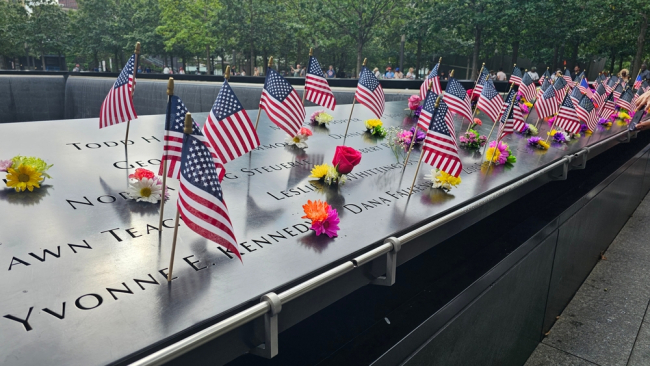
The War on Terrorism: Global Experts Reflect on Lessons Learned Twenty-Five Years After 9/11
Twenty-five years ago, the September 11 attacks prompted the invention of new security architectures that shaped the war on terrorism. Sixteen think tank experts from fifteen countries reflect on the successes, failures, and missed opportunities in the fight against terrorism—a fight that is still ongoing.
From Corsairs to Private Military Contractors. Nonmilitary Maritime Actors and the Historical Continuities of Naval Warfare
Since late 2023, several Houthi attacks on commercial shipping have involved privately contracted armed teams conducting defensive engagements and coordinating immediate response efforts, often in the relative absence of regular naval forces during the immediate hostilities at sea. These cases highlight a strategic tension that increasingly confronts modern navies. On the one hand, they are expected to conduct persistent, low-intensity maritime security tasks such as counterpiracy, maritime policing, and the protection of commercial shipping. On the other hand, they face renewed pressure to prepare for high-intensity conflict against peer and near-peer adversaries amid the return of great power competition.
Framework Nation: A European Challenge and French Ambition
First appearing in the early 2000s, the framework nation concept follows several distinct rationales, whether it refers to a country assuming the leadership of a military operation, directing a multinational capability project, or commanding a permanent force structure. In every case, the country that takes on this role fully intends to derive from it additional politico-military influence.