



How does France’s nuclear deterrent contribute to the defense of Europe?
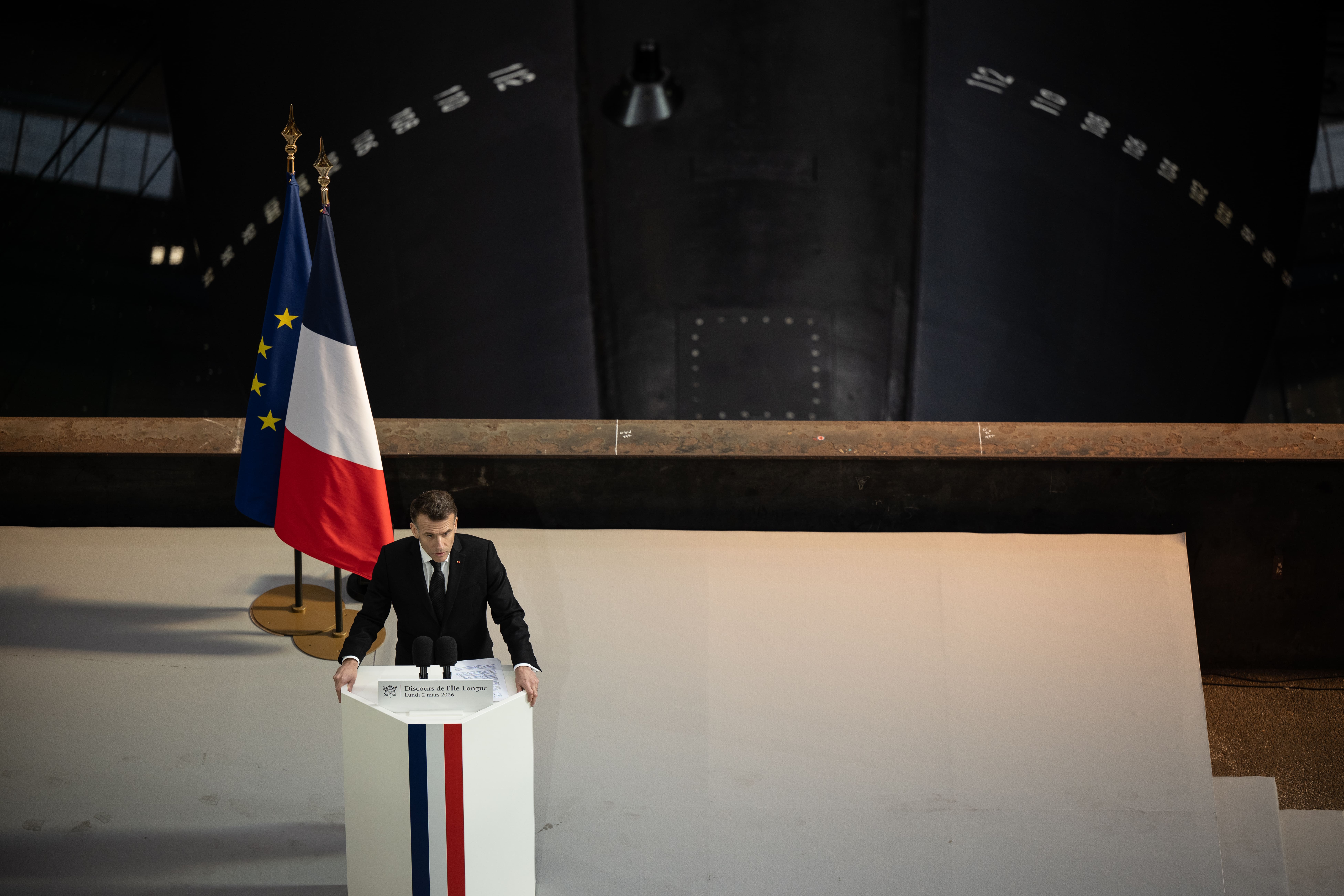
France’s nuclear deterrent, serving first and foremost to defend France’s vital interests, also contributes to the defense of Europe. This contribution has been recognized within the North Atlantic Alliance since 1974, but remains little known. In a speech closely followed by France’s European partners and its adversaries alike, President Emmanuel Macron announced a new concept for French nuclear deterrence: “forward deterrence” (dissuasion avancée). This article aims to explain the origins of this concept, outline its main pillars, and describe the partnerships that are sought. It then discusses the relationship with the U.S. doctrine of “extended deterrence”, and finally offers some ethical considerations.
A historical overview of the French nuclear deterrent
France’s first efforts to develop a nuclear weapon date back to the mid-1950s. Based on scientific research that had begun even before World War II under the leadership of Frédéric Joliot-Curie, France’s goal at the time was to acquire the industrial capability, particularly for the production of fissile material, to build its first weapon in the early 1960s. The main strategic rationale was that in order to survive in the post-World War II world, it was essential to possess nuclear weapons. This reasoning was fueled largely by Soviet nuclear blackmail and a lack of American backing to resist it, during the Franco-British operation in Suez in 1956.
Upon his return to power in 1958, General de Gaulle found a well-advanced nuclear program in place, enabling the first French nuclear test on February 13, 1960. He deliberately steered the program toward the creation of a fully sovereign and independent nuclear strike force, convinced that in this domain, decisions cannot be shared – especially with a more powerful ally that does not necessarily have the same interests. American hostility toward this policy of nuclear independence, coupled with NATO’s adoption of the “flexible response” doctrine – widely perceived in Paris as an elastic doctrine allowing the U.S. to avoid nuclear involvement in the defense of Europe – led to France’s withdrawal from NATO’s integrated military command in 1967. The reflections on nuclear doctrine conducted under the aegis of General Lucien Poirier, as set out in the 1972 White Paper on Defense, clearly stated that a country’s vital interests could be defined only by “reference solely to that country itself”.1 The perception that the French nuclear deterrent protected France – and France alone – thus became firmly established both in France and among its European allies. Nevertheless, the same 1972 White Paper emphasized that the limits of these vital interests must necessarily remain vague and that the logic of deterrence relies on a degree of uncertainty. Noting that France was not isolated and existed within a web of intertwined interests with its European neighbors, it thus pointed out that France’s nuclear deterrence strategy was a determining factor in European security. General de Gaulle had, in fact, clearly stated back in 19632 that nuclear weapons could, if necessary, play a part in protecting France’s allies. The contribution of France’s nuclear deterrent to the defense of Europe was recognized by its allies at the 1974 NATO summit in Ottawa. The final communiqué acknowledged that the two European states possessing nuclear forces were capable of playing a distinct deterrent role that contributed to the overall strengthening of Europe’s deterrent. It was primarily the role of London and Paris as a second decision-making center – complicating the adversary’s calculations – that this acknowledgement highlighted.
Nevertheless, the notion that the French deterrent served exclusively to defend France persisted throughout the Cold War, as evidenced by a famous exchange that took place in June 1987 during a meeting of G7 heads of state and government in Venice.3 Asked by Margaret Thatcher about the use of French nuclear weapons were Bonn to be invaded by the Soviets, François Mitterrand replied that such a scenario would mean that the deterrent had failed. This was a situation that must not be allowed to occur. And, moreover, the mission of protecting the Federal Republic of Germany and Western Europe was the responsibility of the North Atlantic Alliance, not that of France.
However, the post-Cold War era and the construction of a political Europe in the 1990s led French statesmen to attempt to integrate this European dimension into their national deterrent more effectively. It had certainly been present since the beginning but had never been properly developed. In 1995, French Prime Minister Alain Juppé proposed to Germany the concept of “concerted deterrence” between the two countries. This proposal did not meet with a favorable response at the time. The lack of interest in the French deterrent among European countries, starting with Germany, during a period of happy globalization and the United States’ continued commitment to NATO, would thus persist for some thirty years. The only country with which France made progress in this area during that period was the United Kingdom.
The Franco-British nuclear axis
Political talks between the two European nuclear powers led to the creation of a Joint Nuclear Commission in 1992. The initial discussions within this framework focused on comparing the two deterrents in terms of concepts and doctrines, missile defense, and nonproliferation. These discussions revealed that the two countries’ nuclear doctrines were closely aligned. In late October 1995, British Prime Minister John Major and French President Jacques Chirac issued a statement (the so-called Chequers Declaration) in which they affirmed that they could not identify any situation in which the vital interests of one of the two powers might be threatened without those of the other power also being threatened. This declaration was systematically reiterated in the following years by the leaders of both nations, including after Brexit, until it was reinforced by the Northwood Declaration in 2025. This bilateral agreement clearly signaled a strong strategic alignment regarding the vital interests of both nations. Studies on the adoption of a joint air-launched nuclear missile, the ASLP4 were conducted, but without success. The British ultimately rejected this option, given the risks it could pose to their nuclear relations with their American ally.
[...]
Jean-Louis Lozier is an Advisor to the Security Studies Center at the French Institute for International Relations (Ifri) and a naval officer who has served for 39 years in the French Navy. His career at sea has been mainly onboard submarines. Among others, he commanded two nuclear-powered ballistic missile submarines (SSBNs) (2004–2006). Promoted flag officer in 2012, he held during eight years high responsibility assignments, among them head of the nuclear forces directorate and inspector of nuclear weapons. As vice-admiral, his last assignments were “préfet maritime de l’Atlantique” and commander of operations in the Atlantic and Arctic areas.
- This article is published by the journal ‘Ethics and Armed Forces’.

Available in:
Themes and regions
DOI
10.48701/opus4-944
Share


Security Studies Center
Heir to a tradition dating back to the founding of Ifri, the Security Studies Center provides public and private decision-makers as well as the general public with the keys to understanding power relations and contemporary modes of conflict as well as those to come. Through its positioning at the juncture of politics and operations, the credibility of its civil-military team and the wide distribution of its publications in French and English, the Center for Security Studies constitutes in the French landscape of think tanks a unique center of research and influence on the national and international defense debate.
Toward Space-Based Intelligence for All? The Case of the Spring 2026 Iranian Strikes
The conflict in the Middle East has highlighted the effectiveness of Iranian strikes in identifying targets and conducting precision strikes. This raises the question: which capabilities enabled the Islamic Revolutionary Guard Corps (IRGC) to achieve these results?

Confronting Russia’s High-Velocity Arsenal: European Challenges and Solutions
Since February 2022, Russian missile and long-range drone strikes against Ukraine have served as near-daily reminders of what European states could face in a war with Russia. The same weapon systems battering Ukrainian infrastructure and population centers would be directed against European military and civilian targets in any confrontation between Russia and NATO. As Russian missile production expands and its arsenal diversifies, Europe must confront an uncomfortable question: how to deter, and if push comes to shove, fight Russia's long-range strike arsenal?

The War on Terrorism: Global Experts Reflect on Lessons Learned Twenty-Five Years After 9/11
Twenty-five years ago, the September 11 attacks prompted the invention of new security architectures that shaped the war on terrorism. Sixteen think tank experts from fifteen countries reflect on the successes, failures, and missed opportunities in the fight against terrorism—a fight that is still ongoing.
From Corsairs to Private Military Contractors. Nonmilitary Maritime Actors and the Historical Continuities of Naval Warfare
Since late 2023, several Houthi attacks on commercial shipping have involved privately contracted armed teams conducting defensive engagements and coordinating immediate response efforts, often in the relative absence of regular naval forces during the immediate hostilities at sea. These cases highlight a strategic tension that increasingly confronts modern navies. On the one hand, they are expected to conduct persistent, low-intensity maritime security tasks such as counterpiracy, maritime policing, and the protection of commercial shipping. On the other hand, they face renewed pressure to prepare for high-intensity conflict against peer and near-peer adversaries amid the return of great power competition.