






Despite Rising Tensions, Europe to Remain Russia's Main Gas Customer
Tatiana Mitrova, Head of the Oil & Gas Department at the Energy Research Institute in Moscow, joins Hughes Belin to analyse the consequences of troubled EU-Russia relations for energy trade.
How can Batteries support the EU Electricity Network?
Policy Report, Publication Insight_E
Lead Author: Bo Normark (KIC InnoEnergy), co-author: Aurélie Faure-Schuyer (Ifri),
Reviewers: Paul Deane (UCL) and Steve Pye (UCL)
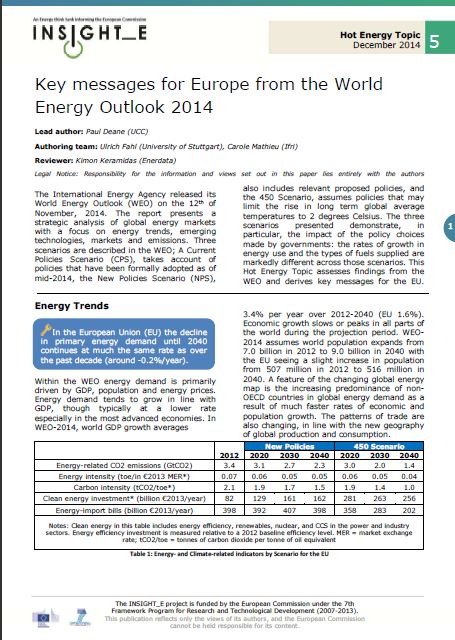
Key messages for Europe from the World Energy Outlook 2014
Hot Energy Topic n° 5, Insight_E publication
Lead Author: Paul Deane (UCC)
Authoring Team: Ulrich Fahl (University of Stuttgart), Carole Mathieu (Ifri)
Reviewers: Kimon Keramidas (Enerdata)
After the end of the end of History
This paper intends to take a step back from current developments in Ukraine in order to analyze the lessons Europeans ought to draw from the crisis that caught many by surprise. Whether the Ukrainian crisis really turns out to be a »game changer« in a structural sense remains to be seen, but it has made clear that Europeans should rethink a number of fundamental assumptions underlying European foreign policy.
The EU Electricity Policy Outlook for the Smart Grid Roll-Out
The energy transition from a socio-economic system based on fossil fuels to a sustainable low-carbon system is a multi-facetted process. This “transformation” of the energy system, more specifically of the power system, creates several challenges.
L'échiquier numérique américain : Quelle place pour l'Europe ?
The United States has established itself as the indisputable global leader in the digital market followed by more interventionist actors such as Russia and China. Europe has fallen behind as it struggles to find its place in this crucial sector. The new European Commission must respond and provide Europe with tools to compete with the market's more dominant actors.
The European Union to Ukraine’s Rescue
Recent events have provided the opportunity for the rekindling of relations between Ukraine and the European Union.
Peace as War’s Goal: A Slow Rediscovery
According to the traditional notion of the just war, an armed conflict should lead to conditions of durable peace.
Europe's Place in the World: from 1914 to 2014
The first wave of globalization in the 20th century triggered deep upheaval of the organization of power and an overall depreciation of European nations.
Europe's Continuing Demilitarization
Beginning in the 1970s, becoming solidified with the “peace dividends” in the 1990s and finally accelerated by the financial crisis of 2008, Europe’s demilitarization is undeniable.
1914–2014: Nation and Nationalism
The increasing militarism prior to the Great War had its roots in national beliefs and ideologies constructed during the 19th century in European countries.
The United States and the ‘Demilitarization’ of Europe: Myth or Reality?
The criticism leveled by Americans at Europe’s neglect of its commitment to defense is not new, and is often exaggerated.
The "War to End All Wars": Total War, Total Peace?
The Paris Peace Conference of 1919-1920 marked the end of the First World War whose purpose was to establish the conditions for enduring, if not perpetual peace.
The Primacy of Alliance: Deterrence and European Security
Since the end of the Cold War, the international security environment has been transformed and nuclear weapons have been marginalized in the West. However, the NATO security policies remain almost unchanged: deterrence is still considered as a principle guiding the Atlantic Alliance, even though the actual policy statements lack target, direction and urgency.
Towards Gas-on-Gas Competition in Europe from Trends to Reality?
Last week Centrica announced having signed a three-year gas supply contract with Gazprom Marketing and Trading UK entirely priced against UK spot gas market (NBP). This move follows other announcements in the sector, such as EON long-term gas supply contracts renegotiation, which allowed it to almost double its net-profit forecasts for 2012, or BP intention to sell Shaz Deniz II gas with spot-indexed contracts. All major European suppliers have been able to renegotiate long-term oil-indexed contracts with Gazprom lately and, more generally, contracts are increasingly being based on some spot-indexed price formula. How could that happen and what does it mean?
NATO Partnerships: Shaking Hands or Shaking the System?
The new Strategic Concept takes stock of the past ten years but outlines only modest objectives for the future of NATO. Partnership falls under the third core task, cooperative security. A subsequent partnership policy was unveiled, but has provided little new impetus.
The Development of Public-Private Partnerships in the European Satcom Sector
Public-Private Partnerships (PPPs) could help to enhance the societal benefits of communication satellites. However, European public entities must avoid the mistakes made during the Galileo concession negotiations.
Ifri, a foundation recognized as being of public utility, relies largely on private donors – companies and individuals – to guarantee its sustainability and intellectual independence. Through their funding, donors help maintain the Institute's position among the world's leading think tanks. By benefiting from an internationally recognized network and expertise, donors refine their understanding of geopolitical risk and its consequences on global politics and the economy. In 2026, Ifri partners with over 90 French and international companies and organizations.
