





The End of a Happy Parenthesis. How the War in UkraineI Is Forcing Germany to Rethink Its Model
The period of peace, economic prosperity, and political stability that Germany has experienced since the end of the Cold War ends with the Ukrainian war. The shock wave of this conflict particularly hit its economy and thereby undermines the foundations on which Germany had based its power, its international influence and established its identity.
The return of war on the European continent leaves Germany shattered in its certainties, weakened in its prosperity, and troubled in its confidence in the future. The competitiveness of the German production site is questioned, and the country is exposed to a risk of deindustrialization and economic stagnation. To what extent will the Scholz government be able to demonstrate its adaptability, like Chancellor Schröder did in the early 2000s, by shaping an ambitious reform agenda? The capacity to define a decarbonized economic model, globally competitive and respectful of social standards, will be a determining element. How should the principles of the social market economy and ordo-liberalism be adapted: will the German state get more assertive as regards industrial and commercial policy? Through the choices that will be made in terms of energy mix, modernization of its economy and social policy, Germany constitutes a laboratory for Europe.
Even if the challenges ahead are considerable, Germany retains significant assets, through its financial power, its innovation potential, and its industrial base, but also the strength of its institutions. In the early 2000s, it already demonstrated its ability to turn a difficult situation to its advantage. Regarding its security, the work of reassurance towards the United States and NATO, of catching up on capabilities for its armed forces and of repositioning industrial partnerships, demonstrates an undeniable pragmatism.
Éric André Martin is Secretary General of the Study Committee on Franco-German Relations (Cerfa).
This publication is available in French: "La fin d’une parenthèse heureuse. Comment la guerre d’Ukraine contraint l’Allemagne à repenser son modèle" (pdf).

The Study Committee on Franco-German Relations (Cerfa)
The Study Committee on Franco-German Relations (Cerfa) was created in 1954 by an inter-governmental agreement between the Federal Republic of Germany and France, in order to raise awareness of Germany in France and analyze Franco-German relations, including in their European and international dimensions. In its conferences and seminars, which bring together experts, political leaders, senior decision-makers and representatives of civil society from both countries, Cerfa develops the Franco-German debate and stimulates political proposals. It regularly publishes studies through two collections: Cerfa notes and studies as well as Franco-German visions.
Cerfa maintains close relations with the network of German foundations and think tanks. In addition to its research and debate activities, Cerfa promotes the emergence of a new Franco-German generation through original cooperation programs. This is how in 2021-2022, Cerfa led a program on multilateralism with the Konrad Adenauer Foundation in Paris. This program is aimed at young professionals from both countries interested in the issues of multilateralism in the context of their activities. It covered a wide range of themes relating to multilateralism, such as international trade, health, human rights and migration, non-proliferation and disarmament. Previously, Cerfa had participated in the Franco-German future dialogue, co-led with the DGAP from 2007 to 2020, and supported by the Robert Bosch Foundation and the Daniel Vernet group (formerly the Franco-German Reflection Group) which was founded in 2014 upon the initiative of the Genshagen Foundation.
A Partnership Built on Security: Post-Brexit Rapprochement between Germany and the United Kingdom
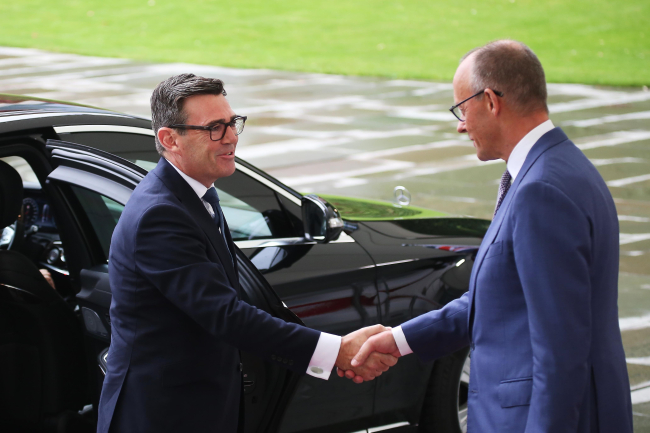
Since the UK’s withdrawal from the EU, UK-German relations have undergone a remarkable transformation: from Berlin’s deliberate distancing from London during the Brexit negotiations, when Germany consistently prioritised EU-27 unity over bilateral arrangements, to a gradual rapprochement, culminating, for the time being, in the 2025 Kensington Treaty of Friendship.
Recalibrating Europe’s Security: Building Partnerships in an Era of ‘Wrecking-Ball Politics
The 2026 Munich Security Conference report observes that “the world has entered a period of wrecking-ball politics.” Indeed, the era of Western predominance, dependable alliances and capable multilateral institutions has given way to shifting balances of power and deepening uncertainty.
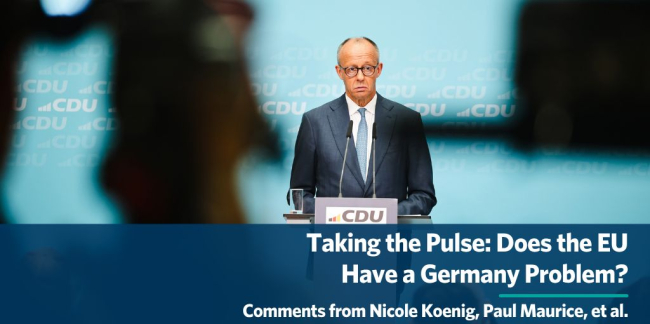
Taking the Pulse: Does the EU Have a Germany Problem?
Are Germany’s economic, industrial, and political struggles becoming a liability for the EU’s ability to rise to the geopolitical moment?
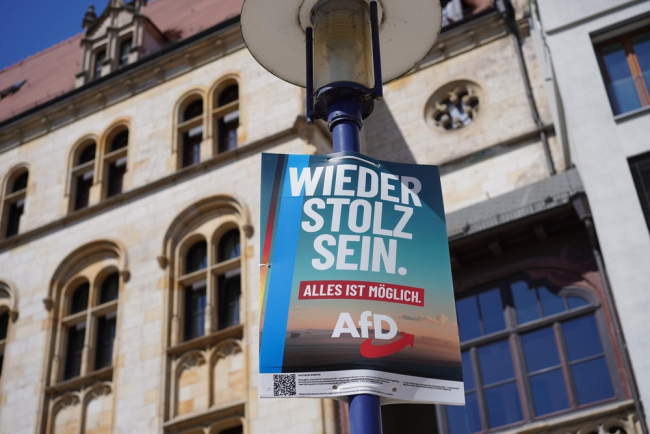
From Protest to Power? The AfD Ahead of the Eastern State Elections
The September state elections will test the AfD’s transition from protest force to potential governing power amid growing political fragmentation and dissatisfaction with Chancellor Friedrich Merz and his coalition. While firmly established in eastern Germany, the AfD is also gaining ground in the west, raising questions about coalition-building and the future direction of German politics.