






NATO: A View from Central Europe
Poland is not just concerned with the usefulness of the Alliance, but also with what can be done to make it more effective, and to maintain its relevance and good health in the decades ahead.
NATO and ESDP: Institutional Complexities and Political Realities
With 50 years’ seniority over the ESDP, and despite its austere origins, NATO transformed itself during the 20th century into a political-bureaucratic machine in search of a more appropriate international role.
NATO and Russia Viewed from Moscow
A new window of opportunity seems to be opening up for NATO and Russia, to re-think their relationship and how to institutionalize it through binding agreements and a permanent decision-making mechanism.
NATO-Russia: Is the ‘Russian Question’ European?
The proliferation of theaters (in Europe, the Caucasus, Central Asia, the Far East, the Middle East and the Arctic) and cross-cutting issues (proliferation, disarmament, energy, arms sales) demonstrate the overall importance of the NATO/Russia relationship.
France’s “Return” to NATO: An Inopportune Decision
The French decision to re-enter NATO’s integrated military structure is merely the confirmation of a series of shifts that started a long time ago. But it is no less questionable a decision. It is a symbolic decision that affects France’s image internationally. It by no means guarantees that the Alliance will evolve in a way that corresponds to France’s national interests; nor does it shed light on France’s ambiguous future. It does, however, in a very real way, risk diminishing France’s will to defend itself.
NATO and Nuclear Weapons
The changes in the way that NATO operates raise the question of whether the nuclear weapons stationed in Europe would, in a time of crisis, be an instrument of solidarity, or lead instead to divisiveness.
Reforming NATO’s Institutions: Pressing Need, Enduring Obstacles, New Opportunities
The lessons learned from its engagement in Afghanistan, a desire to transform itself, and its current financial problems are all factors pointing to the need to reform the Alliance. Formulating a new Strategic Concept will allow institutional reform to be associated with a new sense of purpose.
The Reform of NATO and the Free World’s Security Pact
Reforming the structure does not go to the heart of the problem. A new understanding has to be reached among the allies that takes into consideration the political, economic and technical changes of the last decade.
Russia, NATO and the EU: A European Security Triangle or Shades of a New Entente?
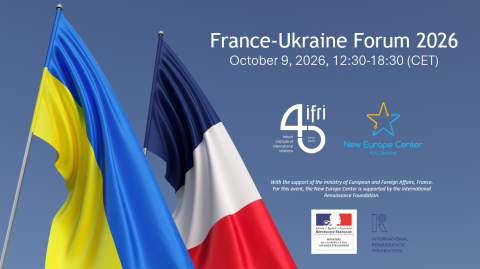
Replay - France-Ukraine Forum 2025
Replay of the France-Ukraine Forum 2025. - Three years after the start of Russia's full-scale war against Ukraine, the France-Ukraine 2025 Forum will welcome politicians, experts, academics, and civil society representatives from both countries to discuss three main topics: Ukraine's current military strategy and strategic perspectives; the country's resilience and recovery; Ukraine's European and transatlantic perspectives, including the EU accession process and its aspirations to join NATO.
Support independent French research
Ifri, a foundation recognized as being of public utility, relies largely on private donors – companies and individuals – to guarantee its sustainability and intellectual independence. Through their funding, donors help maintain the Institute's position among the world's leading think tanks. By benefiting from an internationally recognized network and expertise, donors refine their understanding of geopolitical risk and its consequences on global politics and the economy. In 2025, Ifri supports more than 80 French and foreign companies and organizations.
