



Europe-Russia: Balance of Power Review
European countries can no longer avoid the "Russian question," as Russia has chosen war. They have the necessary potential—that is, the economic means, military capabilities, and technological expertise—to face Russia by 2030, provided they demonstrate the political will to do so.
How should Britain and France cooperate to realise the Northwood Declaration?
During his state visit to the United Kingdom (UK) last week, Emmanuel Macron, President of France, signed a joint declaration with Sir Keir Starmer, Prime Minister, on nuclear cooperation between Britain and France. The Northwood Declaration highlights that while both countries’ nuclear arsenals remain sovereign, cooperation on nuclear deterrence can ‘contribute significantly’ to the security of the North Atlantic Treaty Organisation (NATO) and the Euro-Atlantic region.
Turkey and France - Allies or Rivals: Opportunities to be Seized
As international relations have become increasingly unpredictable, the quest is to find a semblance of normality. Alliances are shifting as interests are changing. The so-called order established after the Second World War is being shattered by those who have given so much to create it. Global relations are being transformed by countries that wish to follow the rules and others that want to circumvent or ignore them. In this uncertain environment, it is therefore all the more crucial to find stable allies.
Taking the Pulse: Can Europeans Build Their Independent Extended Nuclear Deterrent?
Confronted with a U.S. disengagement and the Russian threat, Europeans are reconsidering their stance on nuclear deterrence. Given the capabilities of the French and British arsenals, can Europe develop an independent nuclear deterrent?
A Transatlantic Defense Industrial Base? Two Contrasting Views
The evolving landscape of global defense cooperation has brought the transatlantic relationship between the United States (US) and Europe into sharp focus. As geopolitical tensions rise and the threat environment becomes more complex, the question of how Europe can best ensure its security while navigating its relationship with the United States has become paramount. This double feature report offers two contrasting views on the dynamics of US-Europe defense industrial relations, highlighting the challenges and opportunities that lie ahead for both parties.
How the US under Trump Became a Strategic and Ideological Adversary of Europe
The Europeans' worst security nightmare seems to be coming true: on Tuesday, February 18, 2025, U.S. Secretary of State Marco Rubio and Russian Foreign Minister Sergey Lavrov met in Saudi Arabia to initiate the normalization of relations between their two countries. The meeting also aimed to set up peace negotiations for Ukraine. However, despite having the potential to affect the entire continent, the discussions took place without the Europeans or the Ukrainians being present.
EUDIS, HEDI, DIANA: What's behind Three Defense Innovation Acronyms?
In Europe, with Russia’s war of aggression against Ukraine showing little sign of abating, a persistent gap remains between security needs and defense spending. According to a 2006 commitment enshrined at the 2014 Wales NATO summit, the North Atlantic Treaty Organization (NATO) members should disburse no less than 2% of their national gross domestic product (GDP) on defense, out of which 20% is to be spent on equipment and research and development. In 2024, only 23 Allies out of 32 are expected to meet or exceed this target, though a significant improvement from only three in 2014. This total includes the United States (US) devoting 3.38% of its GDP to defense, constituting almost 70% of all NATO member defense spending combined.
NATO's New Ambitions for Space
Ahead of Russia's invasion of Ukraine, a devastating cyber attack targets Ukrainian army communications, exposing Western dependence and vulnerability to space technologies, and calling NATO's defensive posture into question.
Russia’s New Challenges in the Baltic/Northern European Theater
The long war in Ukraine has brought a drastic geopolitical reconfiguration of the Baltic theater and a deep shift in the military balance between Russia and the North Atlantic Treaty Organization (NATO).
Freedom, EU, NATO: Ukrainian Society Has Made its Choice
The Ukrainian resistance should be seen in its long-term context, starting with independence in 1991, and confirmed by the events of 2014.
Europe-Russia: Balance of Power Review
European countries can no longer avoid the "Russian question," as Russia has chosen war. They have the necessary potential—that is, the economic means, military capabilities, and technological expertise—to face Russia by 2030, provided they demonstrate the political will to do so.
How should Britain and France cooperate to realise the Northwood Declaration?
During his state visit to the United Kingdom (UK) last week, Emmanuel Macron, President of France, signed a joint declaration with Sir Keir Starmer, Prime Minister, on nuclear cooperation between Britain and France. The Northwood Declaration highlights that while both countries’ nuclear arsenals remain sovereign, cooperation on nuclear deterrence can ‘contribute significantly’ to the security of the North Atlantic Treaty Organisation (NATO) and the Euro-Atlantic region.
Turkey and France - Allies or Rivals: Opportunities to be Seized
As international relations have become increasingly unpredictable, the quest is to find a semblance of normality. Alliances are shifting as interests are changing. The so-called order established after the Second World War is being shattered by those who have given so much to create it. Global relations are being transformed by countries that wish to follow the rules and others that want to circumvent or ignore them. In this uncertain environment, it is therefore all the more crucial to find stable allies.
Taking the Pulse: Can Europeans Build Their Independent Extended Nuclear Deterrent?
Confronted with a U.S. disengagement and the Russian threat, Europeans are reconsidering their stance on nuclear deterrence. Given the capabilities of the French and British arsenals, can Europe develop an independent nuclear deterrent?
A Transatlantic Defense Industrial Base? Two Contrasting Views
The evolving landscape of global defense cooperation has brought the transatlantic relationship between the United States (US) and Europe into sharp focus. As geopolitical tensions rise and the threat environment becomes more complex, the question of how Europe can best ensure its security while navigating its relationship with the United States has become paramount. This double feature report offers two contrasting views on the dynamics of US-Europe defense industrial relations, highlighting the challenges and opportunities that lie ahead for both parties.
How the US under Trump Became a Strategic and Ideological Adversary of Europe
The Europeans' worst security nightmare seems to be coming true: on Tuesday, February 18, 2025, U.S. Secretary of State Marco Rubio and Russian Foreign Minister Sergey Lavrov met in Saudi Arabia to initiate the normalization of relations between their two countries. The meeting also aimed to set up peace negotiations for Ukraine. However, despite having the potential to affect the entire continent, the discussions took place without the Europeans or the Ukrainians being present.
The Future of Europe from the US and Asian Point of View
In this special issue of Politique étrangère devoted to the proceedings of the conference organized by Ifri on April 10, 2019, in the Grand Amphitheater of the Sorbonne, on the occasion of its fortieth anniversary, discover the debate moderated by Sylvie Kauffmann between John Allen and Kishore Mahbubani.
The Reform of NATO and the Free World’s Security Pact
Reforming the structure does not go to the heart of the problem. A new understanding has to be reached among the allies that takes into consideration the political, economic and technical changes of the last decade.
NATO-Russia: Is the ‘Russian Question’ European?
The proliferation of theaters (in Europe, the Caucasus, Central Asia, the Far East, the Middle East and the Arctic) and cross-cutting issues (proliferation, disarmament, energy, arms sales) demonstrate the overall importance of the NATO/Russia relationship.
The Global NATO Debate
The ultimate direction taken by the Alliance – be it a ‘return to home base,’ a ‘global expansion’ or the pursuit of ‘global missions’ – will be heavily influenced by perceptions of what happens in Afghanistan over the next two years.
Nuke-talk is heating up among Europeans in Munich
Multiple European countries are publicly backing talks on a homegrown nuclear deterrent to complement American atomic weapons following an erosion of trust in a Donald Trump-led U.S.
Build and Maintain Air-Sea Superiority in a Contested Operational Environment – CNP 26
An exceptional opening roundtable at the 2026 Paris Naval Conference, bringing together the Chiefs of Naval Staff of the French, U.S., British, Italian and Dutch navies.
'Russia holds a decisive edge in terms of manpower, firepower and mobilization capacity'
Three researchers at the French Institute of International Relations, Dimitri Minic, Tatiana Kastouéva-Jean and Paul Maurice, are urging Europe to intensify its power dynamic with Moscow. The French Institute of International Relations (IFRI) published a report on Tuesday, November 4, that highlights Europe's vulnerabilities in the event of a high-intensity conflict with Russia.
Thomas Gomart, director of the French Institute of International Relations: 'Trump reasserts the US' strategic centrality'
By bombing Iran alongside Israel, Donald Trump has performed a show of force aimed at China and Russia, explains the director of the French Institute of International Relations in an interview.
quoted by Leila Abboud in the Financial Times
Build and Maintain Air-Sea Superiority in a Contested Operational Environment – CNP 26
An exceptional opening roundtable at the 2026 Paris Naval Conference, bringing together the Chiefs of Naval Staff of the French, U.S., British, Italian and Dutch navies.
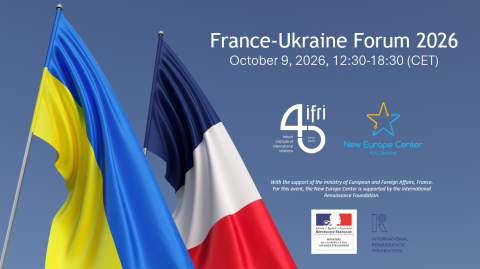
Replay - France-Ukraine Forum 2025
Replay of the France-Ukraine Forum 2025. - Three years after the start of Russia's full-scale war against Ukraine, the France-Ukraine 2025 Forum will welcome politicians, experts, academics, and civil society representatives from both countries to discuss three main topics: Ukraine's current military strategy and strategic perspectives; the country's resilience and recovery; Ukraine's European and transatlantic perspectives, including the EU accession process and its aspirations to join NATO.
The European Pillar of Security
Leo Litra and Lesia Ogryzko are joined by Élie Tenenbaum and Oleksandr Sushko to discuss June’s NATO summit—and what Europe’s security step up means for Ukraine.
Addressing the Threat of Terrorism | NATO Public Forum 2025
NATO Public Forum 2025 LIVE | Day 1, 24 June 2025. Terrorism, instability and regional fragility continue to pose urgent challenges across the Middle East, North Africa, and the Sahel with direct implications for Allied security. How can NATO partnerships in its southern neighbourhood address the intertwined security, demographic and economic drivers behind this challenge? How to respond to the growing relevance of cyber terrorism and hybrid conflict?
France, Turkey, and Shifting Balance - Léo Péria-Peigné
The interview explores France’s withdrawal from Africa, its strategic pivot to NATO’s eastern flank, and the complex dynamics with Turkey. It also touches on Europe’s military dilemmas, the growing strength of Turkey’s defense industry, and the limits of French influence in the Middle East. A clear-eyed look at where Europe stands—and where it may be heading.
Replay - Paris Naval Conference 2025: Naval Power in support of Maritime Economy
Replay of the third edition of the Paris Naval Conference (CNP), bringing together high-level speakers from the military, industry and academia, for the aim of addressing the issues of securing the maritime economy for the world's navies.
Naval Power and Maritime Economy: Rear Admiral Olivier Berdal, Chief of the Royal Norwegian Navy
On the sidelines of the Paris Naval Conference 2025, on February 4, 2025, organized by Ifri and the French Navy (Marine nationale), Rear Admiral Olivier Berdal, Chief of the Royal Norwegian Navy, shares insights on the crucial role that naval power plays in support of maritime economy.
Naval Power and Maritime Economy: an interview with Admiral Sir Ben Key, First Sea Lord, Royal Navy
On the sidelines of the Paris Naval Conference 2025, on February 4, 2025, organized by Ifri and the French Navy (Marine nationale), Admiral Sir Ben Key, First Sea Lord, Royal Navy, shares insights on the crucial role that naval power plays in support of maritime economy.
Naval Power in Support of Maritime Economy: An Interview with Vice-Admiral Jeffrey Anderson (U.S. Navy)
On the sidelines of the Paris Naval Conference 2025, on February 4, 2025, organized by Ifri and the French Navy, Vice-Admiral Jeffrey Anderson, Commander of the 6th Fleet, U.S. Navy, and Commander of the Striking and Support Forces NATO, share insights on the crucial role that naval power plays in support of maritime economy.
Naval Power and Maritime Economy: Rear Admiral Søren Kjeldsen, Chief of the Royal Danish Navy
On the sidelines of the Paris Naval Conference 2025, on February 4, 2025, organized by Ifri and the French Navy (Marine nationale), Rear Admiral Søren Kjeldsen, Chief of the Royal Danish Navy, shares insights on the crucial role that naval power plays in support of maritime economy.
Naval Power and Maritime Economy: an interview with Admiral Nicolas Vaujour (Chief of Staff of the French Navy)
On the sidelines of the Paris Naval Conference 2025, on February 4, 2025, organized by Ifri and the French Navy (Marine nationale), Admiral Nicolas Vaujour, Chief of Staff of the French Navy share insights on the crucial role that naval power plays in support of maritime economy.
NATO: 75 Years of Strategic Solidarity (replay)
The war in Ukraine, burden-sharing between Allies, U.S. disengagement from Europe, new areas of conflict... At a time when the Alliance has just celebrated its 75th anniversary and the Stoltenberg era is drawing to a close after ten years at the head of the organization, NATO's agenda bears witness to the diversity of its areas of action, as well as to the different perceptions of the Allies on these issues.
In the wake of the Washington summit, this conference of diplomats, military officers and researchers aims to analyze the short- and medium-term prospects for the Atlantic Alliance.
Support independent French research
Ifri, a foundation recognized as being of public utility, relies largely on private donors – companies and individuals – to guarantee its sustainability and intellectual independence. Through their funding, donors help maintain the Institute's position among the world's leading think tanks. By benefiting from an internationally recognized network and expertise, donors refine their understanding of geopolitical risk and its consequences on global politics and the economy. In 2025, Ifri supports more than 80 French and foreign companies and organizations.
