



The Gulf Search for Power(s) / Politique étrangère, Vol. 90, No. 4, 2025

Persian Gulf countries have become heavyweights in the international arena, wielding influence both regionally and far beyond. Acting as diplomatic mediators, investors, and hosts of global events, they are attempting to move beyond their long-standing role as suppliers of energy resources and reshape their economic, social, and political foundations through ambitious national “Visions”. Their international alliances are proving increasingly flexible, broadening their diplomatic reach (even if Washington’s influence remains decisive)—with Saudi Arabia, Qatar, and the United Arab Emirates all part of a dynamic pushing many global actors toward multi-alignment.
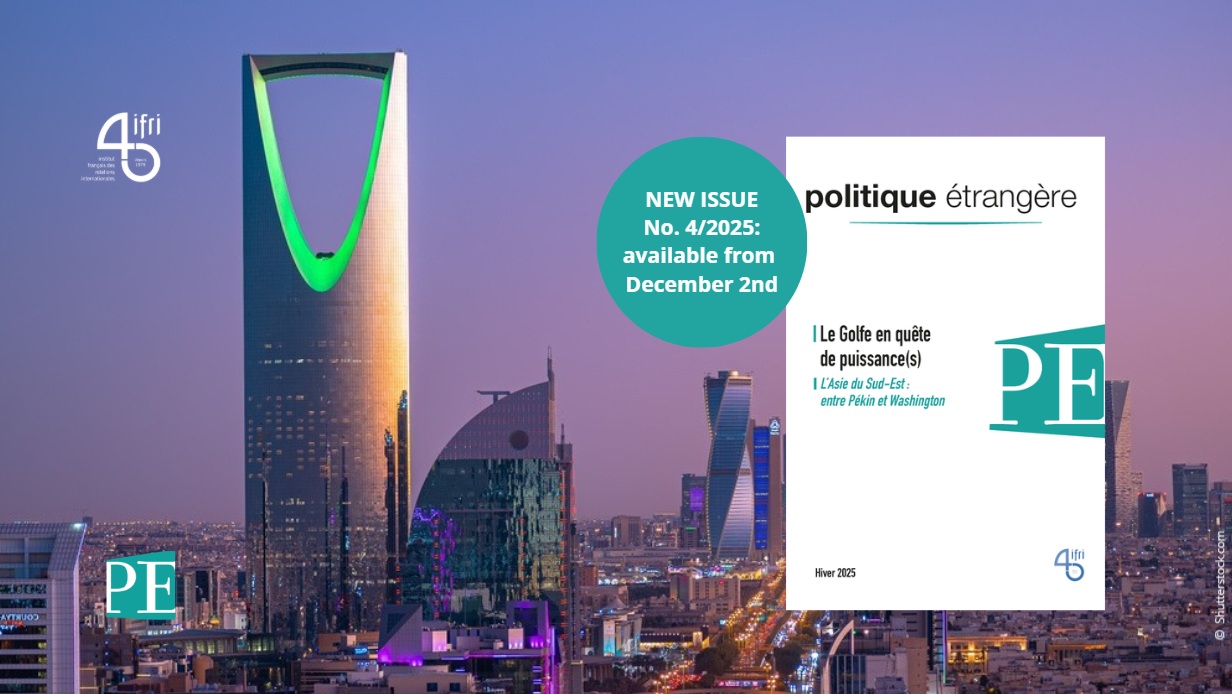
In Southeast Asia, the balance of influence tilts between China and the United States. Does the region’s broad spectrum of foreign policies signal flexibility and pragmatism, allowing these countries to capitalize on the Sino-American rivalry? Or does it instead reveal the underlying economic, social, and political contradictions of a space struggling to organize itself collectively? Despite its aspirations to become the leading regional architecture, in practice ASEAN exerts little influence over the defense and security decisions of its members, who are caught between largely conflicting agendas.
In multiple ways, the Gulf and Southeast Asia epitomize the emergence of a deregulated world order, where a multitude of actors vie to leverage their room for strategic maneuver—a latitude that remains precarious as major behemoths tirelessly amass the instruments of their dominance.
THE GULF'S SEARCH FOR POWER(S)
The New Diplomatic Weight of Gulf Countries, by Camille Lons
Gulf Sovereign Wealth Funds: Major Actors in World Finance, by François-Aïssa Touazi
Saudi Arabia 2030: EnVisioning all the Challenges, by Hasni Abidi
Qatar and the UAE: Mirrored Ambitions, by Emma Soubrier
Caught between Beijing and Washington: The Gulf’s Search for Multi-Alignment, by Jean-Loup Samaan
Caught between China and the US: Southeast Asia’s strategic fence-sitting, by Sophie Boisseau-du-Rocher and Françoise Nicolas
Has ASEAN become Marginalized within Regional Security architecture?, by Juliette Loesch
CURRENT AFFAIRS
Bangladesh: Caught between a Political Crisis and the Rise of Islamism, by Charza Shahabuddin
Frontex, the First and Last European “Army”?, by Thomas Canvel
Foreign Policy at City Hall, by Yves Viltard
REFLECTIONS
Toward a Latino-Pacific Geo-economic Strategy, by Andrés Bórquez, Juan Enrique Serrano-Moreno, Carlos Olguín, and Rodrigo del Río
Iraq power Outages: An Absence of Governance?, by Myriam Benraad
Will France’s Nuclear Deterrent Extend Europe-Wide?, by Elie Perot
BOOK REVIEWS
Editor: Marc Hecker
L'ère des affrontements: Les grands tournants géopolitiques, by Thierry de Montbrial
Reviewed by Alain Dejammet
Under the Nuclear Shadow: China’s Information-Age Weapons in International Security, by Fiona Cunningham
China’s Quest for Military Supremacy, by Joel Wuthnow and Phillip C. Saunders
Reviewed by Marc Julienne
216 pages. 23 euros.
December 2nd, 2025.
Diffusion : Pollen/Dif'Pop.
Subscription: Armand Colin.
To buy an issue: leslibraires.fr.
To buy the Epub (in French): Immatériel.fr.
Have a look on Politique étrangère's blog: Politique étrangère.

Available in:
Themes and regions
ISBN / ISSN
Share
Iran: Anatomy of a Power at War
The elimination of Supreme Leader Ali Khamenei and several high-ranking officials at the outset of the 2026 American-Israeli operation did not succeed in bringing down the Iranian regime. The regime had prepared for such a scenario, notably by decentralizing its structures. Moreover, it continues to adapt to war. The power of the Islamic Revolutionary Guard Corps is growing at the expense of the Shiite clergy. The security apparatus defends the country’s sovereignty and justifies its actions in the name of raison d’état.
“Remodeling” the Middle East?
Chaos continues to spread, seemingly without end, across the Middle East. The Israeli-American attack on Iran has resulted in a clear military and diplomatic failure, but it is paving the way for a regional realignment, the consequences of which remain uncertain. New regional groupings are taking shape, either centered around Israel or built on the prospect of coexistence with Tehran, alongside a decline in American influence and the marginalization of Europe, while China maintains a low-key presence.
Silicon Valley and War: Lessons from Ukraine
Over the course of international conflicts, and particularly in Ukraine, major tech companies have emerged as central actors. Initially subject to wartime maneuvering, they have since become decisive actors in their own right, privatizing a significant share of wartime exchanges, shaping the information flows of societies, and presenting themselves as providers of security. This situation raises important questions about states’ autonomy in making decisions and taking action.
Does Artificial Intelligence Change the Nature of War?
From Gaza to Ukraine and Iran, current conflicts are being shaped by the arrival of artificial intelligence and robots on the battlefield. The changes under way are so profound that humans risk rapidly losing control over entire aspects of the conduct of military operations. While these technological developments are altering the character of war, their impact on the very nature of war itself remains a matter of debate.