




Cooperating with African Armed Forces
Nowadays, numerous actors are involved in military cooperation programs aiming to strengthen African armed forces and build special partnerships.
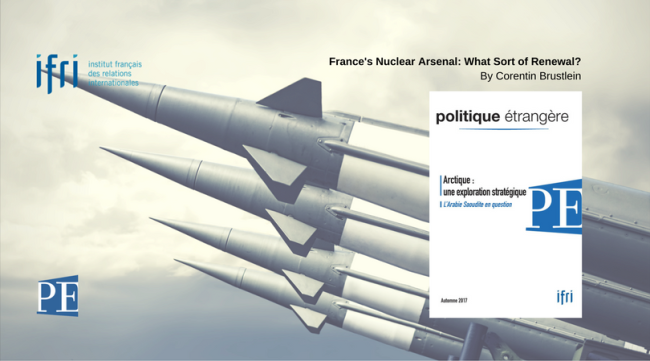
France's Nuclear Arsenal: What Sort of Renewal?
Over the course of the next few years, France will have to renew its nuclear arsenal to ensure that it remains a credible dissuasion in the eyes of its potential enemies.
Corée du Sud, la septième armée du monde ?
As Democratic Republic of Korea’s (DPRK) continuous development of non-conventional weapons and challenges of the international community reaches a new level, Republic of Korea (ROK) appears more than ever as the frontline state on which most of North-East Asia security depends.

RAMSES 2018. Will the Information War Take Place?
RAMSES 2018. Will the Information War Take Place?, written by Ifri's research team and external experts, offers an in-depth and up-to-date analysis of global geopolitics.

The Future of British Defense Policy
As the prospect of the United Kingdom leaving the European Union raises increasing challenges to its international position, as well as major divisions at home, the future of British defense policy seems more uncertain than ever.

Nordic Countries in the Face of Russian Action in the Baltic and Kaliningrad
Nordic countries share the same perception, that Russia does not pose an immediate threat but that its actions nevertheless remain worrying.
La survivabilité sur le champ de bataille : entre technologie et manœuvre
The concept of survivability is central to the design of combat vehicles and to the elaboration of doctrines for the employment of military forces.

Foreign Policy Challenges for the Next French President
France’s current presidential campaign has created an unprecedented situation fuelled by revelations and a total absence of restraint, but it has not truly taken account of the disruptions of the last year: Brexit, the attempted coup in Turkey, the election of Donald Trump, the recapturing of Aleppo by Bashar al-Assad, Xi Jinping’s declarations about “economic globalization”, or the behavior of North Korea. The debate, or rather its absence, can be looked at in two ways.
North Korea's Nuclear Posture: an Evolving Challenge for U.S. Deterrence
A more capable, nuclear-armed, North Korea will pose very substantial challenges to the U.S. deterrence posture.

Japan: The Reluctant Cyberpower
Japan’s cyberdefenses remain underdeveloped compared to the country’s great reliance on information and communications technology. Despite Japan’s initial slow response to the security challenges emerging from cyberspace, this paper posits that cybersecurity under the administration of Japanese Prime Minister Shinzo Abe has moved to the core of the country’s national security policy. The 2020 Olympics Games are a major catalyst for this.

France vs. Jihadism: The Republic in a New Age of Terror
This paper assesses the current state of the jihadist threat to France, as well as the French authorities’ security response. With the upcoming presidential election, 2017 will be a decisive year for the country. Terrorism will be at the heart of the campaign and ISIS will most likely try to strike again.
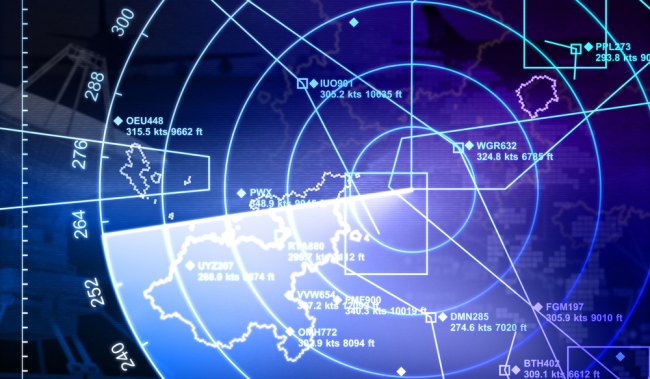
Les mutations du renseignement militaire : dissiper le brouillard de la guerre ?
Military intelligence has evolved significantly as a result of advanced technology and the changing character of war.
Entry Operations and the Future of Strategic Autonomy
The ability to penetrate remote and contested theaters of operation is a crucial asset for any expeditionary military power.
Japan's New Dual-Use Space Policy: The Long Road to the 21st Century
Japan’s latest space policy is designed to support a more proactive US-Japan alliance role in containing China, and robustly defend Japan against North Korean ballistic missile threats.
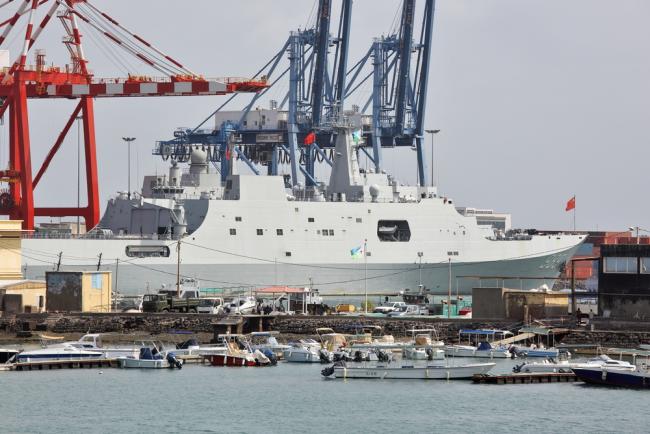
China in Djibouti: A military base with Chinese characteristics?
Last February, the Chinese Defense Ministry confirmed the launch of the construction of a Chinese military base in Djibouti. For a long time, Chinese officials had insisted that China would never build military bases or to station troops abroad.
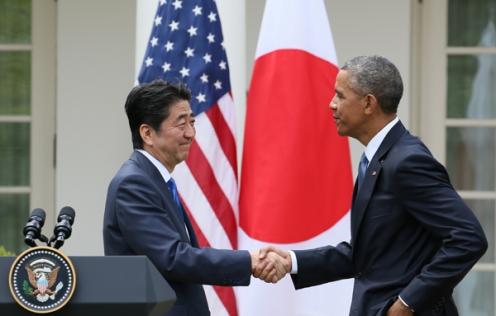
Japan and its Alliance with the US. Structure, Dynamics, Evolution to 2030
China’s rise, US rebalancing in Asia, historic defense reforms in Japan, the adoption of new Guidelines for bilateral cooperation: the Japan-US alliance has reached a turning point in its history.
Defending Europe? A stocktaking of French and German Visions for European Defense
The aim of this study consists of taking stock of strategic thinking in France and Germany. More concretely, it intends to identify compatible and incompatible aspects, as well as the potential for compromise, in these national considerations on the future of CSDP and NATO. In so doing, it concentrates on five issues: strategic visions, threat perception and military doctrine; the institutional framework for European defense; military interventions; capabilities as well as the industrial dimension.

The defense posture of China
Alice Ekman comments the defense posture of China as Beijing is holding a large military parade on September 3rd.
The Return of Robert Gates
The memoirs of public men are exercises in self-promotion and self-justification. They are designed to etch a portrait of the (wo)man that will live across time. It's the legacy thing. These days, that legacy pertains also to the "here and now" since memoirs are not necessarily the conclusion of a career but rather the curtain-raising on its next act.
Defence Reform in the United Kingdom: A Twenty-First Century Paradox
The context of budgetary constraint offered a strong incentive for the 2010 Coalition Government to improve its management of defence equipment.
Ifri, a foundation recognized as being of public utility, relies largely on private donors – companies and individuals – to guarantee its sustainability and intellectual independence. Through their funding, donors help maintain the Institute's position among the world's leading think tanks. By benefiting from an internationally recognized network and expertise, donors refine their understanding of geopolitical risk and its consequences on global politics and the economy. In 2026, Ifri partners with over 90 French and international companies and organizations.
